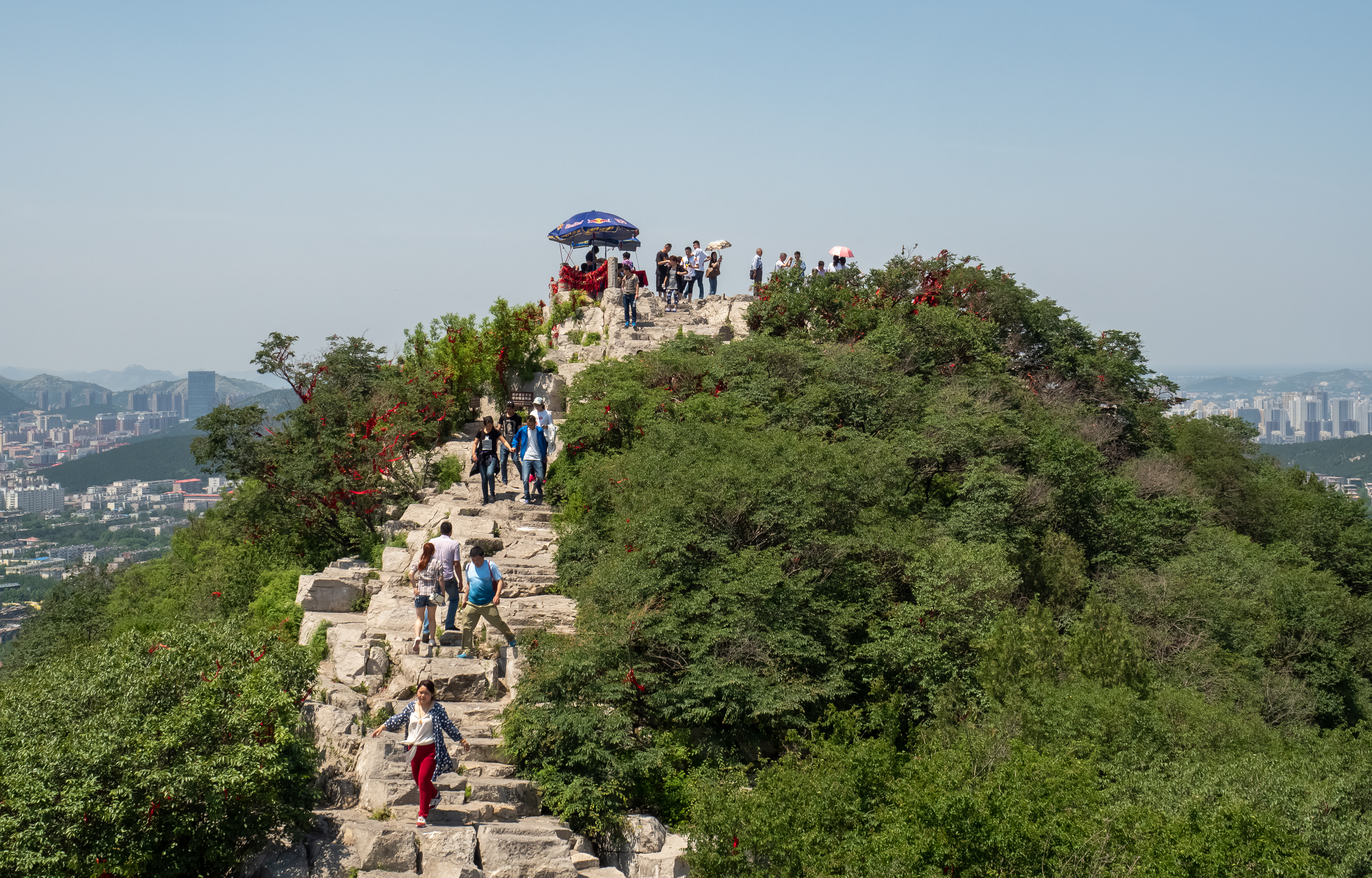
Thousand Buddha Mountain
About 130 stone Buddhas remain on the cliff face, carved there during the Sui dynasty more than 1,400 years ago. Some are barely twenty centimeters tall, tucked into niches so small you could miss them. Others sit in caves three meters high, their features worn by centuries of weather and worship. This is Thousand Buddha Mountain, a 285-meter hill just 2.5 kilometers southeast of downtown Jinan, and one of the Three Greatest Attractions in the city alongside Baotu Spring and Daming Lake. What makes it remarkable is not just the antiquity of the carvings but the way the mountain continues to accumulate layers of meaning -- religious, cultural, and deeply personal.
Where Shun Plowed the Earth
Local tradition holds that the legendary Emperor Shun first cultivated the soil here, and the mountain's alternate name -- Shungeng Hill, meaning "the hill where Shun cultivated" -- preserves that claim. A sculpture of Shun stands in one of the temple courtyards, honoring an emperor credited not only with taming the land but with inventing the writing brush. Whether the legend is historical or mythological matters less than what it reveals: this hill has been sacred ground long before the first Buddhist chisel struck the rock. The Xingguochan Temple, reached by climbing 300 stone steps, sits about halfway up the slope. Its courtyards contain stone tablets inscribed by renowned calligraphers, and a large cliff-face inscription identifies it as the "Number One Temple." Temple fairs have been held here since the Yuan dynasty, on the third day of the third month and the ninth day of the ninth month by the lunar calendar.
Carved, Broken, Restored
The Thousand-Buddha Cliff, on the northern flank behind the temple, is pierced by four caves named Longquan (Dragon Spring), Jile (Extremely Happy), Qianlou, and Luzu. The Sui-dynasty carvings that survive here are the mountain's oldest treasures, but the Cultural Revolution dealt them significant damage. Restoration began in 1979, and since then the mountain has gained new monuments on a scale the Sui artisans never imagined. A 20-meter-tall sitting Maitreya Buddha was completed in 2000, and a 10-meter-long reclining Buddha carved from granite was finished in 1996, weighing approximately 50 tonnes. In the eastern part of the mountain, the Maitreya Garden -- built in 2000 as a China-Japan Friendship Garden -- houses a 30-meter-tall Maitreya statue, described as the largest Buddha north of the Yangtze River. Behind the statue, carvings on an annular rock face stretch 36 meters long and 3.5 meters high.
The Underground Gallery
At the foot of the northern slope, a different kind of Buddhist art awaits. The Myriad Buddha Cave is an artificial tunnel stretching more than 500 meters, housing late-20th-century recreations of statues from four of China's most celebrated grottoes: Dunhuang and Maiji Shan in Gansu Province, Longmen in Henan Province, and Yun Gang in Shanxi Province. The originals span the Northern Wei, Tang, and Song dynasties. According to park operators, around 28,000 Buddhist images fill the cave, the largest being a reclining Buddha 28 meters long. It is a remarkable compression of geography and time -- masterworks that are scattered across thousands of kilometers of Chinese landscape, brought together in a single subterranean walk.
Matchmaking on the Mountain
Not everything on Thousand Buddha Mountain is ancient or solemn. During the week of Qixi Festival -- Chinese Valentine's Day -- the park transforms into a massive outdoor matchmaking event. Single men and women, mostly in their twenties and thirties, post their personal information on boards while browsing for potential partners. Parents who want their children married climb the hill too, scouting on their behalf. By 2019, this event had been held thirteen times. On the Double Ninth Festival, an autumn celebration traditionally marked by climbing high ground, the mountain hosts a temple fair drawing over 62,000 visitors in a single day. Folk handicrafts, local snacks, and artistic performances fill the slopes. It is a place where fourteen centuries of Buddhist devotion coexist comfortably with parents looking for a good match for their son.
From the Air
Located at 36.645°N, 117.027°E, approximately 2.5 km southeast of downtown Jinan. The hill rises to 285 meters above sea level and is visible as a forested prominence against the flat urban grid. Nearest airport is Jinan Yaoqiang International Airport (ZSJN), about 30 km northeast. Look for Daming Lake to the north and the city center between the lake and the mountain. Recommended viewing altitude 2,000-3,000 feet AGL.