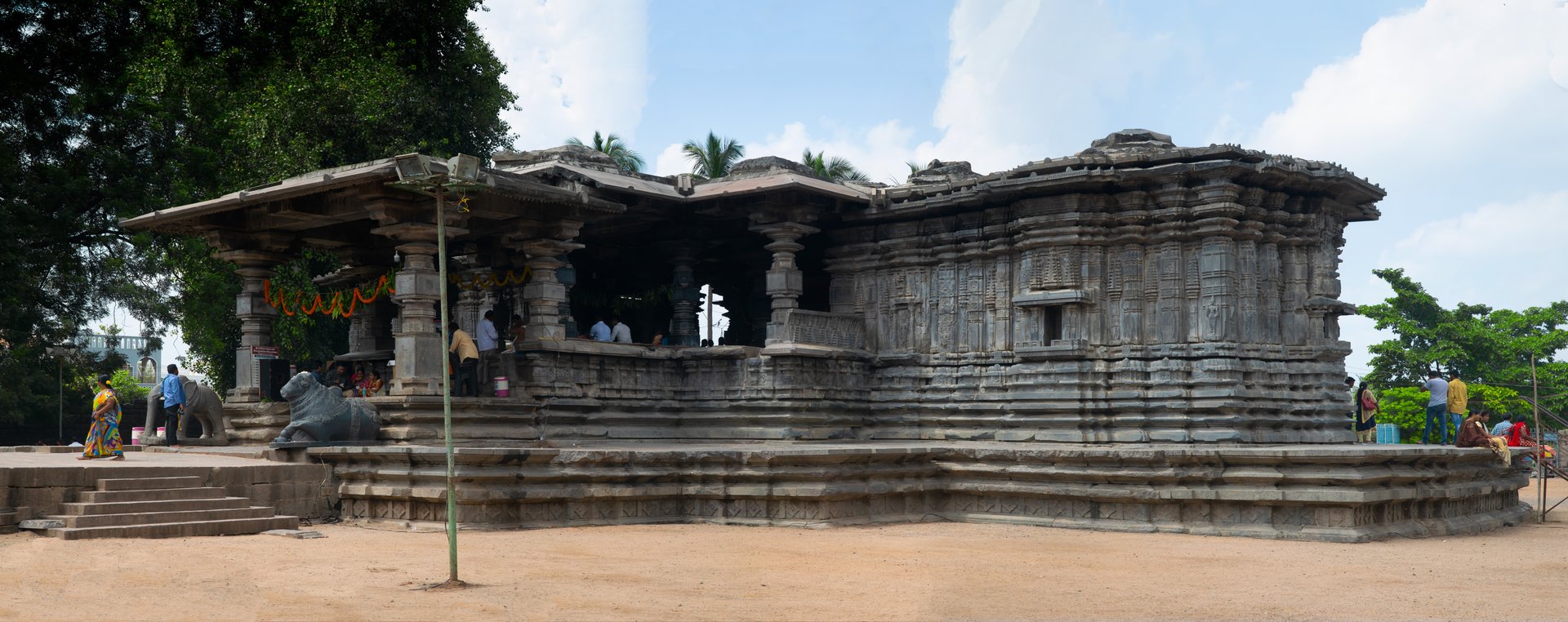
Thousand Pillar Temple
Count the pillars and you lose track around three hundred. The builders counted to a thousand -- or so the name claims -- and each one is carved with a precision that seems to mock the idea that this temple was built without power tools, computer modeling, or anything beyond human hands, iron chisels, and an obsessive devotion to geometry. The Thousand Pillar Temple in Hanamakonda, Telangana, is what happens when a medieval dynasty decides to put everything it knows about stone, faith, and beauty into a single structure. Built between 1175 and 1324 CE under the Kakatiya kings, it has stood through invasion, desecration, and centuries of monsoon rains -- battered but never quite broken.
Three Gods Under One Roof
Most Hindu temples are dedicated to a single deity. This one hedged its bets -- or, more accurately, expressed a theological generosity rare in sacred architecture. The Thousand Pillar Temple is a Trikutalaya, a triple-shrined complex honoring Shiva, Vishnu, and Surya simultaneously. The three sanctums radiate from a central hall in a star-shaped plan, each facing a different direction, each housing its own deity. The design reflects the later Chalukyan and early Kakatiyan architectural traditions, where mathematical precision meets devotional ambition. In the central Nava Ranga Mandapa, the pillars rise in rows so regular they create visual corridors that seem to extend deeper than the physical space allows. A monolithic Nandi bull, carved from a single block of black dolerite and polished to a mirror-like shine, guards the Shiva shrine with an expression of serene patience.
The Sculptor's Obsession
What distinguishes Kakatiya sculpture from the work of other Deccan dynasties is a quality best described as controlled extravagance. The pillars here are not merely structural -- they are lathe-turned, a technique that produces the same precise cylindrical forms you would expect from a modern machine shop but achieved entirely by hand. The dolerite and granite surfaces carry a polish so fine that they reflect light eight centuries after they were finished. Perforated stone screens filter the Deccan sunlight into geometric patterns on the temple floor, shifting throughout the day like a slow-motion kaleidoscope. Rock-cut elephants flank the approaches with a naturalism that suggests the sculptors studied living animals rather than working from convention. The temple took decades to complete -- construction spanned the reigns of multiple Kakatiya rulers including Rudra Deva, Ganapati Deva, and the remarkable queen Rudrama Devi, one of the few women to rule a medieval Indian kingdom.
What the Invaders Left Behind
In the early fourteenth century, the Tughlaq dynasty swept through the Deccan, and the Thousand Pillar Temple did not escape their attention. The temple was desecrated during the Tughlaq invasion -- sculptures defaced, sacred spaces violated in the pattern of destruction that marked the Sultanate's expansion across southern India. But destruction is not the same as erasure. The temple's fundamental structure survived, its thousand pillars too deeply rooted and too numerous to topple entirely. Centuries later, an unlikely patron intervened: Mir Osman Ali Khan, the seventh and last Nizam of Hyderabad, donated one lakh rupees toward the temple's reconstruction. That a Muslim ruler funded the restoration of a Hindu temple desecrated by earlier Muslim invaders speaks to the layered, contradictory history of the Deccan, where religious boundaries have always been more porous than ideologues on any side would prefer.
A Place on the World's List
The Thousand Pillar Temple, alongside the nearby Warangal Fort and the iconic Kakatiya Kala Thoranam gateway, now sits on UNESCO's tentative list of World Heritage Sites. The Archaeological Survey of India renovated the temple in 2004, and ongoing conservation work continues to stabilize and restore what remains. Hanamakonda itself has grown into a twin city with Warangal, and the temple sits near the highway connecting the two, surrounded by the noise and commerce of modern Telangana. Visitors who arrive expecting ruins find instead a living temple -- worship continues here, and the three shrines still receive offerings. The nearest railway station at Warangal is just six kilometers away, and Rajiv Gandhi International Airport in Hyderabad connects the site to the wider world. But the real connection is older: standing among those thousand pillars, watching the light shift through perforated stone screens, you are looking at what the Kakatiya dynasty wanted to last forever. So far, they are winning.
From the Air
Located at approximately 18.004°N, 79.575°E in Hanamakonda, Telangana, near the Warangal-Hanamakonda highway. The temple complex is identifiable from lower altitudes in clear conditions. Warangal Railway Station is 6 km away. Rajiv Gandhi International Airport (VOHS) in Hyderabad is the nearest major airport, approximately 150 km to the southwest. The surrounding terrain is typical Deccan Plateau -- flat to gently undulating with granite outcrops.