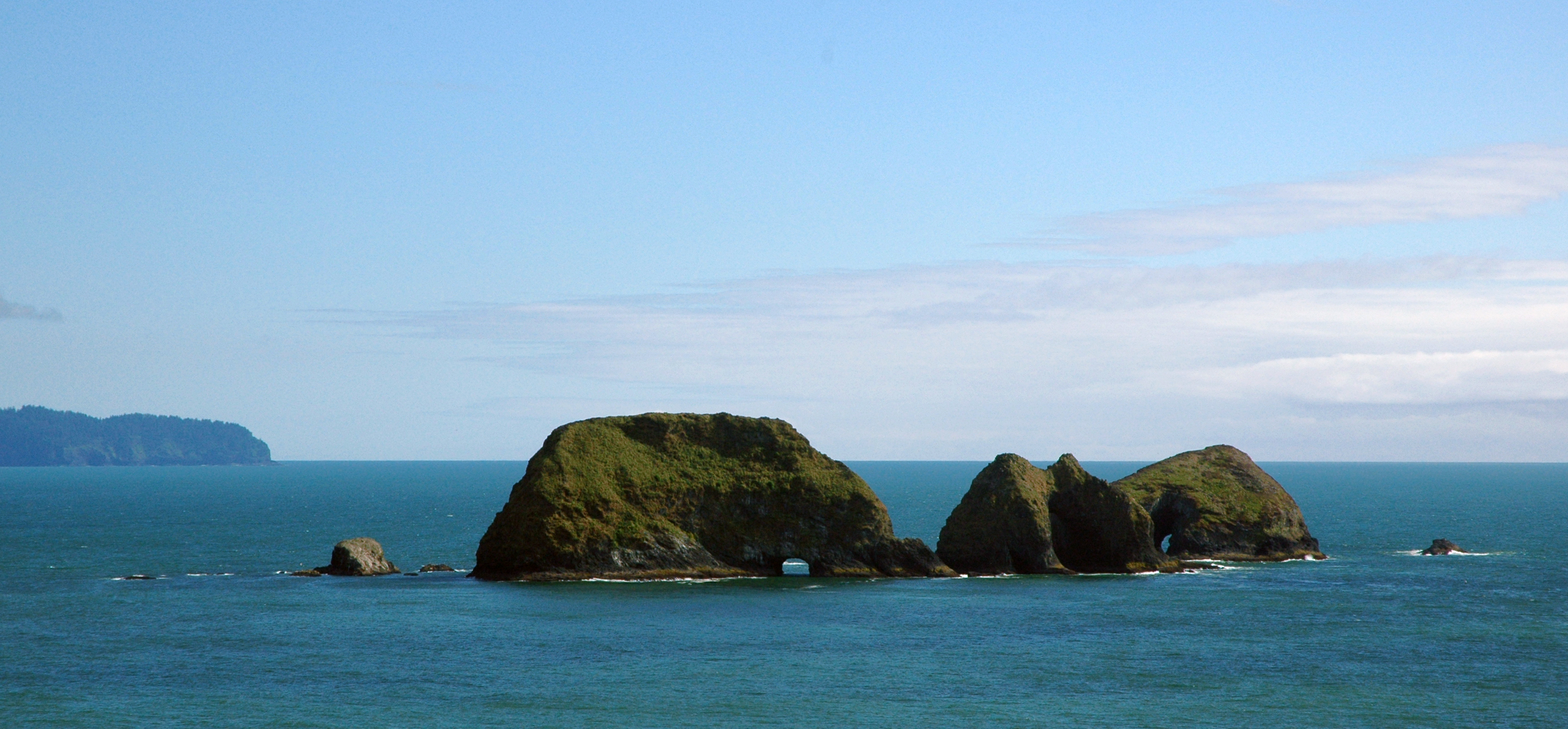
Three Arch Rocks National Wildlife Refuge
Two young men in a rowboat changed the future of American conservation. In 1901, photographer William L. Finley and his partner Herman Bohlman began paddling out from the village of Oceanside, Oregon, to a cluster of sea stacks half a mile offshore -- three large rocks pierced by natural arches, surrounded by six smaller islets, the whole formation barely fifteen acres of bare stone. What they found there horrified them. Hunters were slaughtering dozens of sea lions at a time for skin and oil. Sportsmen were shooting seabirds purely for entertainment. Because chicken farms were scarce along this stretch of coast, seabird eggs fetched up to a dollar a dozen, and collectors were systematically raiding the nesting colonies. Finley and Bohlman spent years documenting the carnage with their cameras, then carried the evidence to Washington. In 1907, Theodore Roosevelt declared Three Arch Rocks a National Wildlife Refuge -- the first west of the Mississippi River.
A Fortress Built by the Sea
Three Arch Rocks sits about a half mile off the coast near Oceanside, in Tillamook County on the northern Oregon coast. The formation consists of three large rocky islands and six smaller ones, their surfaces carved by millennia of Pacific swells into the natural arches that give the refuge its name. There is no soil to speak of, no trees, no fresh water -- just volcanic rock shaped by wind and salt spray into ledges, crevices, and vertical faces that happen to be ideal nesting habitat. The total area barely covers fifteen acres, making it one of the smallest designated wilderness areas in the entire United States. Yet what those fifteen acres lack in size, they compensate for in sheer biological density. The rocks host the largest breeding colony of tufted puffins in Oregon and the largest common murre colony found anywhere south of Alaska. Steller sea lions -- a threatened species -- use the rocks as their only pupping site in northern Oregon.
The Photographers and the President
William Finley was twenty-five years old when he first rowed out to the rocks. He and Bohlman were not scientists by training but naturalists with cameras, part of a new generation that believed photographs could accomplish what written petitions could not. They returned to Three Arch Rocks repeatedly over several years, hauling heavy plate cameras and tripods across open water in small boats to document the colonies. Their images of tufted puffins crowding the ledges, murres packed shoulder to shoulder on every flat surface, and sea lions hauled out on the lower rocks made the case viscerally: this place was extraordinary, and it was being destroyed. Finley brought the photographs and his arguments directly to President Roosevelt, who was already proving receptive to conservation appeals. On October 14, 1907, Roosevelt signed the executive order establishing the refuge. It was a landmark moment -- the first time federal wildlife protection had been extended to any site west of the Mississippi.
Quarter-Million Wings
More than a century after Roosevelt's order, the refuge protects Oregon's largest seabird nesting colony. Over 230,000 birds breed on these rocks each season, a staggering concentration of life on such a small footprint. Tufted puffins dig burrows into whatever thin soil accumulates in the crevices, their orange bills and blond head tufts visible against the dark rock even from shore. Common murres stand upright in dense ranks on the open ledges, each female balancing a single pear-shaped egg on bare stone -- the egg's shape prevents it from rolling off the cliff face. Cormorants, guillemots, and storm-petrels fill the remaining niches. Below, Steller sea lions bark and jostle on the wave-washed platforms, mothers nursing pups while bulls patrol the perimeter. In 1970, Congress designated the refuge as wilderness, adding another layer of protection to a place that owes its survival to two men with a rowboat and a camera.
Keep Your Distance
The refuge is strictly closed to public entry. No one may land on the rocks, and boats must keep a minimum distance to avoid disturbing the colonies. Aircraft are required to maintain at least 2,000 feet of clearance overhead -- a restriction that underscores how sensitive these nesting populations remain to disturbance. The United States Fish and Wildlife Service manages Three Arch Rocks as part of the Oregon Coast National Wildlife Refuge Complex, which encompasses six refuges along the coast. From the beach at Oceanside, visitors can watch the rocks through binoculars and, on calm days, hear the murre colonies from shore -- a low, continuous roar that sounds less like individual birds and more like a distant stadium crowd. The arches themselves are best seen in profile from the beach, their openings framing blue sky or gray fog depending on the day, the rock faces streaked white with guano from over a century of uninterrupted nesting.
From the Air
Located at 45.46N, 123.99W, approximately 0.5 miles offshore from Oceanside, Oregon, on the northern Tillamook County coast. IMPORTANT: Aircraft must maintain at least 2,000 feet AGL clearance over the refuge per federal wildlife regulations. The three main sea stacks with their distinctive natural arches are visible from altitude, appearing as dark rock formations against the lighter ocean. Look for the white guano streaking on the rock faces. The Bayocean Peninsula and Tillamook Bay are visible to the northeast. Nearest airport: Tillamook Airport (KTMK) approximately 12nm east-southeast. Portland International (KPDX) is approximately 75nm east.