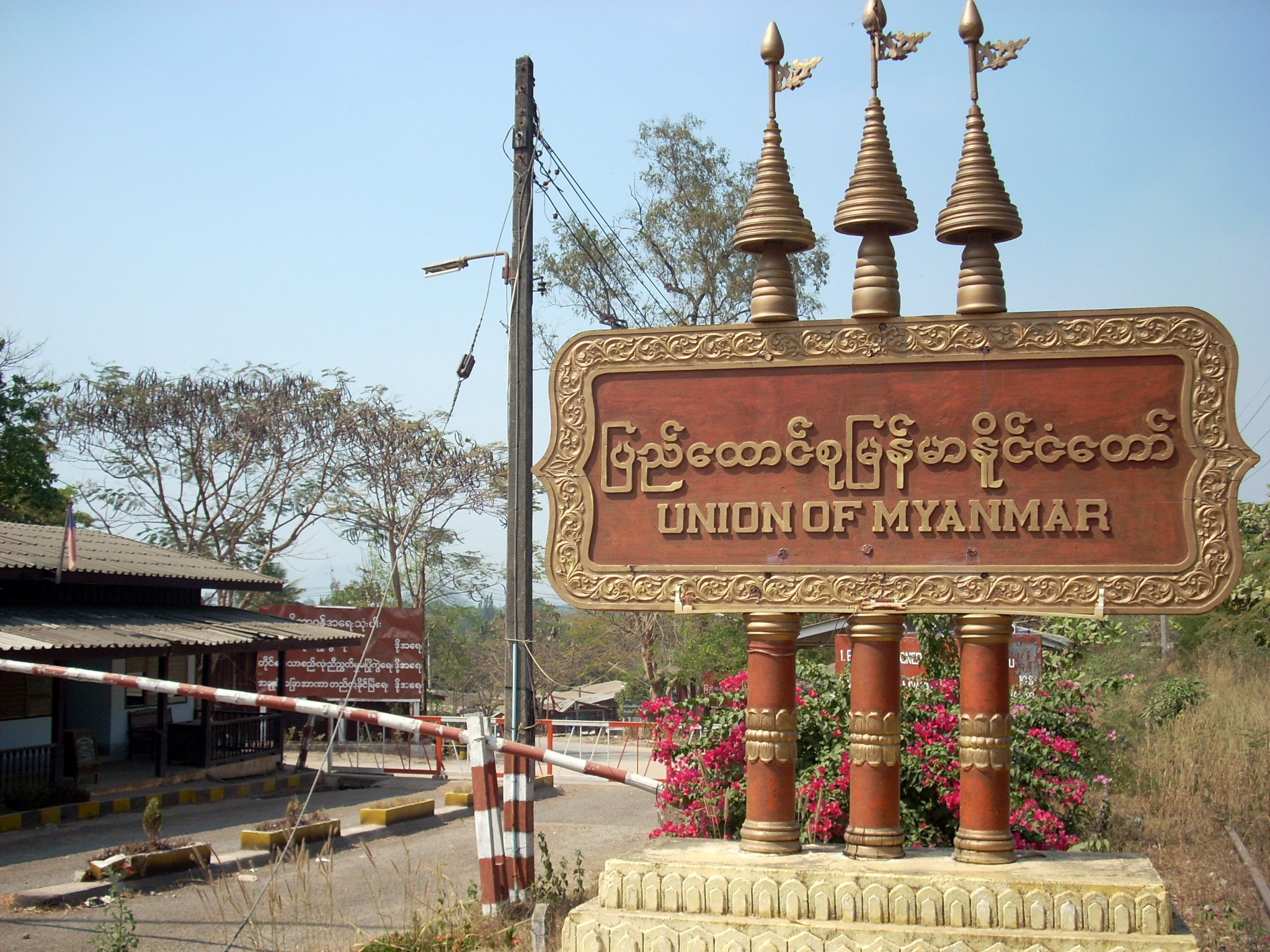
Three Pagodas Pass
Three small stupas, crumbling and whitewashed, stand on the Thai side of a mountain pass that has channeled armies, monks, prisoners, and refugees for at least seven centuries. At just 282 meters elevation, Three Pagodas Pass is one of the few gaps in the Tenasserim Hills, the long spine of forested mountains that separates Thailand from Myanmar. That geographic accident has made this modest notch in the landscape a pivot point for the history of both nations -- and a place where the worst chapters of the twentieth century left marks that have never fully healed.
The Gate Between Kingdoms
The pass connects the town of Nong Lu in Thailand's Kanchanaburi Province to Payathonzu in Myanmar's Kayin State. During the Ayutthaya period, which spanned the fourteenth through eighteenth centuries, it served as the primary invasion route for Burmese armies striking into the heart of Siam. The first recorded Burmese assault through the pass came in 1548, during the Burmese-Siamese War. Siamese forces used it in the opposite direction when circumstances allowed. The three pagodas that give the pass its name were erected in 1929 by Phra Sri Suwan Khiri, the ruler of Sangkhla Buri, with help from local villagers. But the pass's symbolic association with Buddhism runs deeper: tradition holds that Indian monks traveled this route as early as the third century to bring Buddhism into what is now Thailand. The pagodas appear in stylized form on the provincial seal of Kanchanaburi Province.
Rails Built on Suffering
During World War II, Japan chose Three Pagodas Pass as the route for the Burma-Siam Railway, a 415-kilometer line connecting Ban Pong in Thailand to Thanbyuzayat in Burma. The project, known afterward as the Death Railway, was built between 1942 and 1943 using the forced labor of approximately 60,000 Allied prisoners of war and over 200,000 Asian civilians -- romusha conscripts from Malaya, the Dutch East Indies, and Burma. Tropical disease, starvation, and brutal treatment killed an estimated 12,000 prisoners of war and tens of thousands of Asian laborers, though exact numbers for the civilian dead remain uncertain. A memorial near the pass commemorates those who perished. The railway's most famous structure, the bridge over the River Kwai at Kanchanaburi, lies further south, but the pass itself was the corridor through which this immense human suffering flowed.
Peoples Without a Country
The region around Three Pagodas Pass is home to Karen and Mon communities who live in a legal and political limbo that predates the modern border. Many are stateless -- unable or unwilling to obtain citizenship from either Thailand or Myanmar. Mon separatist forces controlled the pass for decades, and their presence made the border area a contested zone where national sovereignty existed more in theory than in practice. In 1990, Burmese troops retook the pass from Mon insurgents, but sporadic fighting has continued into the twenty-first century. As recently as April 2021, clashes erupted in Myanmar opposite Three Pagodas Pass. For the Karen and Mon peoples who live here, the pass is not a tourist attraction or a historical curiosity. It is the seam of a divided world, and they occupy both sides of it without fully belonging to either.
Border Commerce and Festival Days
Despite its fraught history, Three Pagodas Pass has become a modest tourist destination. Thai visitors can obtain a one-day pass to cross into Payathonzu, where the market offers wooden furniture, jade carvings, and textiles from Myanmar. Foreign tourists have been restricted since 2011, as the pass operates as a temporary border checkpoint that permits only day trips between the two countries. The atmosphere shifts dramatically during April, when the Thai New Year festival of Songkran transforms the pass into a site of celebration. Near the Buddhist temple of Wat Suwankhiri, perched on a cliff outside Payathonzu, the festivities include traditional Lethwei -- Burmese kickboxing -- folk dancing, and cockfights, the sacred variety that carries ritual significance in regional Buddhist practice. For a few days, the border crossing that has witnessed so much conflict becomes a place of shared revelry.
From the Air
Located at 15.30N, 98.40E in the Tenasserim Hills on the Thailand-Myanmar border, at an elevation of 282 meters. The pass is visible as a low notch in the north-south mountain ridge. Kanchanaburi town lies approximately 150 kilometers to the southeast. Nearest airports are Kanchanaburi Airstrip and the international airports at Bangkok -- Don Mueang (VTBD) and Suvarnabhumi (VTBS), both roughly 250 kilometers east. The surrounding terrain is heavily forested hill country; maintain altitude and be aware of variable mountain weather.