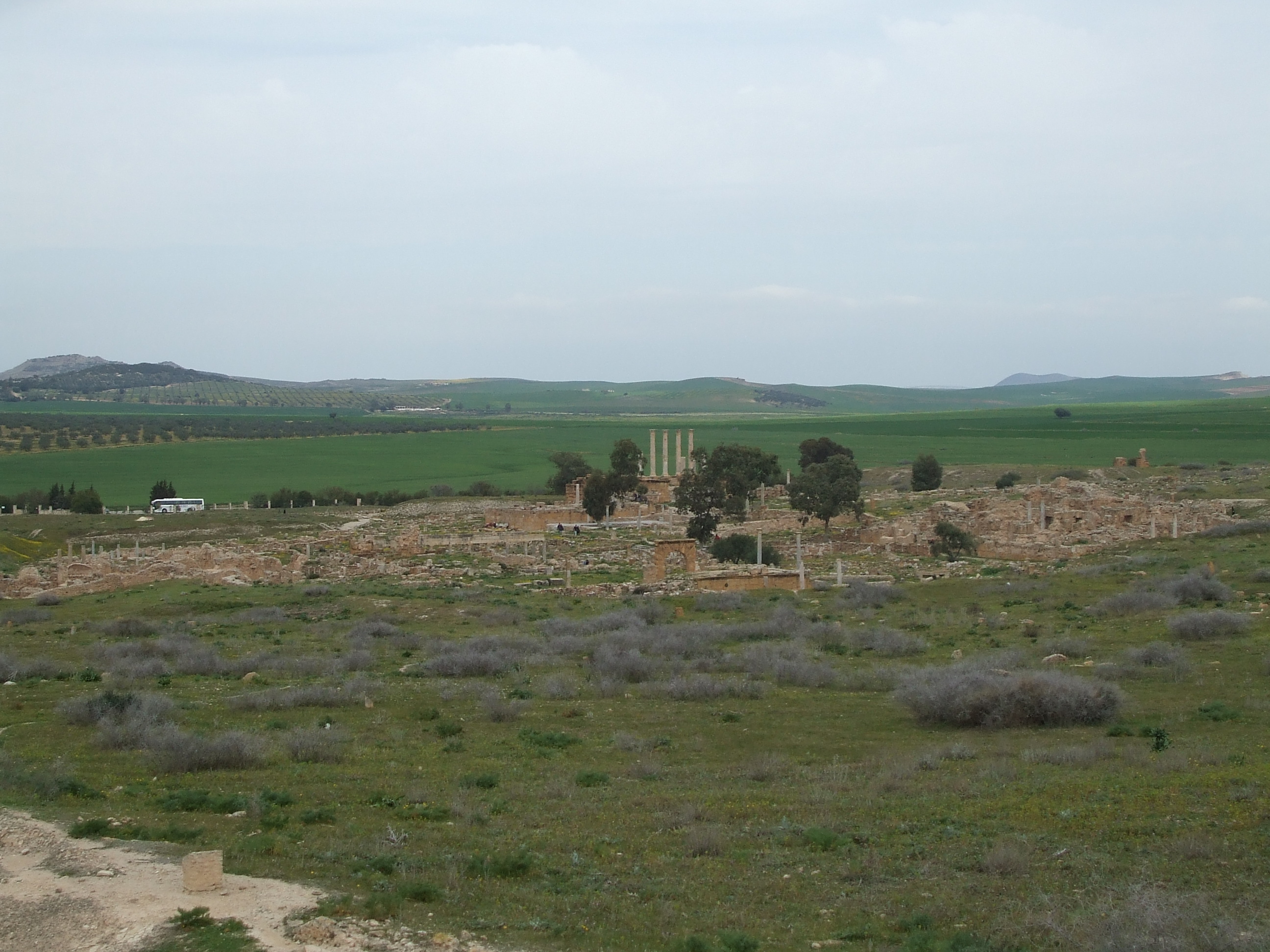
Thuburbo Majus
Sixty kilometers southwest of Carthage, in open countryside with no modern town in sight, the columns and foundations of a Roman city emerge from the Tunisian earth. Thuburbo Majus was not the grandest city in Roman Africa, nor the most famous. But its isolation is precisely what preserved it. No medieval city was built on top of its ruins. No highway cut through its forum. The city that Augustus founded for his retired legionnaires in 27 BC simply emptied and waited.
A Soldier's Reward
Before Rome, there was Carthage. Thuburbo began as a Punic settlement along a major thoroughfare connecting Carthage to the Sahara, a route that passed through Sbiba, Sufes, and Sufetula. When Augustus resettled military veterans across North Africa after the civil wars, Thuburbo received its colony -- soldiers given land to start their post-army lives. The official Roman name, Colonia Julia Aurelia Commoda, recorded the imperial patronage that made the settlement possible. The strategic location on trade routes ensured that the colony thrived. Under Hadrian, Thuburbo was elevated to a municipium, which brought legal privileges and attracted wealth. Emperor Commodus later raised it further to full colonial status. The town grew prosperous on grain, olives, and fruit, and by the mid-second century it was building monuments to match its ambitions.
Stone and Mosaic
Most of the visible ruins date from the great building period of 150 to 200 AD. A Capitolium -- the temple to Jupiter, Juno, and Minerva that marked a city's importance -- arrived in 168 AD. Excavations beginning in 1916 uncovered a tetrastyle temple decorated with statues of Apollo, Venus, Silvanus, Bacchus, and the Dioscuri, along with a satyr and perfume vases etched with scenes of dogs chasing rabbits. The mosaics tell the richest stories. Dating to the late fourth century, they depict still-life arrangements of food, fishing scenes with young people casting from boats on a sea filled with fish, and a nude Venus riding a chariot surrounded by plant life symbolizing fertility and prosperity. Archaeologist Aicha Ben Abed has studied these works extensively. In 1925, remains of the House of Bacchus and Ariadne from the early fifth century yielded evidence of food preparation in a garden -- rare, mundane details of daily life that make ancient Rome feel less monumental and more human.
Saints and Heretics
Thuburbo's importance extended beyond commerce and architecture. The early third-century Christian martyr Perpetua was born here -- a young noblewoman whose account of her imprisonment and death in the Carthage arena became one of the earliest and most vivid pieces of Christian literature. The city became a bishopric, and its ecclesiastical history reads like a chronicle of North African Christianity's turbulent centuries. Bishop Sedatus attended the Council of Carthage in 256. Faustus went to the Council of Arles in 314. By 411, the city had both a Catholic bishop, Cyprianus, and a rival Donatist bishop, Rufinus -- evidence of the theological fault lines that divided the region. When the Arian Vandals conquered North Africa, Bishop Benenatus was exiled by King Huneric in 484. The diocese survived until the Muslim conquest of the Maghreb finally ended the institutional church in the region.
What the Countryside Kept
Today Thuburbo Majus has no fully restored buildings, but the remains are substantial and evocative. The forum, amphitheater, temples, baths, and private houses are all legible in the landscape. Parts of the old Roman road that connected Carthage to the Sahara still survive. Walking the site, surrounded by farmland and silence, the scale of what Rome built in Africa becomes tangible in a way that more famous, more crowded sites cannot match. The fourth-century Crisis of the Third Century nearly destroyed the city, but it was rebuilt and continued into the Byzantine period. Its final centuries left fewer traces, and the site eventually returned to the countryside that had always surrounded it -- grain fields and olive groves, the same crops that the Roman colonists had cultivated two thousand years before.
From the Air
Located at 36.40N, 9.90E in northern Tunisia, roughly 60 km southwest of ancient Carthage (near modern Tunis). The site is in open countryside with no nearby town -- look for exposed ruins amid farmland. Nearest major airport: Tunis-Carthage International (DTTA), approximately 70 km northeast. Recommended viewing altitude: 3,000-5,000 feet to appreciate the site layout.