THUMS Islands
At night, the four islands sparkle off the Long Beach waterfront like floating resorts, their waterfalls illuminated, palm trees swaying, and modernist towers glowing against the Pacific sky. Tourists strolling the shore might imagine exclusive hotels or perhaps billionaire hideaways. The illusion is intentional, and it is perfect. What those towers actually contain are oil derricks, drilling day and night into one of the largest urban oil fields in America. The THUMS Islands represent one of the most audacious engineering deceptions ever built: an industrial operation disguised as paradise, pumping crude oil since 1965 while looking like something out of a travel brochure.
The Billion-Dollar Disguise
The problem facing Long Beach in the early 1960s was simple but vexing: beneath San Pedro Bay lay the East Wilmington Oil Field, containing billions of barrels of crude. But this was Southern California, land of beaches and tourism, not industrial extraction. The solution came from a consortium of five oil giants, Texaco, Humble, Union Oil, Mobil, and Shell, whose initials gave the project its name: THUMS. Their proposal was revolutionary: build artificial islands, then disguise them so completely that no one would know they were looking at an oil operation. The construction was massive. Workers hauled 640,000 tons of boulders from Catalina Island to form the islands' rims, then filled the interiors with 3.2 million cubic yards of dredged material from the bay, enough to fill more than a million dump trucks.
Hidden in Plain Sight
The camouflage went far beyond cosmetics. Landscape architect Joseph Linesch designed the islands as modernist sculptures, with soaring sound walls covered in abstract patterns that looked like contemporary art but actually blocked the industrial cacophony within. Waterfalls cascaded down the walls, their rushing water masking the rhythmic thump of pump jacks. Palm trees and tropical landscaping softened every edge. The drilling rigs themselves were enclosed in colorful towers that resembled high-rise condominiums, complete with decorative lighting that made them glow invitingly at night. The deception was so complete that the islands became a point of civic pride, featured on postcards and promotional materials for Long Beach. They remain the only decorated oil islands in the United States, an industrial facility that doubles as public art.
Memorials in the Water
In 1967, the islands received new names that added an unexpected layer of meaning to their industrial purpose. Each was renamed for an American astronaut who had died in service to NASA. Island Freeman honors Theodore 'Ted' Freeman, the first astronaut killed in active duty when his T-38 Talon struck a goose in 1964. Islands Grissom, White, and Chaffee memorialize the three astronauts, Gus Grissom, Ed White, and Roger Chaffee, who perished in the Apollo 1 fire just two years after the islands were completed. The renaming transformed these artificial mounds of rock and dredged sand into something more solemn: floating memorials to American heroes, visible to anyone flying into or out of Los Angeles International Airport.
A Billion Barrels and Counting
The numbers behind the pretty facades are staggering. The islands pumped their 900 millionth barrel in April 2002 and crossed the billion-barrel threshold in 2011. The operation has not been without challenges. By 1994, the extracted fluid was 92 percent water, requiring massive processing to separate the remaining crude. A 1975 lawsuit accused the THUMS companies of artificially depressing oil prices, resulting in settlements worth hundreds of millions of dollars. Ownership has changed hands too: Occidental Petroleum bought the operation in 2000, and today the THUMS Long Beach Company runs it as part of California Resources Corporation. The oil keeps flowing, the waterfalls keep tumbling, and millions of visitors still have no idea what they are looking at when they gaze out at those beautiful islands.
The View from Above
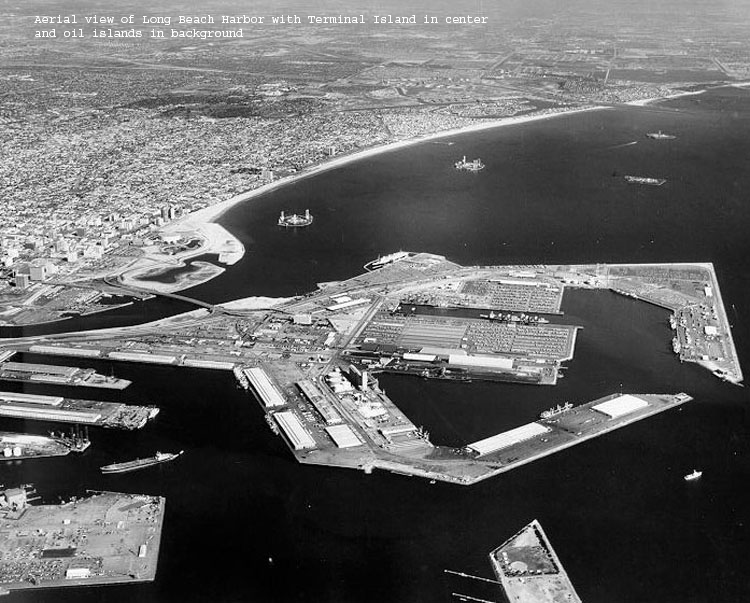
From the air, the deception becomes partially visible. The four islands sit in a rough line parallel to the Long Beach shore, their shapes too regular to be natural. Island Grissom, closest to land, shows the most elaborate landscaping, with waterfalls cascading down its seaward face. Island Freeman, the largest, reveals its industrial heart more clearly from altitude: the geometric patterns of drilling equipment visible within the decorative walls. The transformation of the bay itself is also apparent. The dredging that created the islands altered the underwater topography, changing wave patterns along miles of coast. Yet from most viewing angles, the illusion holds. They still look like private resorts, still sparkle at night, still hide their billion-barrel secret in plain sight.
From the Air
Located at 33.741N, 118.163W in San Pedro Bay, approximately 1 mile offshore from Long Beach, California. Best viewed from 1,500-2,500 feet AGL on approach to Long Beach Airport (KLGB, 4 miles northeast) or when departing Los Angeles International (KLAX, 18 miles northwest). The four islands are clearly visible in a line parallel to shore. At night, the decorative lighting makes them appear as floating resorts. The Queen Mary is docked nearby to the north, providing scale reference.