Thy National Park
Wolves vanished from Denmark in 1813. Two centuries later, in 2012, a dead wolf was found in the dunes of Thy -- a young animal that had apparently walked all the way from the Lausitz region of Saxony, Germany. Its arrival, improbable and unbidden, captured something essential about Thy National Park: this is a place that nature keeps reclaiming, no matter how long humans spend trying to tame it. Stretching 55 kilometers along the northwest coast of Jutland from Hanstholm to Agger Tange, Thy became Denmark's first national park when it opened on 22 August 2008, protecting 244 square kilometers of dune, heath, and coastal wilderness.
The Sand That Swallowed Everything
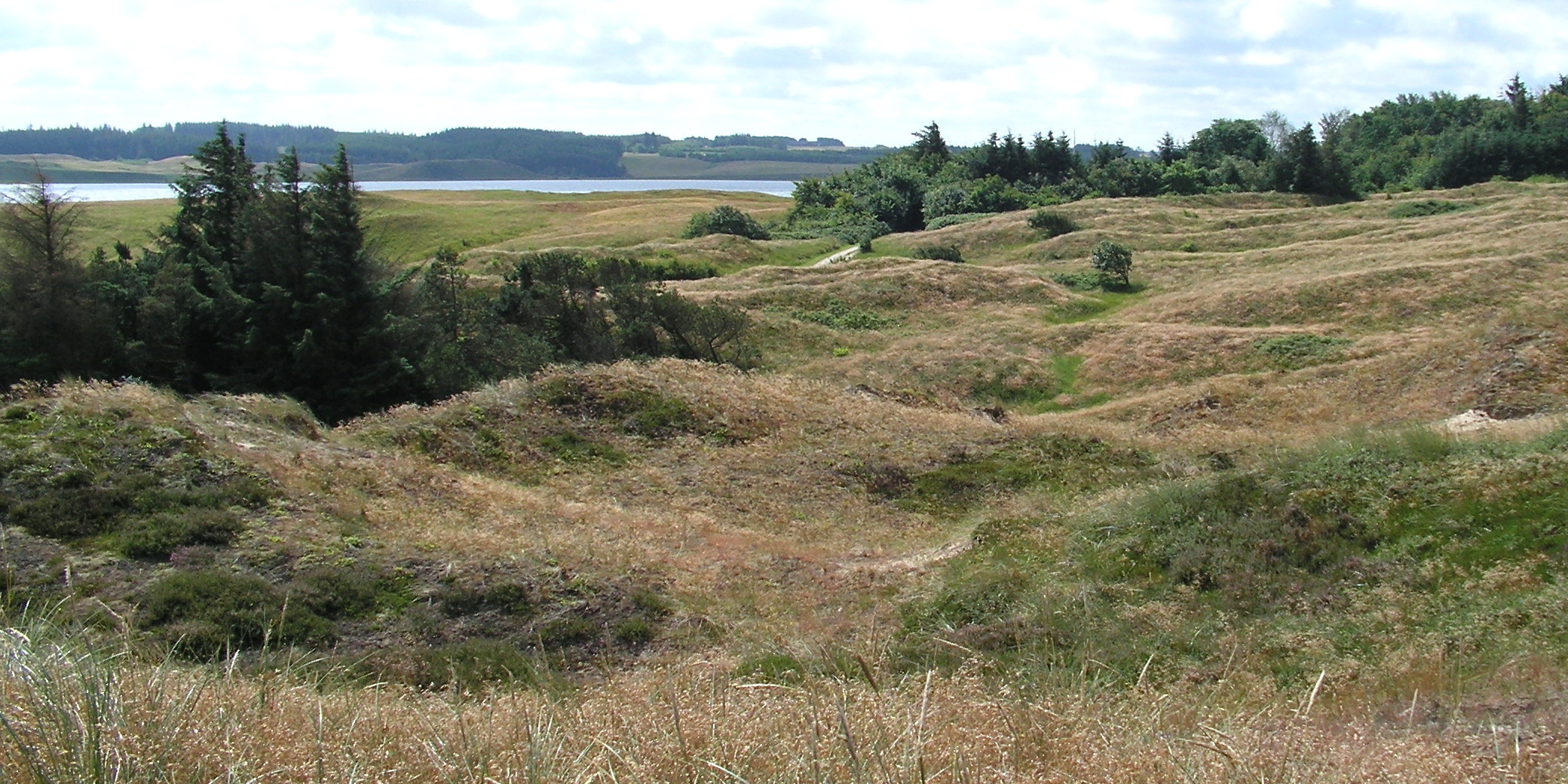
For centuries, drifting sand was the defining fact of life in Thy. It buried fields, smothered buildings, and reshaped the coastline faster than anyone could respond. The land had been overgrazed and stripped of trees during the Viking Age and Middle Ages, and once the vegetation was gone, the sand moved freely. It was not until around 1800 that organized efforts began to fight back, with plantings of marram grass and conifers that took more than a century to succeed. Those dune plantations still stand as living monuments to the struggle. They brought protection from the sand, but also something unexpected: timber, firewood, jobs, and enough shelter for red deer and roe deer to establish themselves in a landscape that had been too exposed to support them.
A Heath Hiding in Plain Sight
The sandy dune heaths of Thy are rare even by European standards, and their protection was a major reason for creating the national park. To an untrained eye, the heath looks monotonous -- low scrub stretching toward the horizon. But the vegetation is remarkably varied: common heather, sand sedge, marram grass, edible black crowberry, bell heather, and carpets of lichen. Wet hollows between the dunes support bog bilberry, bayberry, marsh gentian, cranberry, and carnivorous sundews. The Hanstholm Vildtreservat in the park's northern section contains the largest connected sandy heath in Denmark, roughly 40 square kilometers. It is home to the European golden plover, which breeds nowhere else in the country, along with cranes, wood sandpipers, and the natterjack toad. In the coastal dunes, beach morning glory and scots loveage grow -- plants found almost nowhere else in Denmark.
Burial Mounds and Bunkers
Human history in Thy runs as deep as the dunes are high. When the ice retreated at the end of the last glaciation, the land rose through post-glacial rebound and Stone Age cultures arrived quickly. Their dolmens, burial mounds, kitchen middens, and flint-working sites are scattered across the park, though an unknown number lie buried under centuries of sand. The Bronze Age was especially active here -- the density of surviving barrows, particularly near Hanstholm, suggests a thriving population. Viking Age and medieval traces follow, each era leaving its mark on a landscape shaped by the relentless North Sea. The most visible modern additions are the concrete bunkers of World War II. During the German occupation of Denmark, the Wehrmacht fortified Thy as part of the Atlantic Wall, building massive batteries to dominate the North Sea approaches. Five restored bunkers and batteries survive along the park's coastline, including the Hanstholm Fortress, now a museum.
Where the Wild Things Return
Thy National Park is a place defined by return. The plantations brought back trees that overgrazing had destroyed. The heath, now protected by law, requires constant management -- controlled burning, grazing by large animals, uprooting of invasive vegetation -- to keep it from being overtaken by the very forests that were planted to save it. And then there are the wolves. After the 2012 discovery, further sightings followed, suggesting that a few animals may now live in the park, more than two hundred years after the species was declared extinct in Denmark. The park's lakes and ponds, fed by clean groundwater, harbor their own rarities: water lobelia, quillwort, and the globally near-threatened slender naiad and pillwort fern. Parts of the park have been designated a Ramsar wetland site and a Natura 2000 area. Along the beaches, visitors can forage for blackberries, cranberries, and sea-buckthorn -- a landscape that feeds as much as it fascinates.
From the Air
Located at 56.95N, 8.42E along the northwest coast of Jutland, Denmark. The park stretches 55 km from Hanstholm in the north to Agger Tange in the south, hugging the North Sea coast. Nearest airports: Thisted Airport (EKTS) is adjacent to the park's eastern boundary. Karup (EKKA) is approximately 90 km east. Fly south along the coast at 2,000-3,000 ft for dramatic views of the dune landscape, heath, WWII bunkers, and the narrow barrier between the North Sea and the Limfjord.