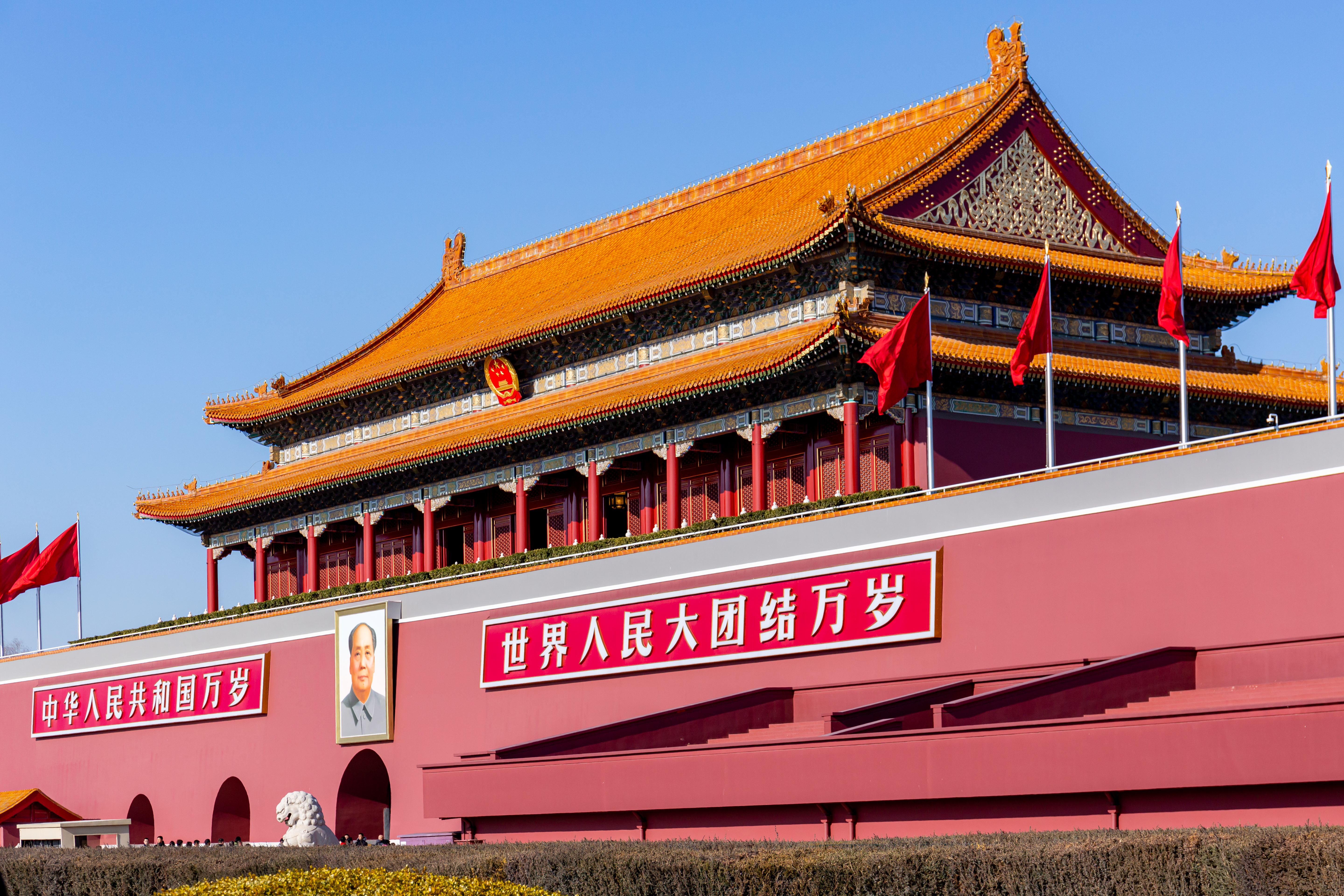
Tiananmen
The name is a kind of prayer. Tiananmen -- the Gate of Heavenly Peace -- derives from a longer phrase: "receiving the mandate from heaven, and pacifying the dynasty." Built in 1420 as the entrance to the Ming emperor's residence, the gate was originally called Chengtianmen, the Gate of Accepting Heavenly Mandate. It has been destroyed by lightning, burned by rebels, rebuilt by conquerors, and secretly reconstructed by a Communist government that wanted it to look exactly the same while making it earthquake-proof. Through six centuries of upheaval, the gate has persisted -- not unchanged, but perpetually renewed, its identity residing less in its physical materials than in what it represents.
Five Destructions
The original gate, built in 1420, was modeled on a structure in Nanjing. Lightning destroyed it completely in July 1457. The Chenghua Emperor ordered its reconstruction in 1465, and the design was transformed from a simple paifang archway into the imposing gatehouse that defined its character ever after. In 1644, rebels under Li Zicheng burned it down during the fall of the Ming dynasty. The incoming Qing dynasty rebuilt it beginning in 1645, completing the work in 1651 and bestowing the name Tiananmen. The building that resulted stood for over three centuries, weathering the Opium Wars and the Boxer Rebellion, until by the 1960s it was severely deteriorated. Zhou Enlai ordered a secret reconstruction between 1969 and 1970 -- the entire gate was concealed behind scaffolding, the project officially described as mere "renovation." The rebuilt gate received an elevator, heating, and reinforced earthquake resistance, all hidden behind a facade engineered to look exactly as it had before.
The Portrait That Never Leaves
In 1925, following Sun Yat-sen's death, his portrait was hung on the gate. In 1945, Chiang Kai-shek's image replaced it to celebrate victory over Japan. On October 1, 1949, Mao Zedong proclaimed the People's Republic from the gate's balcony, and his portrait has hung there ever since, replaced with a fresh painting each year before National Day. Only once was it temporarily exchanged: on March 9, 1953, a portrait of Joseph Stalin was displayed to mark his death. In 1989, three dissidents threw eggs at Mao's portrait during the Tiananmen Square protests. One of them, Yu Dongyue, was sentenced to 20 years; he was released on commutation of sentence nearly 17 years later, in 2006. The portrait caught fire in 2007 when a man from Urumqi set it ablaze. About fifteen percent was damaged. In 2010, a protester threw ink at the wall nearby. Each attack on the portrait has been met with arrest and repair. The image endures.
Symbols Layered on Symbols
The gate is 66 meters long, 37 meters wide, and 32 meters high. Two stone lions guard the front, and two huabiao columns -- tall stone pillars topped with mythical creatures -- stand before the entrance. Originally, huabiao were designed for commoners to post grievances on, but the ones at the Imperial City were purely decorative, symbols of the state's majesty rather than instruments of popular expression. Giant placards flank the gate: "Long Live the People's Republic of China" on the left, "Long Live the Great Solidarity of the World's Peoples" on the right. Both were updated from traditional to simplified Chinese characters in 1964. The phrase "long live" -- wan sui, literally "ten thousand years" -- was historically reserved for emperors. Its application to the republic and its people carries deliberate weight.
The Gate on the Emblem
Tiananmen appears on China's national emblem, on its currency, and on countless official documents. It is the country's most reproduced architectural image. Yet the physical gate remains accessible to ordinary visitors: open daily from 8:30 a.m. to 5:00 p.m., reachable via Tiananmen West and Tiananmen East stations on Line 1 of the Beijing Subway. Tickets must be booked online at least a day in advance. What visitors see is, in a sense, a building that is less than sixty years old pretending to be six centuries old -- a reconstruction so faithful to the original that the distinction barely matters. The Gate of Heavenly Peace has always been less about the physical structure than about the idea it embodies: the place where heaven's mandate meets the governed, where power announces itself to the world.
From the Air
Located at 39.91°N, 116.39°E, the Tiananmen gate sits at the northern end of Tiananmen Square and the southern edge of the Forbidden City. From altitude, the gate is part of the continuous Beijing Central Axis running north-south through the city center. Beijing Capital International Airport (ZBAA/PEK) lies 26 km to the northeast. The gate and square are best viewed at 2,000-5,000 feet.