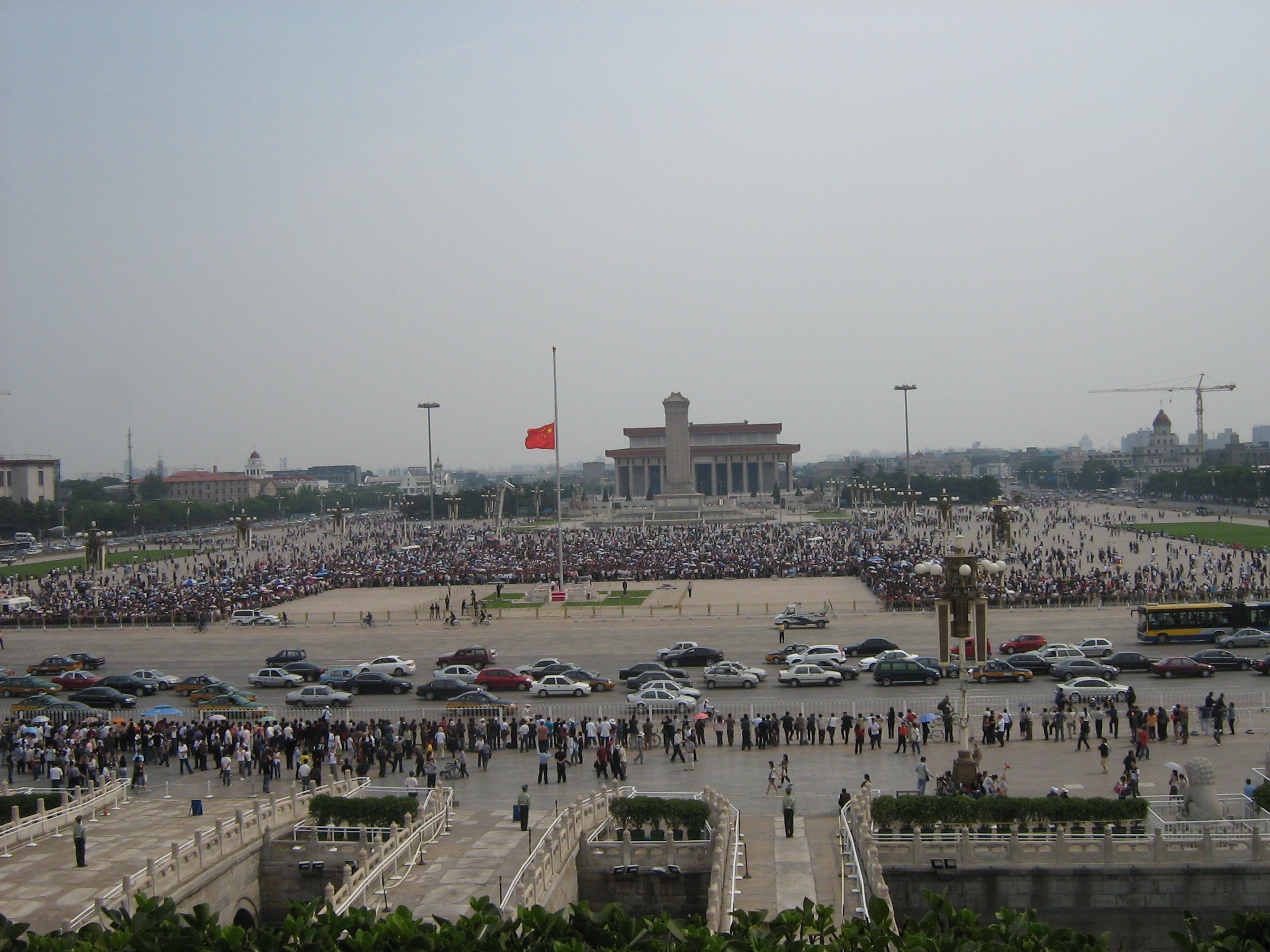
Tiananmen Square
At sunrise, soldiers raise the flag. At sunset, they lower it. Every day, without exception, at the northern end of a 53-acre rectangle of paving stone in central Beijing, this ritual marks the passage of time in a space where time itself is contested. Tiananmen Square is not merely large -- at 765 by 282 meters, it can hold 600,000 people -- but symbolically dense in a way that few places on earth can match. The Forbidden City lies to the north, behind the Gate of Heavenly Peace. The Great Hall of the People fills the western edge. The National Museum anchors the east. And at the center stands the Monument to the People's Heroes, a granite obelisk inscribed with the words of Mao Zedong, who proclaimed the People's Republic from this very spot on October 1, 1949.
From Imperial Enclosure to People's Plaza
The square's origins are imperial. The Tiananmen gate was built in 1417 during the Ming dynasty, and the space before it was designed in 1651 as a walled forecourt to the Imperial City. Commoners were barred from the central gate; traffic was diverted to side passages, and a busy marketplace called "Chess Grid Streets" sprang up to serve the diverted foot traffic. In the nineteenth century, foreign powers carved their presence into the edges of the space: British and French troops camped here during the Second Opium War in 1860, and after the Boxer Rebellion in 1900, the Eight-Nation Alliance assembled military forces in the area. The twentieth century brought the square's most radical transformation. In the 1950s, the Communist government quadrupled its size, demolishing the old Gate of China and the imperial corridor to create the vast open plaza that exists today.
Stage for a Century of Protest
Before it became the symbol of Communist power, the square was the stage for movements that challenged power. Students gathered here during the May Fourth Movement of 1919, protesting the Treaty of Versailles and the government's failure to defend Chinese sovereignty. In 1926, government forces fired on demonstrators in what became known as the March 18 Massacre. After Zhou Enlai's death in 1976, spontaneous mourning in the square turned into political protest against the Gang of Four. Each of these moments left a mark on the square's meaning, layering it with the accumulated weight of dissent, sacrifice, and the state's response to both.
June 1989
The event that defined the square in the world's imagination began with mourning. When reformist leader Hu Yaobang died in April 1989, students gathered in Tiananmen Square to honor him and to call for democratic reforms. Over six weeks, the protests grew into the largest demonstrations China had seen since the Cultural Revolution. On the night of June 3-4, the military moved in. The death toll remains disputed and officially unacknowledged -- estimates range from hundreds to thousands -- with most of the killing occurring in the streets surrounding the square rather than on it. The following day, a lone man stood in front of a column of tanks on Chang'an Avenue, creating one of the most recognized images of the twentieth century. Within China, the government undertakes comprehensive censorship of the events of June 1989. The square itself has been under heightened security ever since, and visitors must now make reservations to enter.
The Weight of the Present
Today, security cameras bristle from lampposts around the square's perimeter. Military parades mark major anniversaries of the People's Republic. The Mausoleum of Mao Zedong, built one year after his death in 1977, occupies the square's central axis, drawing daily queues of visitors who file past the embalmed chairman. In 2024, the square and its surrounding monuments were inscribed as part of the Beijing Central Axis UNESCO World Heritage Site. The designation confirmed what the square's history already demonstrated: this is not simply a public space but a palimpsest, each layer of meaning written atop the last, none fully erasing what came before.
From the Air
Located at 39.90°N, 116.39°E in the geometric center of Beijing. The rectangular plaza is unmistakable from altitude, flanked by the Great Hall of the People to the west and the National Museum to the east, with the Forbidden City's red walls directly to the north. Beijing Capital International Airport (ZBAA/PEK) lies 26 km northeast. Best viewed at 3,000-6,000 feet for full context of the Beijing Central Axis.