Tianjin Eye
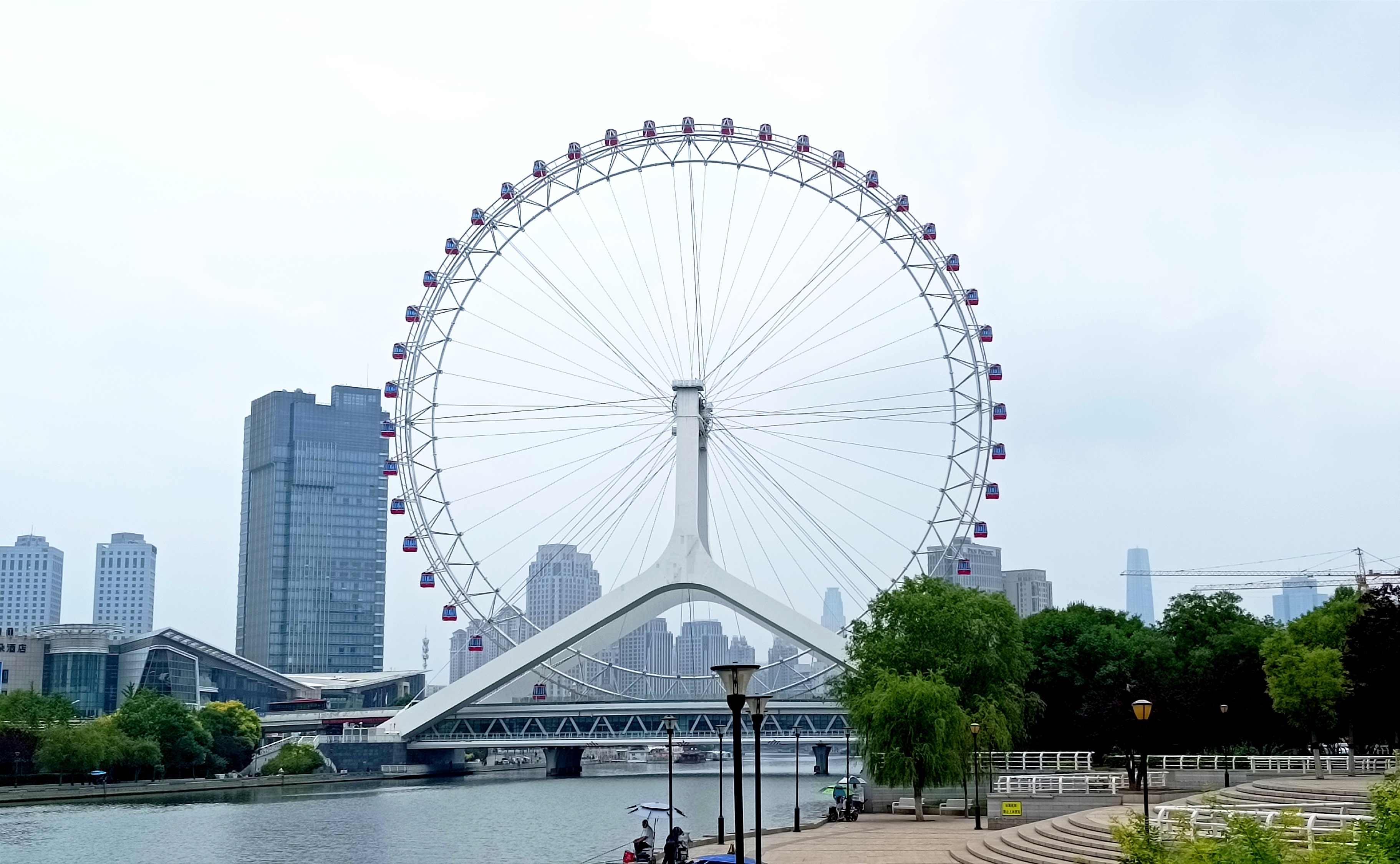
Most Ferris wheels stand beside rivers. The Tianjin Eye sits on top of one. Built directly above the Yongle Bridge -- formerly the Chihai Bridge -- this 120-meter observation wheel straddles the Hai River in a feat of engineering that makes the structure both landmark and infrastructure. When it opened to the public on April 7, 2008, only three Ferris wheels in the world stood taller: the 165-meter Singapore Flyer, the 160-meter Star of Nanchang, and the 135-meter London Eye. What none of those rivals shared was the Tianjin Eye's defining peculiarity: the bridge beneath it carries traffic while the wheel carries sightseers overhead.
Engineering Over Water
Construction began in 2007, and the wheel's main structural body was completed on December 18 of that year -- a remarkably fast build for a structure that had to solve the unusual problem of anchoring a giant rotating mechanism to a functioning bridge over a navigable river. The Yongle Bridge had to bear not only the wheel's weight but the dynamic forces generated by its rotation and the asymmetric loading of passengers in its 48 capsules. The engineering solution was essentially to make the bridge the wheel's foundation, integrating the two structures in a way that transformed urban infrastructure into a tourist attraction.
Forty-Eight Windows on Tianjin
The wheel carries 48 passenger capsules, each holding up to 8 passengers, completing one full rotation every 30 minutes. At peak capacity, 768 people can ride per hour, slowly ascending to a vantage point where the entire sweep of Tianjin's riverfront unfolds below. From the top, riders can trace the Hai River as it winds through the city, picking out the European architecture of the former concession districts, the traditional rooflines of the Ancient Culture Street, and the modern skyline that has grown up around both. The wheel is electrically powered, its rotation so gradual that passengers feel less like they are on a ride than like they are being gently lifted into a panoramic photograph.
A City Seen Slowly
The thirty-minute rotation time is the Tianjin Eye's most underappreciated feature. In a city that has reinvented itself repeatedly over the past two centuries -- from imperial port to colonial patchwork to revolutionary center to modern megacity -- the slow pace of the ride offers a rare chance to take in the layers of history that crowd Tianjin's riverbanks. The Hai River itself is the constant, the geographic feature that made Tianjin a vital port since the Grand Canal era, drew nine foreign nations to claim their concessions along its banks, and still serves as the city's central axis. Seeing it from 120 meters up, at the leisurely pace of a bridge-mounted Ferris wheel, is to understand why this particular bend of river mattered so much to so many.
A Wheel Among Giants
When the Tianjin Eye opened in 2008, the world's Ferris wheel race was accelerating. The London Eye had redefined observation wheels as destination attractions when it opened in 2000. The Star of Nanchang and Singapore Flyer pushed the height competition further. Since then, even taller wheels have risen in Las Vegas, Dubai, and elsewhere. The Tianjin Eye never competed on height alone. Its distinction was always the bridge -- the audacious decision to build an observation wheel not on a pier or a dedicated foundation but on a structure that was already doing something else. At 120 meters, it is tall enough to command the skyline but modest enough to remain a Tianjin landmark rather than a generic attraction, rooted in its specific geography in a way that no other Ferris wheel in the world can claim.
From the Air
Located at 39.15°N, 117.18°E on the Yongle Bridge over the Hai River in central Tianjin. The 120-meter Ferris wheel is clearly visible from the air as a distinctive circular structure spanning the river. It is one of the most easily identifiable landmarks in Tianjin from cruising altitude. Nearest airport: Tianjin Binhai International (ZBTJ), approximately 16 km east. Beijing Capital International (ZBAA) is about 120 km northwest. The wheel's position on the river makes it a useful visual reference point for identifying central Tianjin from the air.