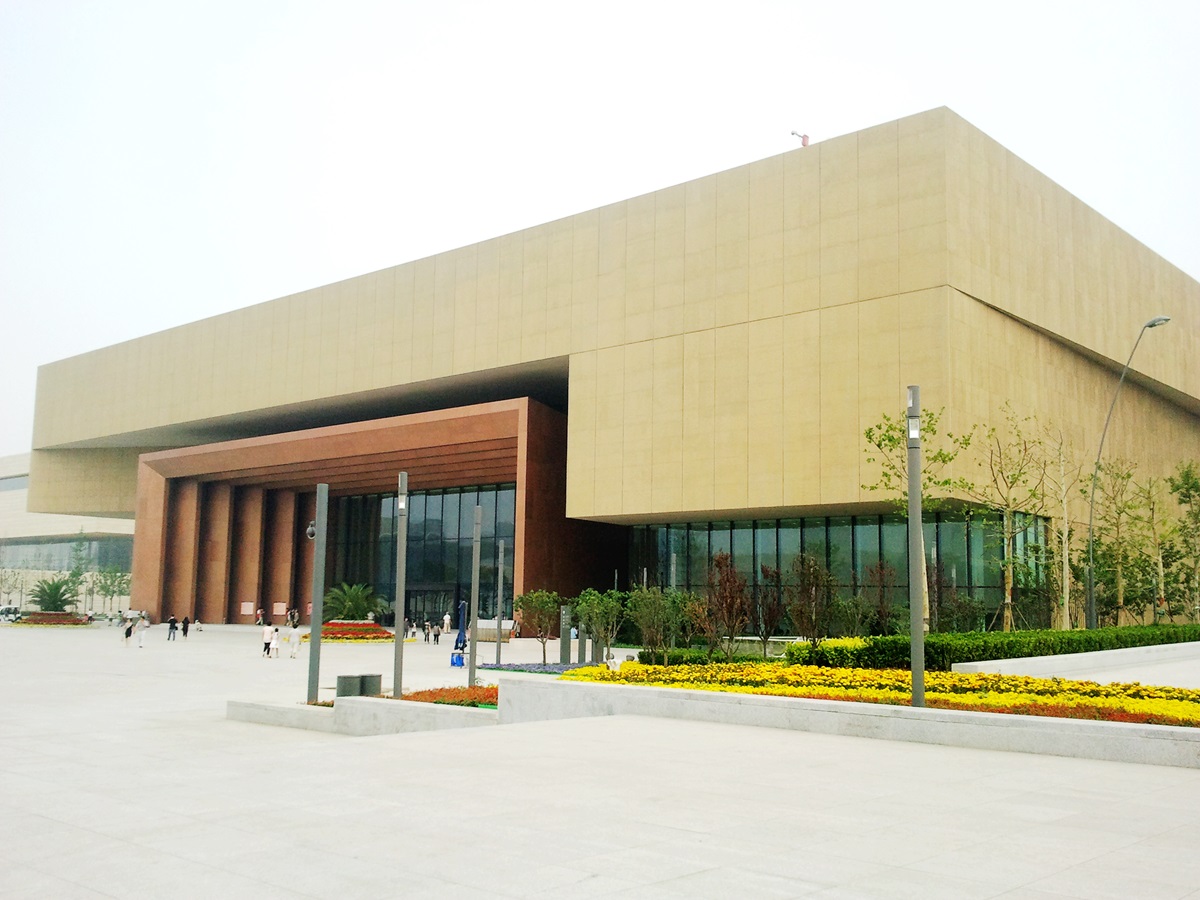
Tianjin Museum
From the air, the building looks like a swan spreading its wings across the plaza. On the ground, inside its 50,000 square meters of gallery space, the Tianjin Museum holds nearly 200,000 objects that trace Chinese civilization from the Shang Dynasty to the modern era. This is the largest museum in Tianjin, and its collection is one of the most comprehensive in northern China.
Swan on the Plaza
The museum sits in Yinhe Plaza in Tianjin's Hexi District, and its most immediate impression is architectural. Designed by Japanese architect Mamoru Kawaguchi and built by Shin Takamatsu Architect and Associates, the building's sweeping curves evoke a bird in flight. The design has made the museum one of Tianjin's most recognizable landmarks, a modernist counterpoint to the city's famous colonial-era architecture in the Five Great Avenues district to the west. The interior spaces match the ambition of the exterior, with galleries arranged to guide visitors through thousands of years of artistic and historical achievement.
Bones and Brushstrokes
The collection reaches back to the very origins of Chinese writing. Jiagu, oracle bones and tortoise shells inscribed during the Shang Dynasty, sit alongside ancient bronze vessels, jade carvings, and ceramic masterpieces spanning millennia. The calligraphy collection alone traces the evolution of Chinese written art from its earliest forms to the refined brushwork of later dynasties. Imperial seals, inkstones used by scholars and officials, and an extensive collection of ancient Chinese coins round out a treasury that touches nearly every dimension of traditional Chinese material culture. Paintings from the dynastic era hang in dedicated galleries, including works like 'The White Head's Honour and Glory' by the eighteenth-century artist Ma Quan.
Northern Treasure House
As a National First-Grade Museum of China, the Tianjin Museum stands in the top tier of the country's cultural institutions. Its strength lies not only in the breadth of its permanent collection but in its dedicated focus on the history of Tianjin itself, a city whose strategic position as the gateway to Beijing has made it a crossroads of Chinese civilization for centuries. From the Grand Canal era through the treaty port period to the industrial present, the museum documents how this northern port city absorbed and reflected the larger currents of Chinese history. Photography is not permitted inside, a restriction that makes the experience of standing before these objects feel more intimate, more immediate. What you see, you must remember with your own eyes.
From the Air
Located at 39.08N, 117.21E in Tianjin's Hexi District, near the Tianjin Cultural Center complex. Tianjin Binhai International Airport (ZBTJ) is approximately 18 km to the east. The swan-shaped building is visible in the Yinhe Plaza area. Best viewed at 3,000-5,000 feet altitude.