Tianjin Nankai High School
Zhou Enlai walked these halls. So did Wen Jiabao. Two of China's premiers, separated by nearly half a century in office, share a common origin: they were both students at Nankai High School in Tianjin, a place that has produced more national leaders, university presidents, and world-class scientists than almost any secondary school on Earth. Founded in 1904, when China's last dynasty was stumbling toward its end, Nankai was built on a radical premise: that modern, practical education could save a nation.
A Scholar's Gamble
Yan Xiu was no revolutionary. A classically trained Confucian scholar who had served in the prestigious Hanlin Academy, he understood traditional Chinese culture deeply. But the humiliations of the late nineteenth century convinced him that only the most progressive reforms could prevent China's further decline. In 1904, he founded Nankai as a private boarding school that replaced the Confucian classics with Western-style college-preparatory subjects. The following year, Yan joined a group of reformers who petitioned the Qing government to abolish the imperial examination system entirely. When the dynasty fell in the 1911 Xinhai Revolution, Yan refused every government position offered to him. He had already chosen his cause: Nankai. By 1919, the school had spawned Nankai University, which would become one of China's most prestigious institutions.
The Principal Who Ate with His Students
Zhang Boling, who ran the school's daily operations, was an unusual figure in Chinese education. He ate meals with his students. He participated in their physical exercises. He personally instructed them in hygiene. In an era when teachers kept a formal distance from their pupils, Zhang broke every convention, modelling the school on British boarding school discipline while infusing it with his own belief that physical activity was essential to intellectual development. He worked to overturn traditional Chinese contempt for manual labor and exercise, enforcing strict daily schedules of activity alongside rigorous academics. His close relationship with students was remarked upon as extraordinary, and many of his graduates reportedly carried deep admiration for him throughout their lives.
A Factory for Leaders
The alumni list borders on the absurd. Zhou Enlai, premier of China from 1949 to 1976. Wen Jiabao, premier from 2003 to 2013. Mei Yiqi, president of Tsinghua University. Wu Dayou and Qian Siliang, successive presidents of Academia Sinica. Zhu Guangya, the first president of the Chinese Academy of Engineering. More than sixty academicians. Seven recipients of China's Top National Scientist Award since the prize was established in 2001. The dramatist Cao Yu, the poet Mu Dan, and the playwright Lao She all had connections to Nankai as students or faculty. Between 1998 and 2005 alone, four Nankai students won gold medals at the International Physics Olympiad, with additional golds in mathematics, chemistry, biology, and informatics.
Still Standing, Still Producing
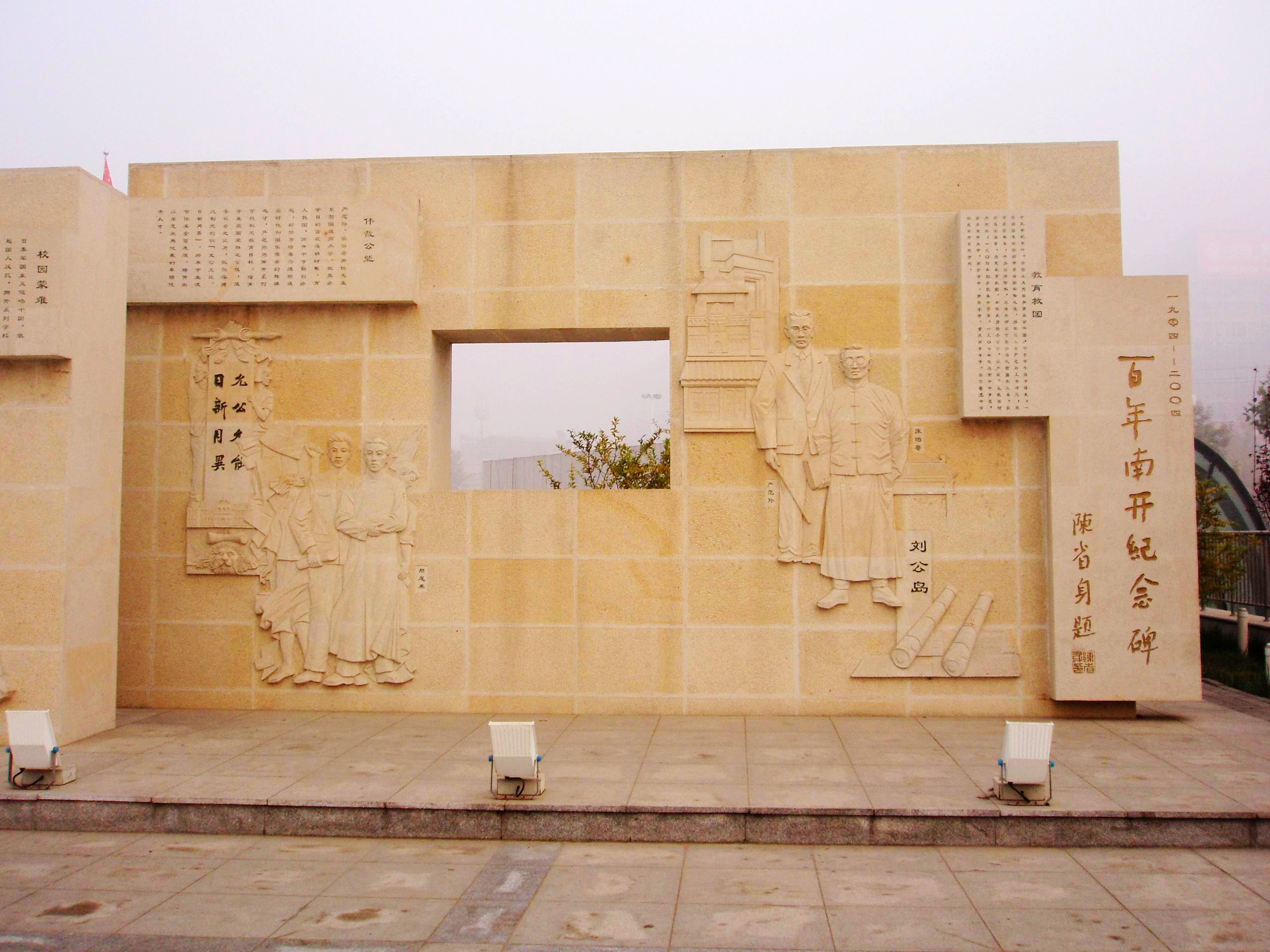
Today Nankai is a public school, and its reputation rests largely on its extraordinary success in preparing students for the Gaokao, China's National College Entrance Examination. Graduates regularly enter the country's top universities and leading institutions worldwide. The main campus still occupies its site at 22 Nankai 4th Road in Nankai District, though two additional campuses have opened in the Sino-Singapore Tianjin Eco-City and Haihe Jiaoyu Yuanqu. A centennial monument on campus marks the school's passage from Yan Xiu's gamble on modernity to its present status as one of the most celebrated secondary schools in China. What began as one man's conviction that education could rescue a failing empire has become a living institution that continues to shape the nation's leadership.
From the Air
Located at 39.13N, 117.16E in Tianjin's Nankai District. Tianjin Binhai International Airport (ZBTJ) is approximately 22 km to the east. The campus sits in the dense urban core west of the Hai River. Best viewed at 3,000-5,000 feet altitude.