Tianjin Natural History Museum
In 1914, a French Jesuit priest named Emile Licent began collecting. Over the next twenty-five years, he trekked 50,000 kilometers through the Yellow River and Haihe River basins, gathering over 200,000 specimens of fossils, animals, plants, ancient human remains, and rocks. He called his growing repository the Hoangho Paiho Museum, naming it for the two great river systems he had spent decades exploring. That collection became the seed of what is now the Tianjin Natural History Museum, a 12,000-square-meter institution holding more than 380,000 geological and biological specimens.
From Jesuit Cabinet to National Museum
Licent's original museum went through a dizzying series of transformations that mirror the upheavals of twentieth-century China. The Hoangho Paiho Museum was renamed the Northern Border Museum as its collections expanded beyond river specimens. After the founding of the People's Republic, the collection was hosted by Tianjin University. In 1952 it became the Tianjin People's Science Museum, then was renamed the Tianjin Nature Museum in 1957. A merger in 1968 folded it into the broader Tianjin Museum before it regained its independent identity as the Tianjin Natural Museum in 1974. A 100-million-yuan renovation in 1997 modernized the facilities, and in 2014 the museum reopened at a new site in the Tianjin Cultural Center after yet another renovation, finally giving Licent's legacy the space it deserved.
Deep Time in Three Floors
The lobby sets the tone immediately. Skeletal mounts of Mamenchisaurus, Omeisaurus, and Bellusaurus tower over visitors, accompanied by a cast of Tyrannosaurus rex. But the real journey begins on the second floor, where eight galleries walk visitors through 3.8 billion years of evolution. The Birth of Life displays fossils of ammonites and early invertebrates. The Cambrian Explosion captures the sudden diversity of half a billion years ago. Competition for the Ocean showcases ichthyosaurs, sharks, and placoderms alongside octopuses and prehistoric sea plants. Moving onto land, visitors encounter giant insect sculptures, synapsids like Lystrosaurus, and petrified wood before reaching the dinosaur halls, where Triceratops, Lambeosaurus, and a large Dsungaripterus pterosaur skeleton dominate. The bird gallery features feathered non-avian dinosaurs such as Dilong alongside early birds like Confuciusornis.
The Mammoth and the Peking Man
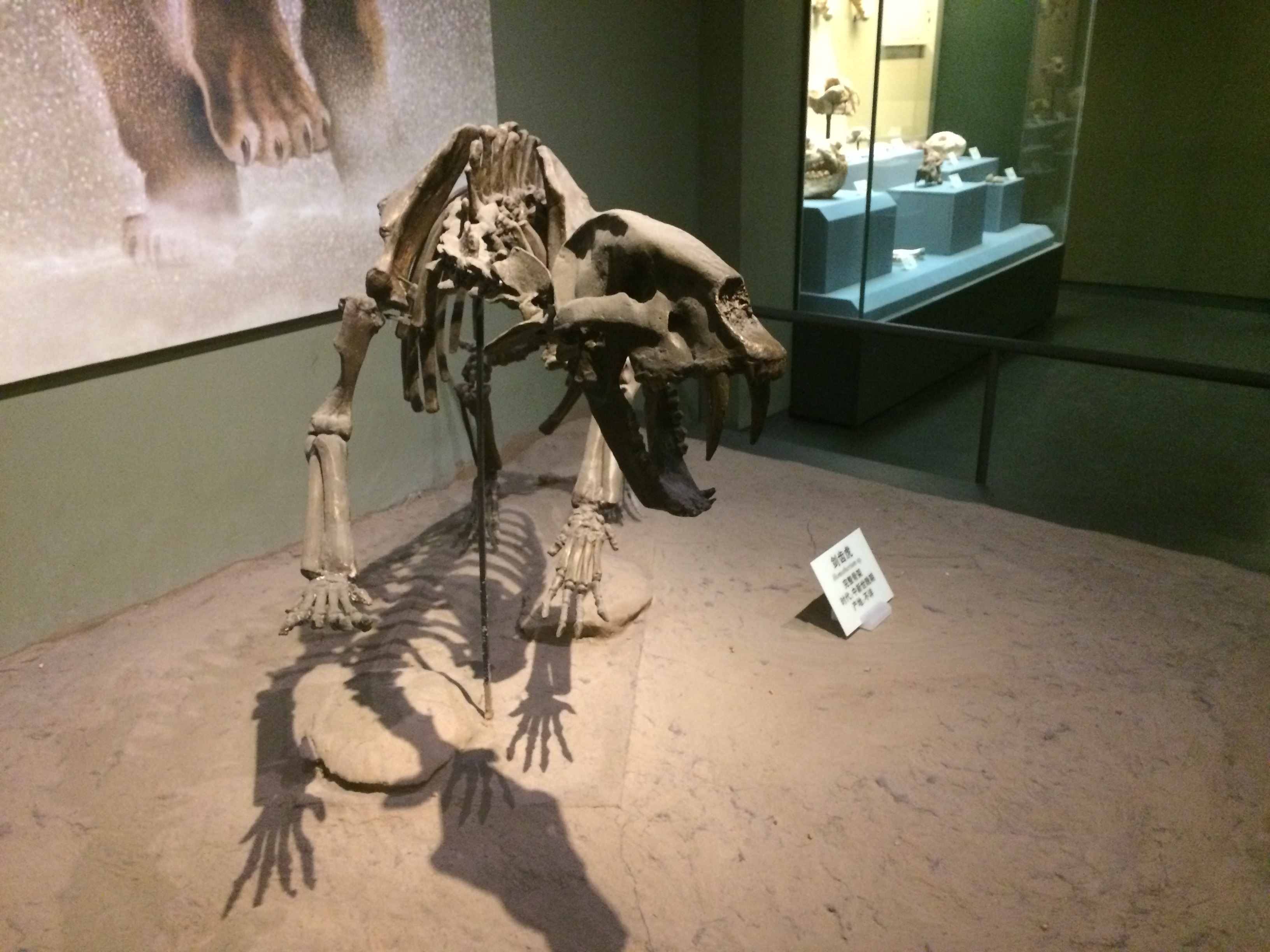
The Cenozoic gallery anchors its narrative in the rise of mammals, with a central display tracing proboscidean evolution from the shovel-tusked Platybelodon through the massive Stegodon to a woolly mammoth. Saber-toothed Homotherium prowls nearby. A display on whale evolution tracks the improbable journey from land-dwelling ancestors to ocean giants. The human story arrives with busts and casts of Peking Man, the Homo erectus specimens originally discovered at Zhoukoudian near Beijing, connecting this museum to one of the most significant paleoanthropological finds in history.
Seven Continents Under One Roof
The third floor turns from deep time to present ecology. Spanning 3,400 square meters, the Earth's Ecology exhibition features over 200 rare wild animal specimens donated by Tianjin honorary citizen Kenneth Behring, displayed alongside the museum's own collection. Seven sections transport visitors from the ancient marsupials of Australia to the rainforests of South America, from the wide-open landscapes of North America to the ice of Antarctica and the melting glaciers of the Arctic. Africa's savannas and the forests and steppes of Eurasia complete the circuit. It is a global survey of ecosystems, a reminder that the same evolutionary forces Licent spent decades tracking through China's river basins have shaped every corner of the planet.
From the Air
Located at 39.09N, 117.21E in Tianjin's Hexi District, within the Tianjin Cultural Center complex. Tianjin Binhai International Airport (ZBTJ) is approximately 17 km to the east. The Cultural Center area is identifiable from the air as a cluster of modern public buildings. Best viewed at 3,000-5,000 feet altitude.