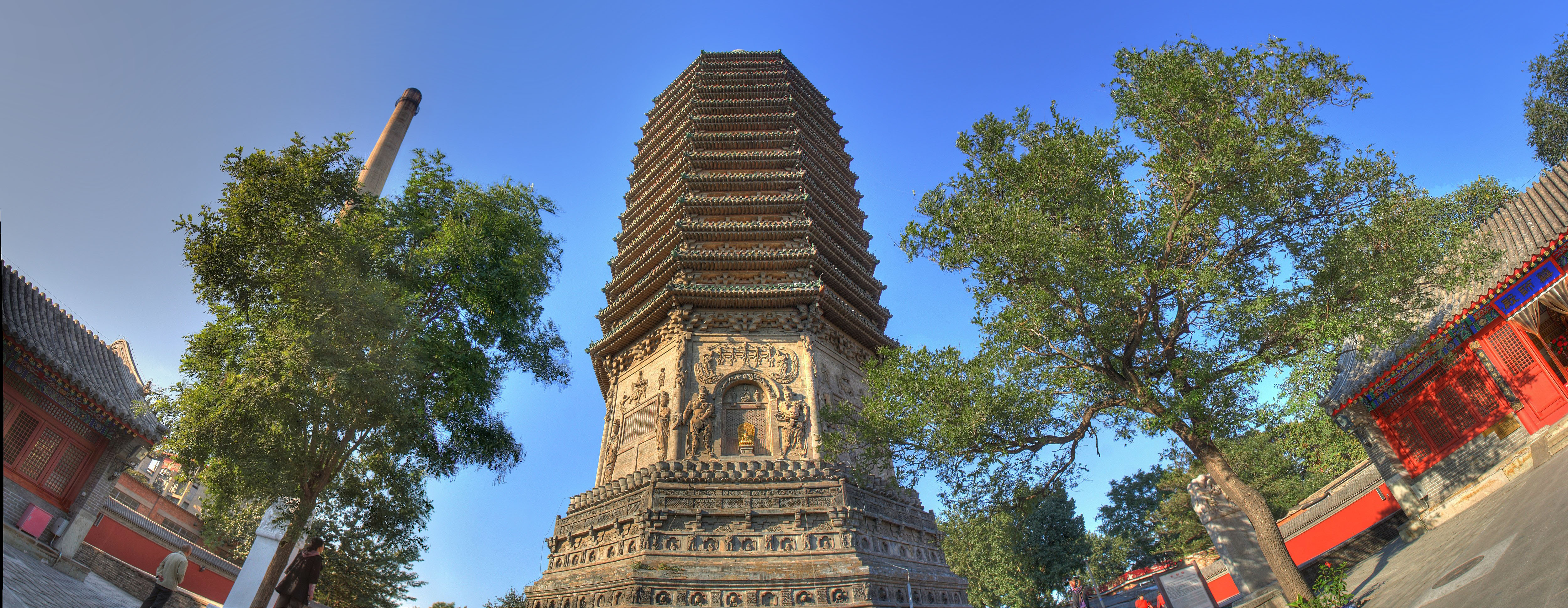
Tianning Temple (Beijing)
The pagoda is solid. No staircase spirals upward through its interior, no hollow chamber waits inside. Thirteen stories of brick and stone rise 57.8 meters above Xicheng District, and every centimeter of it is mass -- a tower built not for climbing but for contemplation. The Pagoda of Tianning Temple has stood in Beijing for nine centuries, outlasting the dynasty that built it, the dynasty that conquered it, and the earthquake that snapped off its crown.
The Last Monument of a Dying Dynasty
Construction began around 1100 CE during the Liao dynasty, a Khitan empire that controlled northern China. The pagoda was completed by 1119 or 1120, just years before the Liao fell to the invading Jin dynasty. It stands as one of the final architectural achievements of a civilization about to be erased from the map. The octagonal tower rises from a large square platform, its base shaped like a sumeru pedestal -- the cosmic mountain of Buddhist cosmology. Though made entirely of brick and stone, the builders gave it ornamental dougong, the interlocking bracket supports characteristic of wooden Chinese architecture. The effect is a stone tower that remembers being made of wood, a deliberate echo of an older building tradition already ancient when the pagoda was new.
Stone Guardians and Silent Verandas
Walk around the base and you encounter arched doorways that lead nowhere -- decorative portals carved into solid mass. Heavenly Buddhist guardians flank these false entrances, their stone faces worn smooth by nine centuries of Beijing weather. A veranda with banisters encircles the tower, offering the illusion of a walkable gallery on what is, in reality, an impenetrable block. This design paradox -- a building that invites approach but denies entry -- influenced later Chinese pagoda construction. The Ming dynasty's Pagoda of Cishou Temple, built in 1576 in Beijing, borrowed directly from the Tianning model, replicating its proportions and ornamental logic nearly five centuries after the original was completed.
Shaken but Standing
On July 28, 1976, the Tangshan earthquake -- one of the deadliest in recorded history -- struck northeastern China with a magnitude of 7.5. The tremor reached Beijing with enough force to snap the pearl-shaped steeple from the pagoda's summit, sending it crashing to the ground. The body of the tower held. It was later restored, the steeple replaced, and the surrounding temple grounds renovated. These grounds had already been rebuilt multiple times during the Ming and Qing dynasties, but the pagoda itself retained its original Liao-era structure and ornamentation through every reconstruction. The architectural historian Liang Sicheng, who spent his career documenting China's oldest surviving wooden structures, called the pagoda a pristine architectural design of antiquity -- high praise from a man who had seen the best the country had to offer.
Nine Hundred Years in a Changing City
Beijing has demolished and rebuilt itself many times since the Liao dynasty. The Jin capital of Zhongdu rose and fell. The Mongols built Dadu to the northeast. The Ming raised the Forbidden City. Modern highways now ring the ancient core. Through all of it, the Tianning pagoda has remained, a fixed point in a city defined by transformation. The Buddhist temple complex around it continues to function, its incense smoke rising past the same octagonal silhouette that Liao-era worshippers would recognize. At 57.8 meters, it is no longer tall by Beijing standards. But height was never the point. The pagoda endures because it was built to be permanent -- not in the way of monuments that declare their importance, but in the quiet way of stone that simply refuses to move.
From the Air
Located at 39.894N, 116.340E in Beijing's Xicheng District, southwest of the Forbidden City. The 57.8-meter octagonal pagoda is visible from moderate altitude against the surrounding urban landscape. Look for it near the intersection of major roads south of the Second Ring Road's western section. Nearest airports: Beijing Daxing International (ZBAD) approximately 45 km south, Beijing Capital International (ZBAA) approximately 30 km northeast. Best viewed at 2,000-4,000 ft AGL.