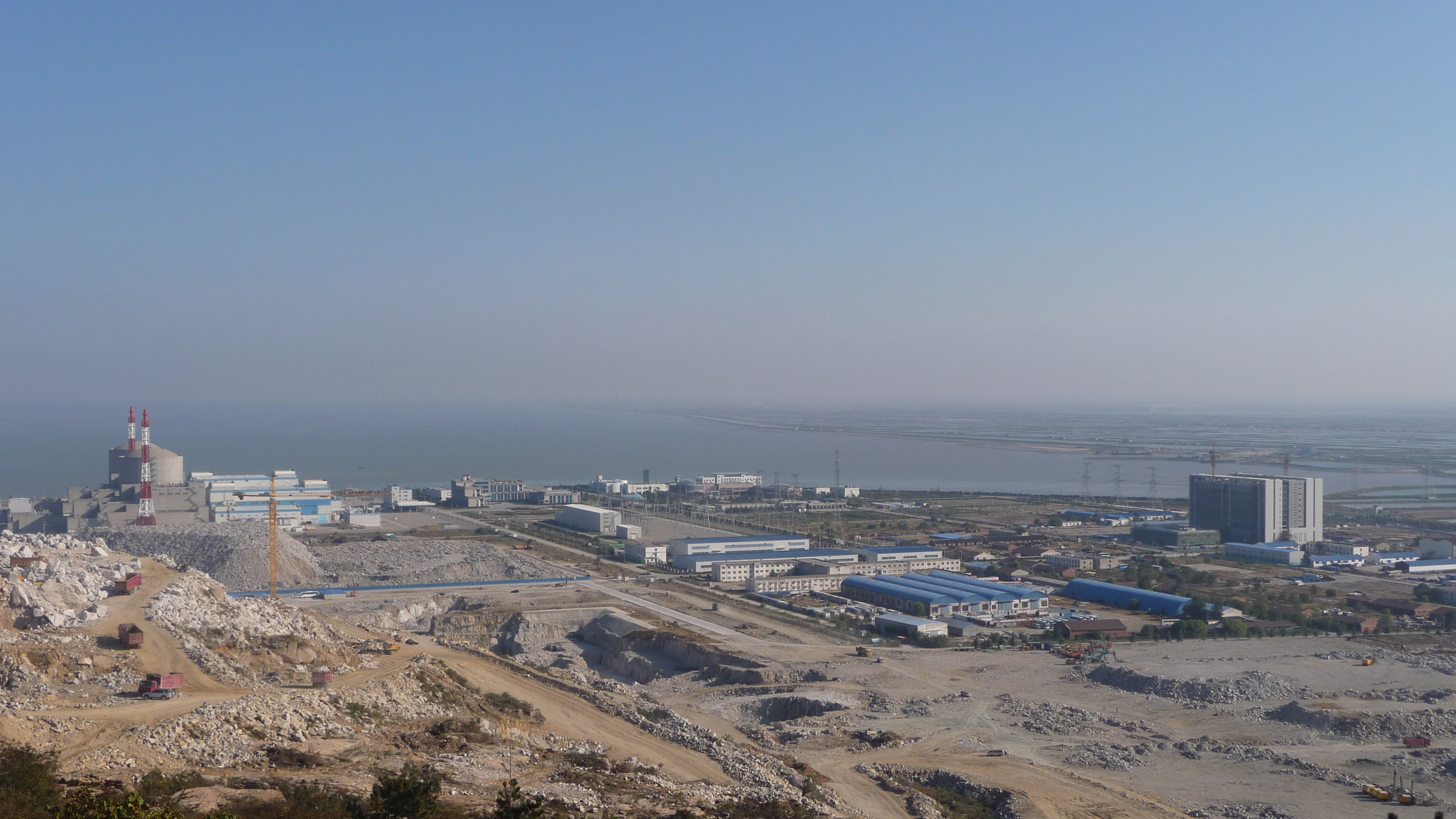
Tianwan Nuclear Power Plant
Thirty kilometers east of Lianyungang, on a stretch of Yellow Sea coastline where Jiangsu Province meets the Pacific, eight reactor domes are rising in stages toward a record. When the last two units at Tianwan Nuclear Power Plant achieve commercial operation -- expected by 2027 -- the facility will surpass both South Korea's Kori plant and Japan's Kashiwazaki-Kariwa to become the world's largest nuclear power station, with generation capacity exceeding 9,000 megawatts. It is a distinction born from a 1992 handshake between Russia and China, and three decades of construction that have unfolded across the end of one era and the beginning of another.
A Cold War Technology in a New Century
Tianwan's reactor design tells the story of its origins. The first four units use Russia's VVER-1000 pressurized water reactors, each producing approximately one gigawatt of electrical power -- proven Soviet-era technology supplied by Atomstroyexport and built to withstand a 20-ton aircraft impact. The reactors include an emergency "core catcher," a safety feature designed to contain molten fuel in the event of a meltdown. Construction began in October 1999, making Tianwan the first instance of civilian nuclear cooperation between Russia and China. Units 5 and 6 broke the pattern: these are Chinese-designed ACPR-1000 reactors, signaling a shift from imported technology to domestic capability. Units 7 and 8 will return to Russian technology, using the updated VVER-1200 design with twice the operational lifetime and a slower refueling cycle.
Building by Decades
The plant's construction timeline reads like a compressed history of modern Chinese industry. The 1992 cooperation agreement took seven years to produce the first concrete pour in 1999. Jiangsu Nuclear Power Corporation signed contracts for units 3 and 4 in 2009, and by 2015 and 2016, China National Nuclear Corporation was starting construction on units 5 and 6. Unit 3 achieved criticality in 2017, and Atomstroyexport transferred control to its Chinese counterpart the following January. Unit 5 reached criticality in 2020, unit 6 entered commercial operation in June 2021, and units 7 and 8 began construction in 2021 and 2022 respectively. Each phase has been faster and more confident than the last, reflecting China's growing nuclear engineering expertise.
Ownership and Investment
Tianwan is owned by Jiangsu Nuclear Power Corporation, a joint venture split among China National Nuclear Power at fifty percent, Shanghai HeXi Power Investment at thirty percent, and Jiangsu Guoxin Group at twenty percent. The financial scale matches the engineering ambition -- Phase II alone, covering two VVER-1000 units, carried an estimated cost of six billion dollars. For the first four units, Russia's Rosatom supplied the reactors while Atomstroyexport designed the complete installations. The transition to domestically designed units for Phase III represented not just an engineering milestone but an economic one, keeping more of the investment within China's nuclear supply chain.
Power on the Pacific Rim
From the air, Tianwan presents itself as a row of containment domes along the coast, their white curves stark against the blue of the Yellow Sea. The plant generates electricity for the Jiangsu grid, one of China's most energy-hungry provincial networks, powering the factories, cities, and data centers of the Yangtze River Delta. Its location on the coast provides the cooling water that nuclear plants require, while the seismic protections built into its Russian-designed containment shells address the geological realities of building on the Pacific Rim. As China's nuclear fleet continues to expand -- the country has more reactors under construction than any other nation -- Tianwan stands as both the largest single installation and a template for what comes next.
From the Air
Located at 34.69°N, 119.46°E on the Yellow Sea coast, approximately 30 km east of Lianyungang. The plant's containment domes are visible from altitude as a row of large white structures along the shore, with associated cooling infrastructure and transmission lines. Nearest airport: Lianyungang Huaguoshan International Airport (ZSLG/LYG), approximately 25 km to the west. Restricted airspace likely surrounds the facility. At 10,000+ feet, the plant and its coastal setting are clearly visible.