Tibet (1912–1951)
In 1912, Tibet began printing postage stamps. They featured the Snow Lion, the symbol of Tibetan statehood, and they were issued by a government that no major power formally recognized as sovereign. This contradiction defined the next four decades. Between the fall of the Qing dynasty in 1912 and the Chinese annexation in 1951, Tibet operated as a de facto independent state - maintaining its own army, issuing its own currency, conducting its own foreign relations - while existing in a legal gray zone that world powers found convenient to leave unresolved. It was a nation in practice and an ambiguity in law, and that ambiguity would prove fatal.
The 13th Dalai Lama's Gamble
When the Qing dynasty collapsed in 1911, Chinese forces lost ground control beyond the city of Kangding, and Tibet seized the moment. The 13th Dalai Lama assumed full control and began building a modern state, starting with the army. With British advisors and weapons from the United Kingdom, he expanded the Tibetan Army to roughly 10,000 soldiers by 1936 - adequately armed infantry for the time, though the force almost completely lacked machine guns, artillery, aircraft, and tanks. In addition to regulars, Tibet relied on large numbers of poorly armed village militias. The army performed relatively well against Chinese warlords in the 1920s and 1930s, and its soldiers were described as "fearless and tough fighters" during the Warlord Era. But the 13th Dalai Lama's ambitions extended beyond defense. He attempted to conquer surrounding regions like Kham, inhabited by Tibetan peoples but controlled by various Chinese factions. In 1932, this overreach backfired: the Muslim Qinghai army under Ma Bufang and the Han-Chinese Sichuan army under Liu Wenhui defeated the Tibetan forces in the Sino-Tibetan War. The Dalai Lama cabled the British in India for help. None came.
A Nation Without Recognition
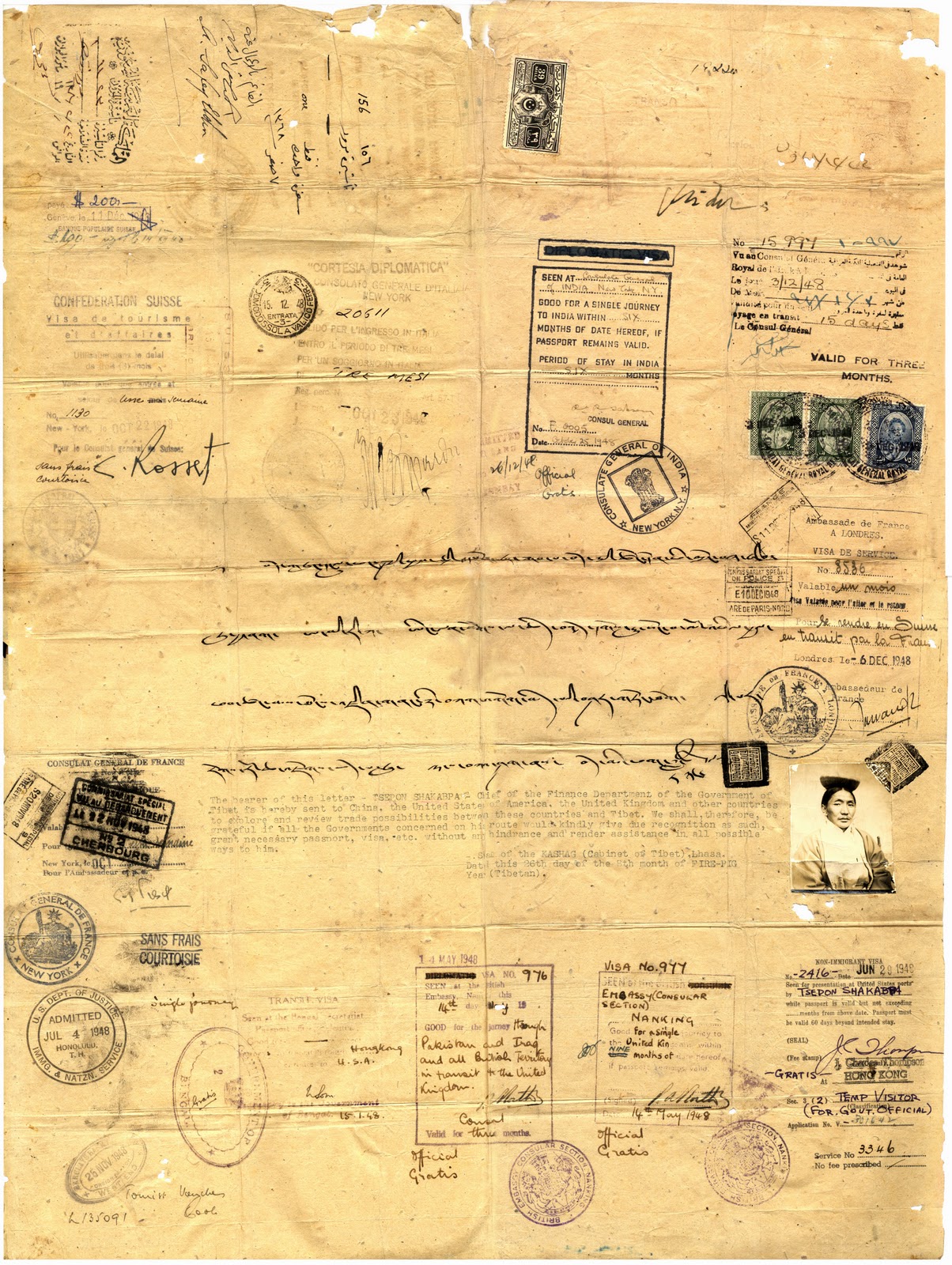
Tibet established a Foreign Office in 1942 and sent diplomatic missions abroad. In 1946, it dispatched congratulatory delegations to both China and India following the end of World War II. The mission to China carried a letter addressed to Chiang Kai-shek stating bluntly: "We shall continue to maintain the independence of Tibet as a nation ruled by the successive Dalai Lamas through an authentic religious-political rule." The mission then agreed to attend a Chinese constitutional assembly in Nanjing - but only as observers, not participants. In 1947, Tibet sent a delegation to the Asian Relations Conference in New Delhi, where it represented itself as an independent nation and displayed its flag at a public gathering, possibly for the first time internationally. India treated Tibet as autonomous but never formally recognized it as independent; in 1954, India explicitly recognized Tibet as part of China via the Panchsheel Agreement. Yet formal sovereignty eluded Tibet. In 1942, the United States told Chiang Kai-shek's government it had never disputed Chinese claims over Tibet. Britain maintained it recognized Chinese "suzerainty" over Tibet, provided Tibet was treated as autonomous. This distinction between sovereignty and suzerainty would prove to be no protection at all.
Warlords, Borders, and a Feudal Society
Tibet's borders during this period were contested and fluid. The government in Lhasa controlled all of U-Tsang and western Kham - roughly the territory of today's Tibet Autonomous Region. Eastern Kham, separated by the Yangtze River, was under the Chinese warlord Liu Wenhui. Qinghai fell to the Hui Muslim warlord Ma Bufang. Southern Kham shifted between Yunnan clique governors. Within this patchwork, Tibet's society was structured around a feudal system that the 13th Dalai Lama had partially reformed in the early 20th century. Estates called shiga functioned similarly to the English manorial system, with hereditary landholdings that were revocable by the state. Tibetans outside the nobility and the monasteries were classified as serfs, though two distinct types existed, both closer in function to tenant farmers than to chattel. Agricultural serfs had title to their own plots and could accumulate wealth; village serfs were bound only for tax and labor duties. By 1950, slavery had probably ceased in central Tibet, though it persisted in border areas. The Dalai Lamas themselves were recruited from peasant families, and the sons of nomads could rise through the monastic system to become scholars and abbots.
The End at Chamdo
In 1949, the newly formed People's Republic of China began reasserting its claims. The Kashag government expelled all Chinese officials from Tibet, but the gesture was symbolic against a rising power. In October 1950, the People's Liberation Army entered the Tibetan area of Chamdo, defeating sporadic resistance from an army that, however brave, was wholly outmatched. The Tibetan Army disintegrated. In 1951, representatives led by Ngapoi Ngawang Jigme, with the Dalai Lama's authorization, negotiated in Beijing. The result was the Seventeen Point Agreement, which affirmed Chinese sovereignty over Tibet. China described it as the "peaceful liberation of Tibet." The four decades of de facto independence were over. The Snow Lion stamps, the army that fought warlords, the Foreign Office that sent missions to Delhi and Nanjing, the flag that flew at the 1947 Asian Relations Conference - all became artifacts of a state that the world had been content to acknowledge but never to protect.
From the Air
This article covers the political entity of Tibet from 1912-1951, centered on Lhasa at approximately 29.60N, 91.10E at 3,650m elevation. The territory roughly corresponds to today's Tibet Autonomous Region. Key cities include Lhasa (the capital), Shigatse, and Chamdo (the site of the 1950 PLA invasion). Lhasa Gonggar Airport (ZULS) is the primary airport in the region. Expect high-altitude conditions across the entire Tibetan Plateau.