Tiger Cave Temple
Exactly 1,260 steps. That is what stands between the parking lot of Wat Tham Suea and the golden Buddha at its summit, 278 meters above the Krabi lowlands. Some of the stair risers exceed 30 centimeters, turning the ascent into something closer to ladder-climbing than walking. Monkeys watch from the railings with studied indifference. The tropical heat is relentless. And yet people keep climbing, because the temple at the top is not really about the temple at the top. It is about what the climb does to you on the way there.
Tigers Real and Imagined
The temple's origin story begins in 1975, when a Vipassana meditation monk named Jumnean Seelasettho, known as Ajahn Jumnean, came to meditate in the caves at the mountain's base. During his practice, he reported seeing tigers roaming the cave. Whether the tigers were physical animals, meditative visions, or something in between depends on who tells the story. Another account holds that a large tiger once lived in the cave system. What is certain is that tiger paw prints mark the cave walls, and the cave's interior bulge resembles a tiger's paw, giving the temple its name: Wat Tham Suea, the Tiger Cave Temple. The multiple layers of the name's origin, part natural history, part legend, part pattern recognition in stone, feel appropriate for a place that blurs the line between the physical and the spiritual.
The Forest Below
Before the stairs begin their punishing ascent, the temple grounds spread through the Kiriwong Valley, a pocket of tropical rainforest dense with old-growth trees. A separate, gentler stairway of 184 steps leads to the foothills where monks live in the caves, practicing the same Vipassana meditation that drew Ajahn Jumnean half a century ago. The cave system extends through several chambers: Tum Khon Than, Tum Lod, Tum Chang Kaeo, and Tum Luk. Archaeologists have found stone tools, pottery shards, and molded Buddha footprints here, evidence that humans have been drawn to these caves for reasons both practical and sacred across centuries. The forest canopy closes overhead, and the air thickens with moisture and the calls of unseen birds. This lower level of the temple is its contemplative heart, a place where stillness comes naturally.
The Climb That Teaches Patience
The staircase was originally built with 1,237 steps, later rebuilt and extended to 1,260. There is no shortcut, no cable car, no alternative route. The stairs rise steeply through jungle, the treads uneven, the risers occasionally brutal. Macaques occupy the lower reaches, lounging on handrails and picking through the belongings of climbers who pause too long. Higher up, the jungle thins and the air opens. The climb takes most people between 45 minutes and an hour, depending on fitness and willingness to stop. Buddhist pilgrimage has always involved physical effort as spiritual practice, and Wat Tham Suea takes that principle literally. Each step is a small decision to continue. By the time the summit platform appears, the effort has stripped away distraction in a way that air-conditioned transport never could.
Gold Against Green
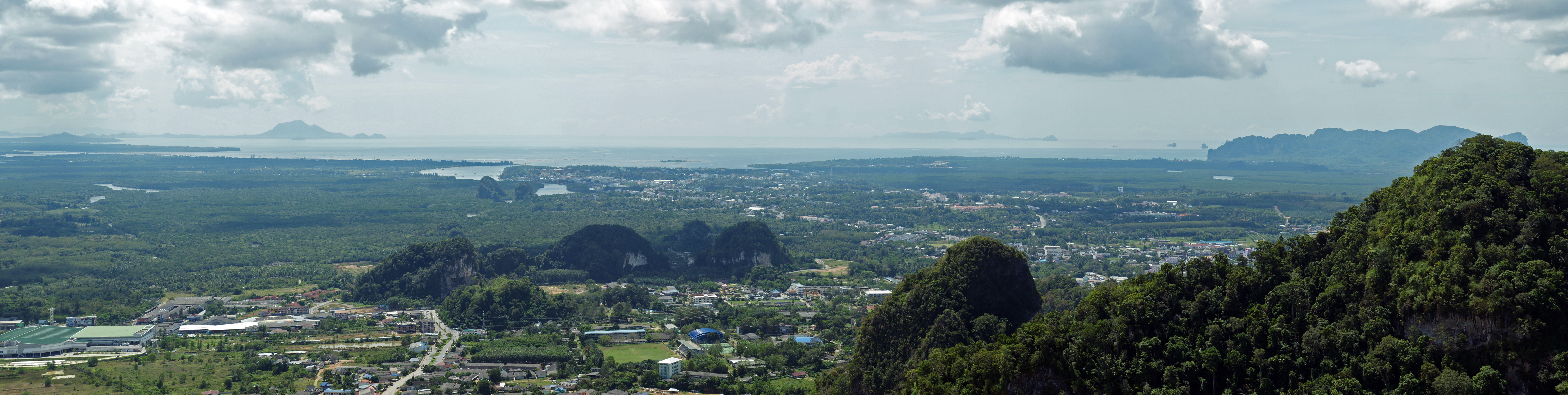
At the summit, a large golden Buddha sits in meditation posture, facing the Krabi lowlands. The view unfolds in every direction: the town of Krabi to the south, mangrove-fringed coastline beyond, and the karst limestone peaks that define this region scattered across the horizon like broken teeth. On clear days, the Andaman Sea glints in the distance. The statue and its surrounding shrine are modest by Thai temple standards, but their placement transforms them. After the climb, the simplicity feels intentional, a reminder that the destination matters less than arriving ready to see it. Other temple buildings cluster nearby, but most visitors are drawn to the overlook, where the scale of the landscape reduces everything, the effort, the heat, the aching legs, to a footnote.
From the Air
Located at 8.12N, 98.93E, approximately 7 km north-northeast of Krabi town center in southern Thailand. The temple sits on a prominent limestone karst hill rising 278 meters above the surrounding flat terrain, making it visible as a forested peak with a golden glint at its summit. Krabi Airport (VTSG) is about 12 km to the east. The surrounding landscape is a mix of lowland jungle and dramatic karst formations typical of the Krabi-Phang Nga region. The Andaman Sea coastline is visible to the west.