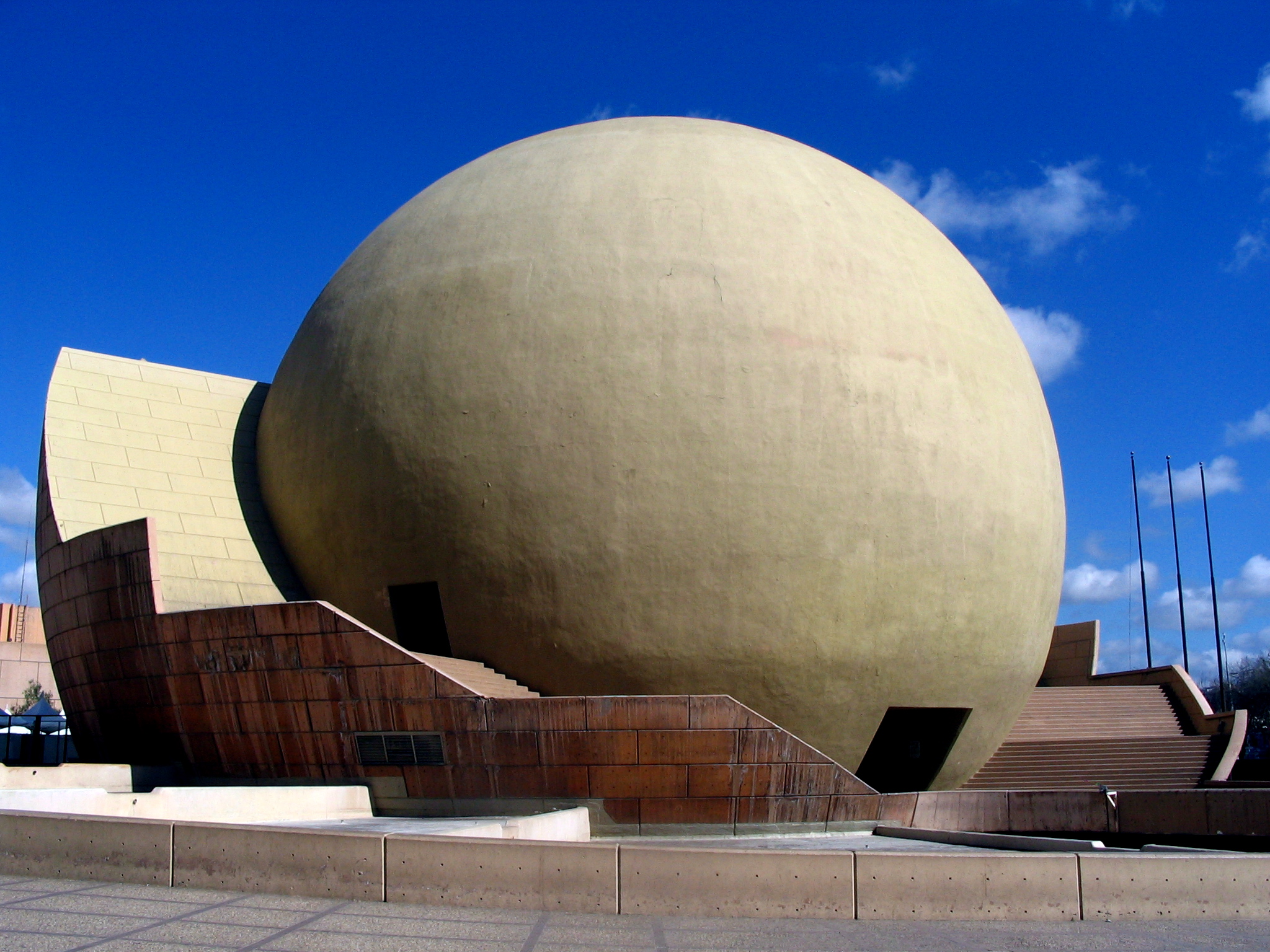
Tijuana Cultural Center
Opened in 1982, the Tijuana Cultural Center — known as CECUT — anchors the Zona Río district with its striking spherical OMNIMAX cinema and stands as a symbol of Tijuana's identity as a city of culture, not just a border crossing.
La Bola: The Sphere That Defines a Skyline
From across the river valley, you can see it before you can read any signs or identify any streets: a perfect sphere rising above the flat-roofed commercial buildings of Zona Río. Locals call it 'La Bola' — the ball — and it has become one of Tijuana's most recognizable landmarks.
The sphere houses the OMNIMAX theater, a domed projection space that opened in 1982 as part of the Centro Cultural Tijuana, commonly known as CECUT. The center was inaugurated on October 20, 1982, at a moment when Tijuana was asserting itself not just as a gateway city but as a cultural destination in its own right. The sphere and its companion buildings — galleries, performance spaces, a museum of Mexican history — were designed to declare that this border city had something to say about art and identity.
The Purpose Behind the Architecture
CECUT was built with a clear intention: to give Tijuana a cultural center worthy of its population and its position as one of the most-visited cities on earth. By the early 1980s, millions of people crossed into Tijuana every year, but most of them came for commerce, nightlife, or transit. The cultural center was meant to offer something different — a space that told the story of Baja California and Mexico through art, museum exhibits, and live performance.
The main building houses a museum of Mexican history that traces the country's timeline from pre-Columbian civilizations through the modern era. Temporary exhibitions rotate through the gallery spaces, featuring Mexican and international artists. The Sala de Espectáculos hosts concerts, theater, and dance performances. At its peak, CECUT draws over a million visitors a year, making it one of the most-visited cultural institutions in Mexico.
A Border City's Cultural Declaration
Tijuana occupies a complicated position in the cultural imagination. For decades it was defined from the outside — a city of bars, souvenirs, and illicit pleasures glimpsed by American tourists who crossed for a few hours and returned home. That narrative obscures a richer reality: Tijuana is a city of more than two million people with its own arts scene, cuisine, music, architecture, and intellectual life.
CECUT was partly a counter-narrative to the border city clichés. It sits in Zona Río, the district that grew up after the canalization of the Tijuana River in the 1970s redirected the watercourse and opened land for development. The cultural center became the neighborhood's civic anchor. The location — 2.1 kilometers from the US border — means that visitors arriving from San Diego can reach it within minutes of crossing.
For the people of Tijuana, CECUT is simply part of the city. School groups visit for history lessons. Families come for performances. The sphere on the skyline is a point of orientation, a familiar shape that tells you where you are.
What Passes Through Here
The US-Mexico border at Tijuana-San Ysidro is the busiest land crossing in the Western Hemisphere. Hundreds of thousands of people pass through each week — commuters, families, tourists, workers. The cultural distance between the two sides of that crossing is often depicted as enormous, but CECUT quietly argues otherwise.
The exhibits here focus on shared histories as much as distinct ones. The programs are bilingual. The performances draw audiences from both sides of the border. The OMNIMAX theater plays documentary films to audiences that include San Diegans who crossed for an evening.
In a city that the world mostly knows as a crossing point, the Tijuana Cultural Center insists on a different identity: a place where culture is made and kept, where the story of a people is told on their own terms.
From the Air
CECUT is located in Tijuana's Zona Río district, approximately 2.1 kilometers south of the US-Mexico border. Flying south from KSAN (San Diego International Airport), you cross the border within minutes; the spherical OMNIMAX dome of La Bola is visible in the river valley below as you approach Tijuana. The Tijuana International Airport (MMTJ) is roughly 5 kilometers to the east.