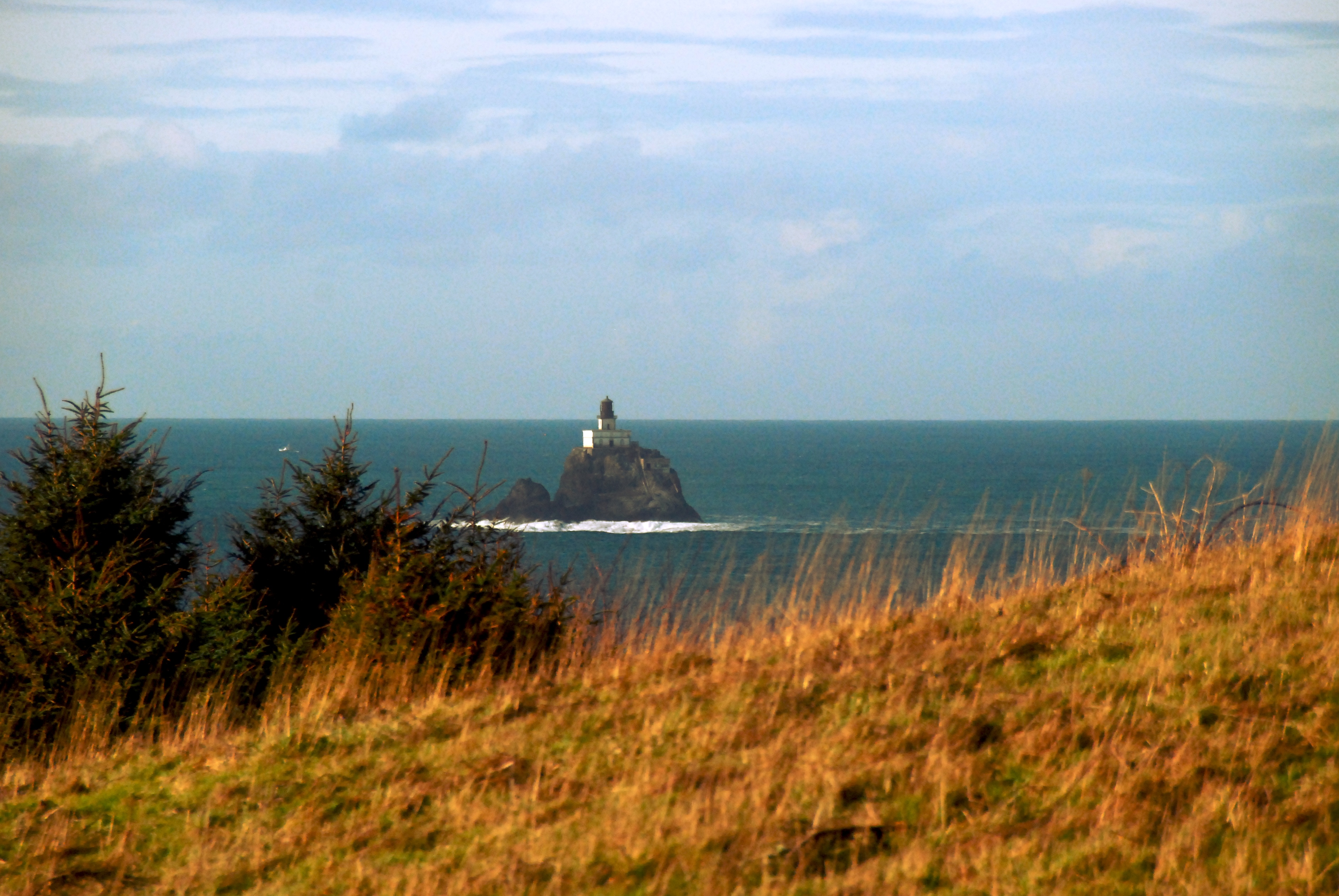
Tillamook Rock Light
They built the lighthouse on a rock the size of a large parking lot, 1.2 miles off the Oregon coast, in seas so violent that the construction took more than 500 days. Before the light was even finished, the barque Lupatia struck near the rock in fog and sank with all sixteen crew members aboard. Only the ship's dog survived. When Tillamook Rock Light was finally lit on January 21, 1881, it was the most expensive lighthouse ever built on the West Coast. The keepers who manned it earned every penny of their pay, and they gave it a name that stuck: Terrible Tilly.
The Wrong Location, Chosen Right
Congress originally appropriated $50,000 in 1878 for a lighthouse atop Tillamook Head, the 1,200-foot promontory visible from Seaside. A survey quickly revealed the problem: the headland was so tall that fog would swallow any light placed on its summit. The alternative was worse in every practical sense but better for navigation -- a jagged basalt rock sitting in open ocean, barely an acre in size, fully exposed to the Pacific. H. S. Wheeler led the survey aboard the cutter Thomas Corwin in 1879, and the U.S. Army Corps of Engineers began construction under George Lewis Gillespie Jr. The final cost reached $125,000, more than double the original appropriation. The light's beam could reach ships eighteen miles out, and a steam foghorn warned them when the beam could not.
Seventy-Six Years of Punishment
Four keepers staffed Tillamook Rock Light at any given time, isolated on their acre of basalt with nothing between them and the storms rolling in from the Pacific. Over the decades, waves shattered the lens, damaged the structure, and eroded the rock itself. Repairs cost $12,000 and were not fully completed until February 1935 -- more than fifty years after the light first shone. The keepers' commute was a journey by boat through unpredictable surf, or later, by helicopter when weather permitted. The lighthouse operated for seventy-six years before being decommissioned in 1957, replaced by more modern navigation aids that did not require people to live on an exposed rock in the open ocean.
From Beacon to Burial Ground
After decommissioning, Terrible Tilly passed through the hands of several private owners, each inheriting a structure that the sea was steadily reclaiming. In the 1980s, a company called Eternity at Sea converted the lighthouse into a columbarium -- a repository for cremated remains. For nearly two decades, urns were placed inside the battered walls where keepers had once maintained their vigil. The columbarium operation ended in 1999, but the ashes remain. In 2022, the property was listed for sale again, its buildings in need of complete renovation after decades of damage from storms, nesting seabirds, and sea lions that have claimed the rock's lower surfaces. Access is limited to helicopter only, and even the owners cannot visit during nesting season.
Still Standing, Barely
Tillamook Rock Light was added to the National Register of Historic Places in 1981, exactly one hundred years after its first beam swept the ocean. It is part of the Oregon Islands National Wildlife Refuge, which means the seabirds that nest on its surfaces have more legal protection than the building itself. The lighthouse remains visible from Seaside, Cannon Beach, and the trails of Ecola State Park -- a dark shape on the horizon that looks, from a distance, like it could be a natural feature of the rock rather than something humans once spent 500 days and a fortune constructing. That illusion is fitting. Terrible Tilly has always been more rock than lighthouse, more nature than engineering. The Pacific built it, in a geological sense, and the Pacific is slowly taking it back.
From the Air
Tillamook Rock Light sits at 45.94N, 124.02W on a small basalt rock approximately 1.2 miles offshore from Tillamook Head. From the air, look for the distinctive lighthouse structure on an isolated rock west-southwest of Seaside. The rock is tiny -- less than an acre -- and the lighthouse is the only structure. Tillamook Head (1,200 ft) rises prominently on the nearby coastline. Nearest airports: Seaside Municipal (56S) 6nm northeast, Astoria Regional (KAST) 18nm north. Marine fog and strong winds are common year-round.