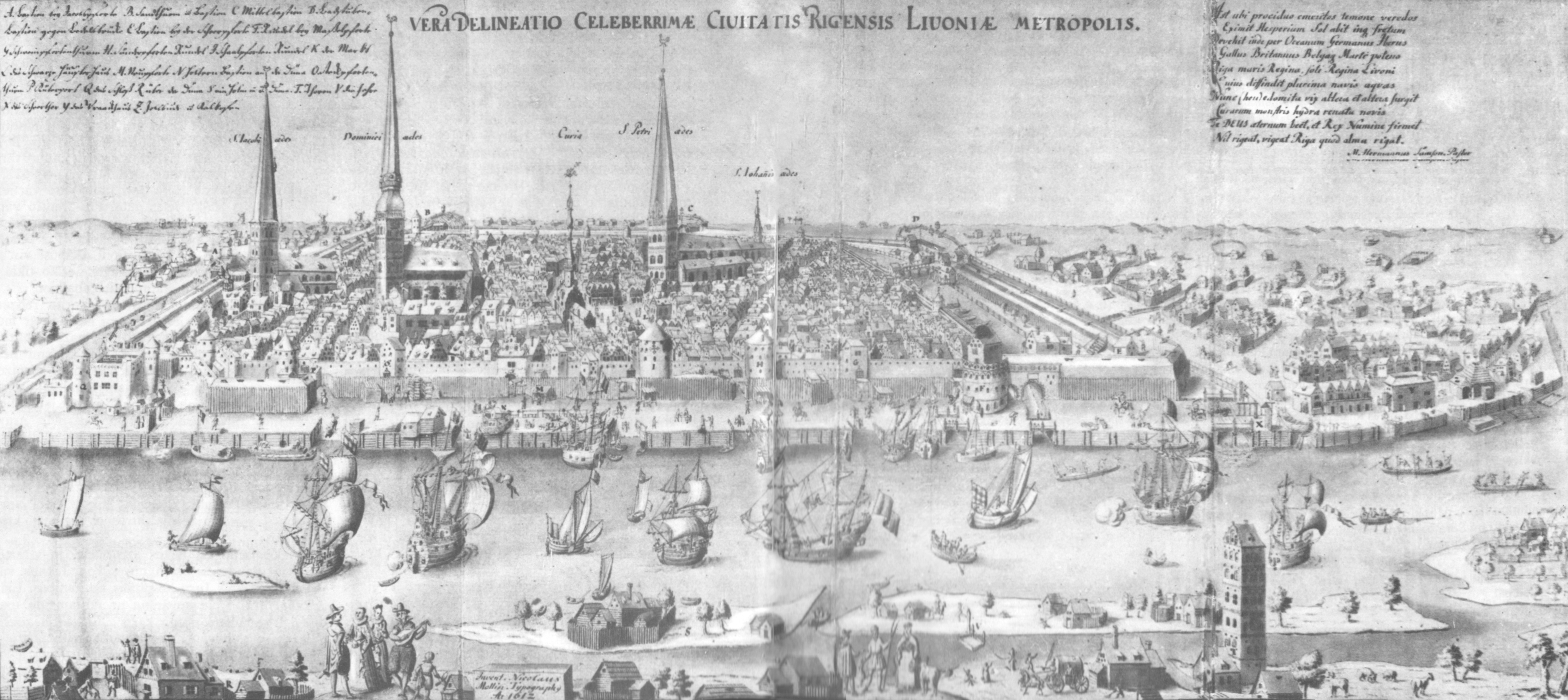
Timeline of Riga
An Augustinian monk named Meinhard climbed out of a longboat at the mouth of the Daugava in 1184 and began preaching Christianity to the Liv people who lived on the riverbanks. He promised them, around 1185, that if they accepted baptism he would build them a stone castle for protection from raids. They were skeptical. Fourteen years later, in 1198, the German bishop Berthold of Hanover arrived with a crusader army and was killed in a fight with a Liv warrior named Imaut. In the chronicle account of that fight, the place name Riga appeared in writing for the first time. The town that would carry that name through the next eight centuries was, from its very first sentence, contested ground.
The Bishop's Town (1201 to 1561)
Bishop Albert of Buxhoeveden arrived in 1200 with a thousand men in twenty-three ships. By 1201 he had founded the town and moved the bishopric of Livonia to it from Üxküll. He built a permanent military force, the Livonian Brothers of the Sword, modeled on the Templars. St. Peter's Church was active by 1209. By 1225 a town council met. In 1282 Riga signed an alliance with Lübeck and Visby and joined the Hanseatic League — and for nearly three centuries it traded amber, fur, wax, and grain across the Baltic. The Black Death arrived around 1350. The Reformation arrived in 1521 with the chaplain Andreas Knöpken's sermons; by 1524 iconoclast riots had stripped the city's Catholic churches. In 1561 Gotthard Kettler swore vassalage to Poland and the medieval bishopric ended.
Polish, Then Swedish, Then Russian (1581 to 1710)
Stephen Báthory of Poland-Lithuania entered Riga in 1582 and tried to push the city back toward Catholicism, ordering churches returned to the Jesuits and the Gregorian calendar imposed. The Calendar Riots of 1584 lasted five years. In 1621 Gustavus Adolphus took the city for Sweden, beginning a near-century of Swedish rule that left its mark in fortifications and in the Swedish Gate, built in 1698, that still pierces the old town wall. Then came Peter the Great. In 1710, after a brutal siege and a plague that halved the city's population from ten thousand to five thousand, Riga surrendered to Boris Sheremetev. By the Treaty of Nystad in 1721 it formally joined the Russian Empire, and it would remain Russian for almost two centuries — Riga, Riga, Рига, the same harbor under different flags.
The Industrial Capital
Under the Romanovs, Riga became one of the great commercial cities of the empire. Population: 70,463 in 1857. The fortifications came down in 1858, opening the city to the boulevard ring that still defines its center. The first railway to Daugavpils opened in 1861, the Polytechnical Institute the following year, the City Theatre in 1863. By 1897 the population had reached 282,943, and by 1914 it stood at 569,100 — a city of port workers, Latvian factory hands, German merchants, Russian administrators, and a substantial Jewish community. The Art Nouveau buildings that line Alberta and Elizabetes Streets, with their cats and screaming faces and writhing women, date from this period and remain one of Europe's densest concentrations of the style.
Independence, Occupation, Independence Again
On 18 November 1918 Riga became the capital of an independent Republic of Latvia. The Freedom Monument, unveiled in 1935, with its bronze figure of Milda holding three stars for the country's three regions, became its symbol. Then came 1940 and the first Soviet occupation. On 13 and 14 June 1941 the Soviets carried out the June deportation, sending thousands of Latvians east in cattle cars. A week later the Wehrmacht arrived, and the next three years brought the murder of nearly all of Riga's Jews — most at Rumbula and Biķernieki forests on the city's edges. On 13 October 1944 the Soviets reoccupied. Forty-six years of Soviet Latvia followed. Then in January 1991 came the Barricades — Rigans piled trucks and stones in the streets to defend the parliament from Soviet special forces — and on 6 September 1991 the USSR recognized Latvia's independence.
The Living City
Pope John Paul II celebrated Mass at St. James's Cathedral and in Mežaparks in September 1993. The Museum of the Occupation of Latvia opened the same year, in a brutalist black box on the edge of the old town. The new National Library of Latvia, the so-called Castle of Light designed by Gunnar Birkerts, was completed in 2014, its mountain of glass facing the old town across the Daugava. In 2022, after Russia's full invasion of Ukraine, the Soviet-era Monument to the Liberators in Pārdaugava — long a flashpoint — was demolished. Today Riga is a city of about 600,000 with a UNESCO-listed old town, a Jugendstil district, and a working port. From the spire of St. Peter's, the river bends west toward the Gulf of Riga, the same river mouth where Meinhard climbed out of his longboat eight centuries ago.
From the Air
Located at 56.949°N, 24.106°E on the Daugava river, about 15 km from its mouth on the Gulf of Riga. From altitude, identify by the wide Daugava splitting the city, the dense pre-war old town on the east bank, and the Soviet and modern districts spreading outward. Riga International Airport (EVRA) is 10 km southwest. Three landmark spires — St. Peter's, the Cathedral, and St. James's — define the medieval skyline.