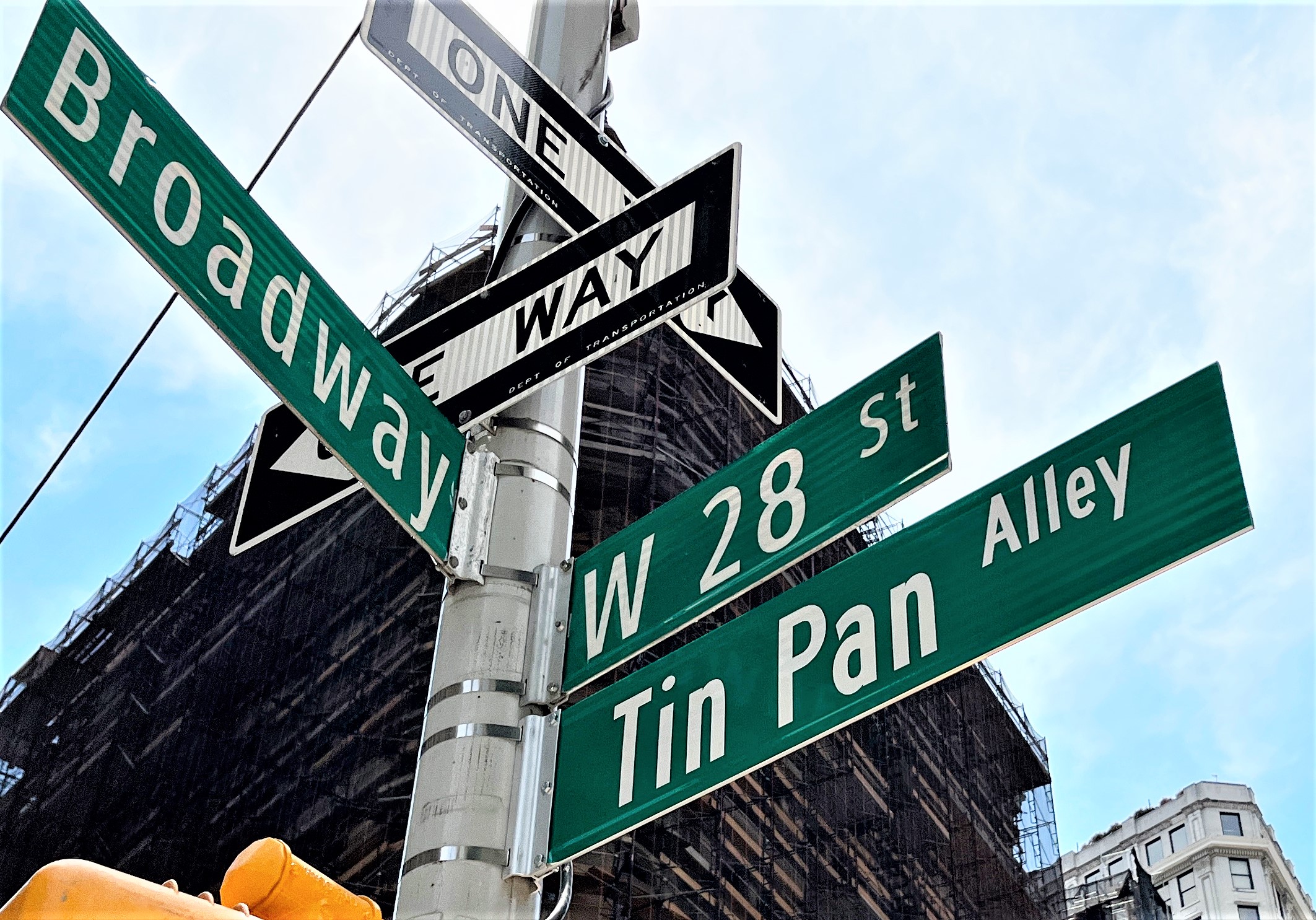
Tin Pan Alley
Harry von Tilzer modified his piano by slipping strips of paper between the hammers and the strings. The result was a tinny, percussive clatter. When a journalist came to interview him about the block of West 28th Street in Manhattan where music publishers clustered their offices, he listened to von Tilzer's altered instrument and said: 'Your Kindler and Collins sounds exactly like a tin can. I'll call the article Tin Pan Alley.' The name stuck — first to the block between Fifth and Sixth Avenues, then to the entire American popular music publishing industry, then to a way of thinking about how songs got made and sold.
The Business of Melody
Tin Pan Alley began around 1885, when music publishers started clustering their offices in the same section of lower Manhattan. The logic was practical: publishers wanted access to the same pool of vaudeville performers, Broadway producers, and working musicians, and songwriters wanted access to the publishers who might buy their compositions. The men who built this industry came from unexpected backgrounds. Isadore Witmark had sold water filters. Leo Feist had sold corsets. Joe Stern and Edward B. Marks had moved neckties and buttons before they moved songs. What they understood, which the previous generation of sheet music publishers had not fully grasped, was that popular music was a product — and like any product, it needed to be demonstrated, promoted, and relentlessly pushed into public consciousness.
Song Pluggers and Boomers
The mechanism for this promotion was the 'song plugger' — a pianist or singer employed by a publisher to play the firm's new songs anywhere an audience might be listening. Most sheet music stores had pluggers on staff. Publishers sent them on the road to seed the public with tunes that hadn't yet become hits. Among those who worked as song pluggers early in their careers were George Gershwin, Harry Warren, and Vincent Youmans. The more aggressive variation was 'booming': buying dozens of tickets to a show, filling the audience with shills, and singing the target song until the crowd couldn't leave without humming it. Louis Bernstein of Shapiro, Bernstein and Company described taking his plugging crew to cycle races at Madison Square Garden, where they had a pianist and a singer with a large amplifying horn. 'We'd sing a song to them thirty times a night,' he recalled. 'When people walked out, they'd be singing the song. They couldn't help it.'
Who Wrote the Songs
The composers who found their way to the publishing houses on 28th Street ranged from formally trained musicians to self-taught immigrants who arrived in New York with nothing except an ability to hear what people wanted to hear. Harold Arlen, Irving Berlin, George M. Cohan, Dorothy Fields, Scott Joplin, and Fats Waller all passed through. Many Jewish immigrants built careers as publishers and writers here, finding in the music business a form of entrepreneurship that rewarded talent more than credentials. The arrangements were often exploitative — when an unknown songwriter sold a tune outright, the publisher's staff member sometimes got credit as co-composer, keeping royalties in-house. But the music that emerged was genuinely extraordinary: 'Stardust,' 'God Bless America,' 'Take Me Out to the Ball Game,' 'Swanee,' 'Alexander's Ragtime Band.' The Tin Pan Alley catalog is the sound of the early twentieth century.
The End That Bob Dylan Announced
The Great Depression began to thin the industry in the 1930s. The phonograph, the radio, and the motion picture reduced sheet music from the dominant medium of popular music consumption to something secondary. The rise of rock and roll in the 1950s pushed Tin Pan Alley's methodology — centralized publishing, professional staff songwriters, the separation of composer from performer — further toward irrelevance. The Brill Building at 1619 Broadway became the new center for the industry's remaining adherents, but the ethos had already shifted. In 1985, Bob Dylan was direct about it: 'Tin Pan Alley is gone. I put an end to it. People can record their own songs now.' On December 10, 2019, the New York City Landmarks Preservation Commission designated five buildings at 47–55 West 28th Street as individual landmarks. On April 2, 2022, the city officially co-named the block 'Tin Pan Alley.' The music stopped long ago. The street sign stays.
From the Air
Located at 40.7456°N, 73.9896°W on West 28th Street in the Flower District of Manhattan, between Fifth and Sixth Avenues. The block is within the dense midtown Manhattan grid, recognizable from altitude by the regular block pattern south of the 30s. Nearby airports include LaGuardia (LGA), approximately 5 miles northeast, and Newark Liberty International (EWR), approximately 10 miles southwest. Recommended viewing altitude is 2,000–3,500 feet MSL for context within the Manhattan street grid.