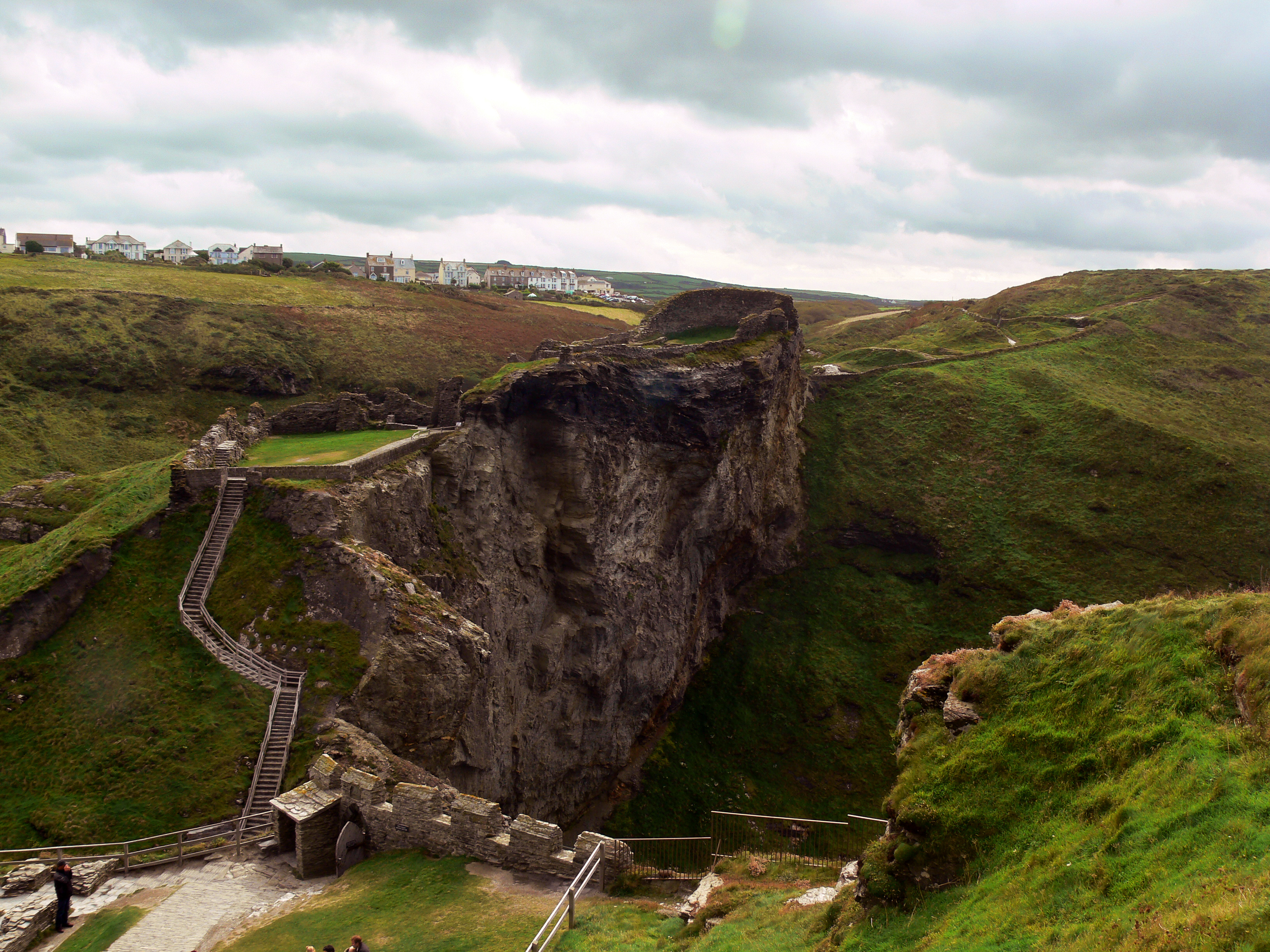
Tintagel Castle
Geoffrey of Monmouth planted the seed in the twelfth century: Tintagel was where King Arthur was conceived. Eight hundred years later, the legend still draws 200,000 visitors a year to a dramatic headland on Cornwall's north coast. But here is the twist that archaeology keeps sharpening. The real Tintagel -- the one buried beneath medieval ruins and Victorian myth-making -- turns out to be more extraordinary than any legend. This was not a place of knights and round tables. It was a trading hub of the post-Roman world, a seat of Dumnonian kings who drank Mediterranean wine from African pottery while most of Britain had forgotten how to read.
Before the Legend
Long before anyone connected the headland to Arthur, people lived and traded here. Roman-era artifacts have surfaced on the peninsula, including a leather purse containing ten low-denomination coins spanning the reigns of Tetricus I (270-272 AD) to Constantius II (337-361 AD). But the truly astonishing period came after Roman control collapsed in the early fifth century. The former district of civitas Dumnoniorum became the Kingdom of Dumnonia, and Tintagel appears to have served as one of the seasonal residences for its rulers. Archaeologist Charles Thomas estimated that a typical Dumnonian king traveled with an entourage of one to three hundred people -- family, hostages, officials, and a private war-band -- moving between strongholds throughout the year. What makes Tintagel exceptional is the imported pottery. Thomas found that the quantity of Mediterranean ceramics unearthed here was 'dramatically greater than that from any other single site dated to about 450-600 in either Britain or Ireland' -- in fact, greater than the combined total from all known sites of that period. Shiploads of African and Phocaean red slip, amphorae that once held wine and oil, had crossed the Mediterranean to reach this windswept Cornish headland.
The Castle That Wanted to Be Old
In 1233, Richard, 1st Earl of Cornwall, built a castle on the headland -- not because it was militarily strategic, but because Geoffrey of Monmouth's wildly popular History of the Kings of Britain had already made Tintagel synonymous with Arthur. Richard deliberately built in an old-fashioned style to make his new castle look ancient, borrowing the site's legendary prestige to bolster his own political standing. The ploy worked for a generation. But his successors had no interest in maintaining a remote Cornish fortress, and by the 1330s the roof had been stripped from the Great Hall. The isthmus connecting the castle to the mainland eroded steadily, making access increasingly perilous. When the antiquarian John Leland visited in the 1540s, he found the only way across was a makeshift bridge of tree trunks. The castle served intermittently as a prison and sheep pasture before the Victorians, seized by the same Arthurian fever that had motivated Earl Richard six centuries earlier, turned its ruins into a tourist destination.
Digging Through the Myth
Serious archaeology began in 1933 when Ralegh Radford started excavating the site for the Office of Works. He initially interpreted the early medieval remains as a Celtic Christian monastery, drawing parallels with seventh-century Whitby Abbey. That theory held for decades before collapsing under the weight of contradictory evidence. By the 1980s, archaeologists had reinterpreted the site as an elite secular settlement -- a royal stronghold, not a house of prayer. Excavations funded by English Heritage in 2016 and 2017 pushed the story further. The Cornwall Archaeological Unit uncovered the outlines of a palace dating to the fifth or sixth century, along with more amphora shards and, crucially, slate bearing inscribed writing. The inscription proved that literacy survived in this corner of post-Roman Britain, a discovery that challenged assumptions about the so-called Dark Ages. Earlier, in 1998, the 'Artognou stone' had been found on site, bearing a Latin inscription that some have claimed connects to a historical Arthur, though most historians reject that interpretation.
The Cliff's Edge
Today Tintagel is managed by English Heritage and owned by the Duchy of Cornwall. A cantilevered steel footbridge, designed by Ney & Partners and William Matthews Associates to evoke the line of a sword, was opened to the public in August 2019 and nominated for the RIBA Stirling Prize in 2021. A bronze statue called Gallos -- Cornish for 'power' -- stands on the headland, deliberately ambiguous about whether it represents Arthur or the site's older, documented royalty. But the headland itself is disappearing. In September 2022, English Heritage identified Tintagel as one of six sites at risk from accelerating coastal erosion driven by rising sea levels and increasingly violent storms. Parts of the castle have been falling into the sea for centuries, but by 2022 the erosion had reached the visitor centre. A footpath and viewing area had already collapsed into the waves. The irony is pointed: the real Tintagel, the one that archaeology reveals as a remarkable post-Roman trading center and royal seat, may not survive long enough for its full story to be excavated. Only about five percent of the island's accessible surface has been explored.
From the Air
Located at 50.67N, 4.76W on Cornwall's dramatic north coast. The castle ruins are split between a near-island headland and the mainland, connected by a modern footbridge. Merlin's Cave is visible at the base of the cliffs at low tide. Nearest airports: Newquay Cornwall (EGHQ) 18 miles southwest, Exeter (EGTE) 60 miles east. Best viewed at 1,000-2,000 feet to appreciate the eroding isthmus and the precarious position of the ruins.