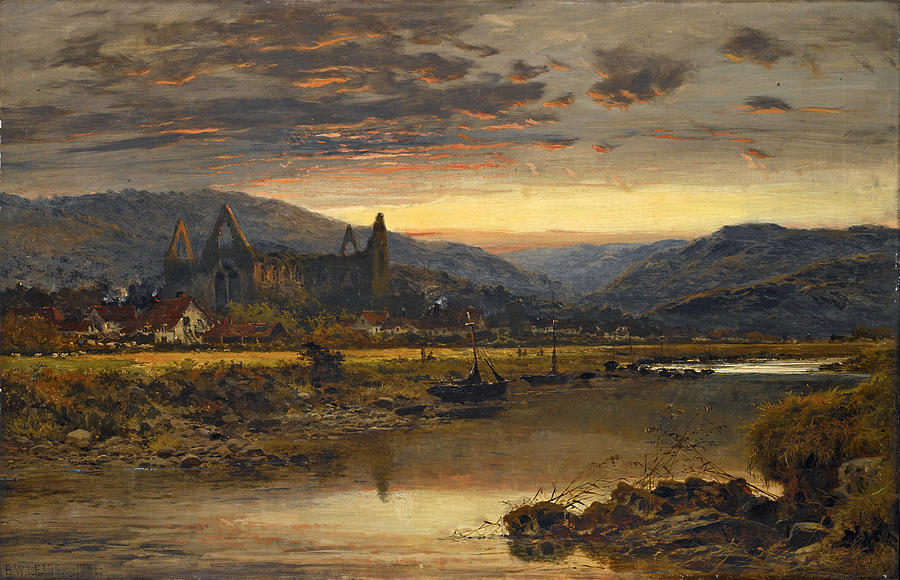
Tintern Abbey
Wordsworth did not actually write about Tintern Abbey. His poem, composed in July 1798 after revisiting the Wye Valley, is titled "Lines Composed a Few Miles Above Tintern Abbey" and concerns the landscape, memory, and the passage of time rather than the ruin itself. But the abbey's name has been inseparable from Romantic poetry ever since. Turner painted it, Gilpin sketched it, tourists by the boatload came to admire its picturesque decay. The ruin that stands today in its green valley on the Welsh bank of the River Wye is as much a monument to how the English learned to see beauty in broken things as it is to medieval monasticism.
White Monks in a Green Valley
Tintern Abbey was founded on 9 May 1131 by Walter de Clare, Lord of Chepstow. It was the first Cistercian foundation in Wales and only the second in Britain, after Waverley Abbey in Surrey. The Cistercians -- called White Monks for their undyed wool habits -- sought remote locations far from worldly distractions, and the narrow Wye Valley, hemmed in by wooded hills, suited their asceticism perfectly. The original twelfth-century buildings were modest. It was in the thirteenth century, under the patronage of Roger Bigod, Earl of Norfolk, that the great church was rebuilt in the Decorated Gothic style whose skeletal remains still stand. Construction of the church began around 1269 and was consecrated in 1301. At its peak, the abbey sustained a community of some 400 monks and lay brothers.
The Architecture of Absence
What makes Tintern extraordinary is not what survives but what is missing. The walls of the great church still rise to their full height, their tracery windows intact as stone frames against the sky. But there is no roof, no glass, no floor tiles. The crossing tower is gone. Grass grows where monks once chanted the canonical hours. The effect is theatrical: the building becomes a frame for the landscape beyond it, the sky visible through every window, trees crowding the empty apertures. It is this quality -- architecture returned to nature, sacred space opened to the elements -- that captivated the Romantics and continues to draw roughly 70,000 visitors annually.
Dissolution and Discovery
Henry VIII's commissioners dissolved Tintern in 1536. The lead was stripped from the roof, the bells melted down, the buildings left to decay. For two centuries the abbey was little more than a local quarry and cattle shelter. Then, in the mid-eighteenth century, the cult of the Picturesque transformed how the English regarded ruins. The Reverend William Gilpin published his Observations on the River Wye in 1782, praising Tintern's "gloomy grandeur" and establishing the Wye Tour as a fashionable excursion. Artists and poets followed: Turner visited multiple times, producing watercolours that captured the interplay of crumbling stone and shifting light. The abbey became perhaps the most painted ruin in Britain.
The Valley Endures
Since 1984, Cadw, the Welsh government's historic environment service, has managed the site. Conservation work has stabilised the walls without attempting to restore what dissolution destroyed. The approach is deliberate: Tintern's power lies in its incompleteness, in the tension between what was built and what was lost. The surrounding Wye Valley, designated an Area of Outstanding Natural Beauty, remains much as Wordsworth described it -- steep woods running down to the river, the sound of water audible from the abbey grounds. Stand inside the roofless nave on a still evening and you understand why the Romantics fell in love with this place. The beauty is not in spite of the ruin. It is the ruin.
From the Air
Located at 51.697N, 2.680W in the Wye Valley on the Welsh-English border, Monmouthshire. The roofless abbey is clearly visible from the air, its pale stone walls contrasting with the dark wooded valley. Nearest airports: Bristol (EGGD) approximately 25nm southeast, Cardiff (EGFF) approximately 25nm southwest. Best viewed from 1,500-2,500ft following the meandering River Wye.