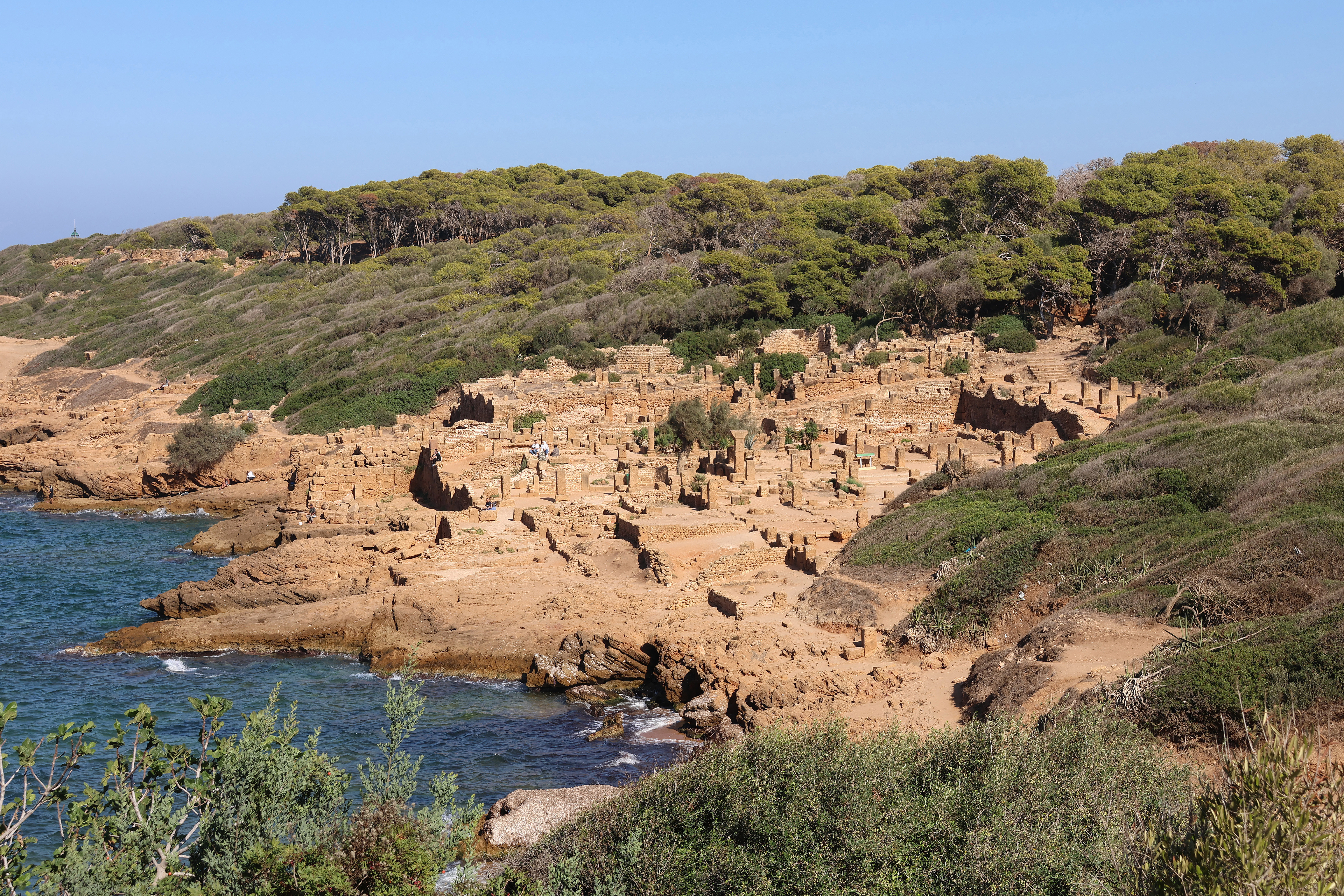
Tipasa
When the Arabs conquered this place at the end of the seventh century, they named it Tefassed -- "badly damaged." It was an honest assessment. By then, the city that had served as a Punic trading post, a Roman military colony, and an early Christian stronghold had been reduced to ruins. But the name stuck, and the ruins endured, and in 1982 UNESCO declared the remains of ancient Tipasa a World Heritage Site. Today the city known as Tipaza sprawls along the central Algerian coast, its modern buildings growing up around columns and basilicas that refuse to disappear entirely.
From Trading Post to Military Colony
Tipasa began small -- a Punic outpost where Carthaginian merchants traded along the North African shore. Rome changed its scale. Emperor Claudius converted the settlement into a military colony for the conquest of the Mauretanian kingdoms, and the place received the formal name Colonia Aelia Augusta Tipasensium. The Roman city rose on three small hills overlooking the sea, roughly 20 kilometers east of Caesarea, the provincial capital. Its harbor and position along the coastal road system gave Tipasa both commercial and strategic importance, and a defensive wall of approximately 2,300 meters enclosed the public buildings and residential districts that grew within. Commercially, the colony prospered. It was not a center of art or learning -- that distinction belonged to Caesarea -- but it was a place where goods moved and soldiers garrisoned.
A Faith That Left Its Foundations
Christianity reached Tipasa early, with records placing the faith here as early as 238 AD. The remains of a large Christian basilica, a martyrium, and other religious structures still stand among the ruins, stone evidence of a community that adopted the new faith centuries before it became dominant across Europe. But the Christian era at Tipasa was not peaceful. The centuries that followed brought doctrinal conflicts, political upheaval, and eventual decline. By the time Arab forces arrived at the end of the seventh century, the city was already falling apart. The conquerors completed what decay had started, reducing Tipasa to the wreckage their name described.
Layers Under Mediterranean Light
Walking through the ruins today is an exercise in reading time. The Cardo Maximus -- the main north-south street of any Roman city -- still traces its line through the site. An amphitheater and a theater sit within view of each other, entertainment venues for a population that numbered in the thousands. Temples dedicated to unknown deities stand alongside a nymphaeum, a monumental fountain that once channeled water as both utility and spectacle. Near the site, the Royal Mausoleum of Mauretania marks the tomb attributed to Juba II and Cleopatra Selene II, connecting Tipasa to the broader story of Berber kings who governed under Roman authority. Each structure represents a different moment in the city's layered history -- Phoenician, Roman, Christian, Byzantine -- compressed into a single archaeological landscape along the Mediterranean shore.
Heritage Under Threat
The same sea that made Tipasa prosperous now threatens its survival. In 2002, UNESCO placed the site on its List of World Heritage in Danger, citing degradation from urban encroachment and inadequate conservation. Efforts to stabilize the ruins led to the site's removal from the danger list in 2006, but the reprieve may be temporary. The IPCC's Sixth Assessment Report, published in 2022, identified Tipasa among African cultural sites vulnerable to sea level rise, coastal erosion, and flooding by the end of the century. A city that has already been destroyed once by conquest may face a slower, less dramatic, but equally final destruction by water. The Mediterranean, which once carried the traders and soldiers who built Tipasa, could eventually reclaim what they left behind.
From the Air
Located at 36.60N, 2.44E on the central Algerian Mediterranean coast, Tipaza Province. The archaeological site occupies coastal hills near the modern town of Tipaza. Nearest major airport is Algiers Houari Boumediene (DAAG), approximately 70 km east. The Royal Mausoleum of Mauretania is visible as a large circular structure on a hilltop between Cherchell and Tipaza. Best viewed at 2,000-4,000 feet AGL along the coastline. Clear weather typical of the Mediterranean climate provides good visibility most of the year.