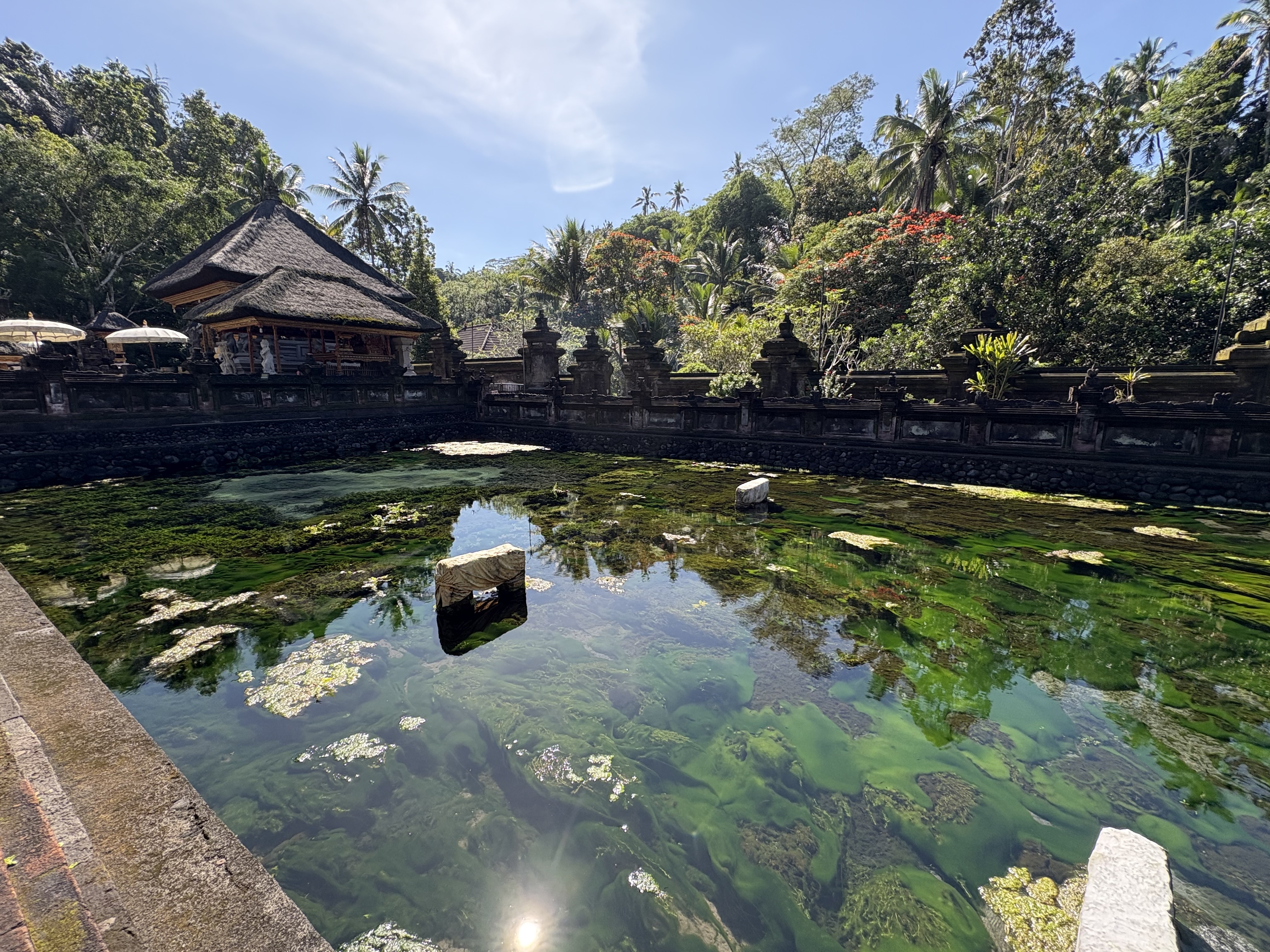
Tirta Empul: Where the God Struck the Earth
Thirty stone spouts pour water into a pool where strangers stand shoulder to shoulder in white sarongs, eyes closed, lips moving in prayer. Each spout carries a different blessing. Two carry warnings -- they cleanse the dead, and the living do not touch them. At Tirta Empul, water is not a metaphor for purification. It is the mechanism itself, a spring that has been flowing since 962 A.D., when the Warmadewa dynasty built a temple around what they believed was a gift punched into the earth by a god's own hand.
The Spring That Defeated a Demon
Balinese Hindu mythology traces the spring to a war between the god Indra and the demon king Mayadanawa, a shape-shifting giant and son of Dewi Danu Batur. Mayadanawa had forbidden his subjects from worshipping the gods, and when Indra descended to challenge him, the demon poisoned a pool to kill Indra's army. Soldiers drank and fell. Indra struck the ground with his staff, and clean water surged upward -- Tirta Empul, the holy spring. The water revived his fallen warriors. Mayadanawa fled, shifting form after form, until he became a boulder. Indra's arrow found him anyway. The spring kept flowing. Over a thousand years later, it still does, feeding the Pakerisan River and filling the temple's pools with water the Balinese call amritha -- the nectar of immortality.
Three Courtyards, Thirty Spouts
The temple divides into three sections, each a step deeper into the sacred. Jaba Pura, the front yard, receives visitors with split gates carved with the face of Bhoma, a protective spirit whose open mouth wards off evil. Jaba Tengah, the central yard, holds the purification pools -- two rectangular basins fed by thirty spouts, each named and ordered. Pengelukatan cleanses the spirit. Pebersihan purifies the body. Sudamala washes away curses. Pancuran Cetik, the poison spouts, echo the legend of Mayadanawa's toxic pool. The innermost yard, Jeroan, is where Balinese Hindus pray at shrines dedicated to Vishnu, the god of water and preservation. Non-Hindu visitors can observe but not enter the prayer areas. The architecture is ancient sandstone layered with moss, draped in black-and-white checked cloth that represents the Balinese concept of balance between good and evil.
The Melukat
Purification at Tirta Empul is not symbolic bathing -- it is a structured ritual called Melukat, and participants follow it with precision. You wrap yourself in a sarong and sash. You enter the pool at the leftmost spout. You stand beneath each one in sequence, letting the cold spring water hit the crown of your head while you press your palms together and pray. Some spouts demand specific intentions: health, prosperity, release from grief. The two spouts reserved for the dead are skipped without discussion. Moving through the full sequence takes time; the water is startlingly cold for the tropics, fed by a spring that maintains its temperature year-round. Balinese Hindus perform Melukat at key life transitions -- before weddings, after illness, during periods of spiritual unease. Tourists participate too, though temple guides encourage them to approach it as ceremony rather than experience.
The Presidential Villa on the Hill
On a ridge overlooking the temple compound, a modernist villa sits in deliberate contrast to the centuries below it. President Sukarno, Indonesia's founding leader, had the residence built in 1954 as a retreat during his visits to Bali. The villa offered a view down into the temple's pools and gardens, positioning political power -- literally -- above spiritual tradition. After Sukarno's fall from power in the late 1960s, the villa became a government rest house for visiting dignitaries, and it remains one today. The juxtaposition is striking: the spring has flowed since the tenth century, the temple since the Warmadewa dynasty, but the villa is barely seventy years old. Below, pilgrims still line up at the spouts. Above, the building that once housed Indonesia's most powerful man sits largely empty.
A Spring Under Pressure
Tirta Empul draws hundreds of visitors daily, and the spring that once served a small Hindu community now supports a major tourism operation. In 2017, Gianyar regency authorities investigated reports of E. coli contamination in the temple waters, raising uncomfortable questions about whether the holy spring that mythology says can revive the dead might now pose health risks to the living. The temple sits within a UNESCO-recognized cultural landscape along the Pakerisan River, and conservation efforts have intensified. For Balinese Hindus, the water's spiritual purity is separate from its chemical composition -- the spring cleanses the soul, not the body. But the tension between sacred site and tourist attraction grows each year, as more visitors arrive seeking an experience that was never designed to be one.
From the Air
Located at 8.42S, 115.31E near Tampaksiring in central Bali. From the air, the temple compound appears as a cluster of traditional Balinese structures nestled in a river valley, surrounded by terraced rice paddies. The green of the surrounding jungle makes the stone temple and pools visible against the landscape. Nearest airport is Ngurah Rai International (WADD/DPS) in Denpasar, approximately 37 km to the southwest. Mount Agung dominates the eastern horizon. Best viewed at 3,000-5,000 feet AGL for detail of the temple layout and surrounding rice terraces.