Titanic Belfast
The building stands exactly 126 feet tall, the same height as the hull of the ship it commemorates. Its facade of 3,000 silver anodised aluminium shards catches the Belfast light differently with every shift in weather, and its angular form -- four interlocking ship's prows -- points down the original Titanic and Olympic slipways toward the River Lagan. Titanic Belfast opened on 31 March 2012, the centenary year of the most famous maiden voyage in history, on the very ground where the ship was built. The museum was expected to draw 425,000 visitors per year. In its first year, 807,340 came.
Reclaimed from Rust
The building rises on Queen's Island, an area of land at the mouth of Belfast Lough that was reclaimed from mudflats in the mid-nineteenth century. For generations it belonged to Harland and Wolff, who built the enormous slipways and graving docks needed to construct RMS Titanic, her sister ship Olympic, and the Britannic simultaneously. When shipbuilding declined, Queen's Island became derelict. Most structures were demolished, though heritage features like the slipways, docks, and the iconic Samson and Goliath cranes received listed protection. In 2001, the wasteland was renamed the Titanic Quarter and earmarked for regeneration. Development rights over 185 acres went to Harcourt Developments for 47 million pounds. The idea of a world-class museum came in 2005, with the centenary of the sinking as a natural deadline.
Designing a Ghost Ship
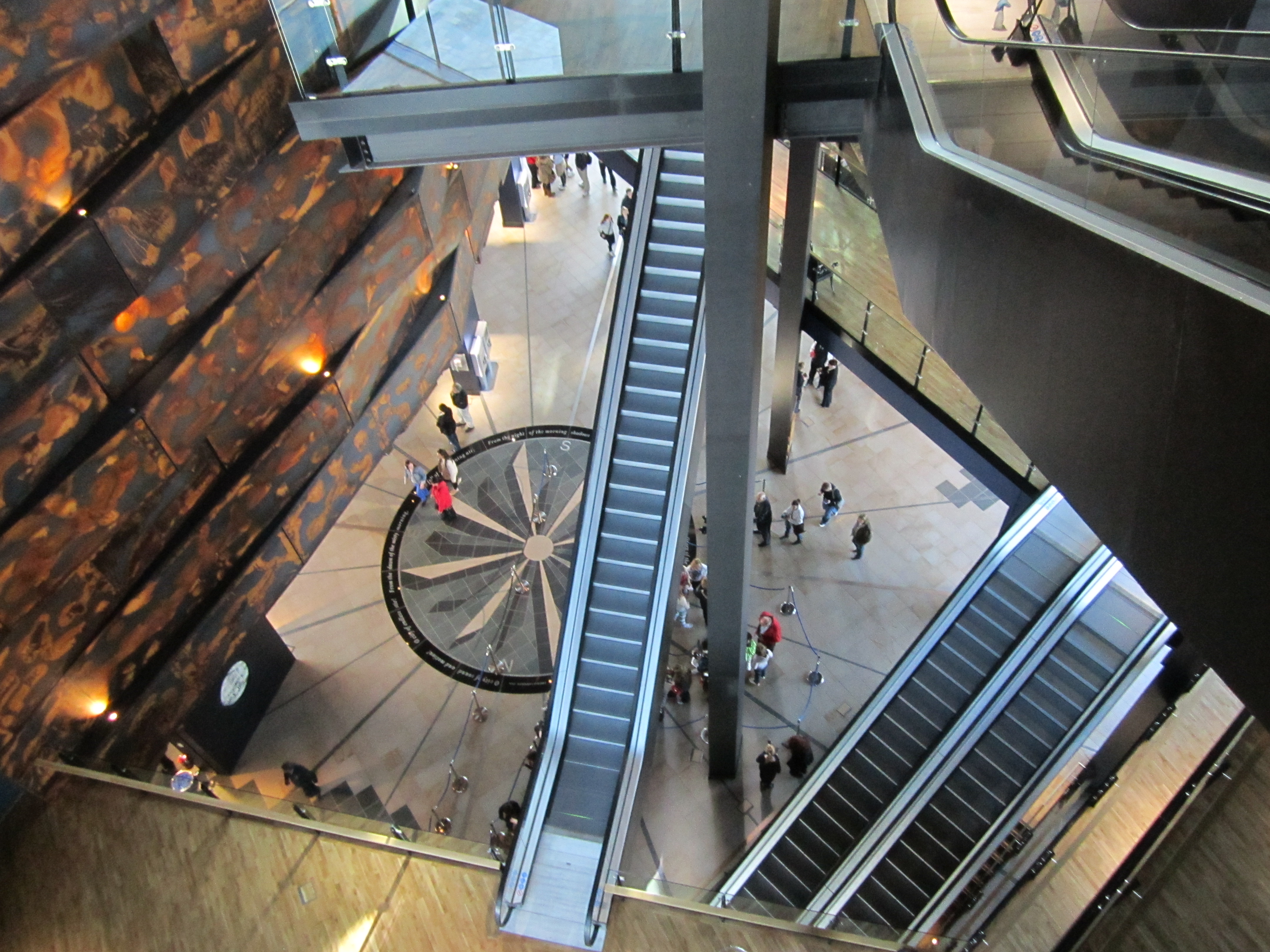
American architect Eric Kuhne conceived the building as an echo of the industrial landscape it replaced. Todd Architects led the project to completion. The design deliberately evokes not just ships' prows but the crystalline structure of ice and the star emblem of the White Star Line. The eight-storey interior provides 12,000 square metres of space across nine interpretive galleries, each exploring a different aspect of Titanic's story: from the boomtown Belfast of 1909 to the ship's construction, launch, maiden voyage, sinking, and legacy. Visitors ride miniature cars up and around a replica of Titanic's rudder, passing through a steel scaffold that alludes to the Arrol Gantry -- the massive structure within which the ship was built. The actual gantry was four times taller. A reproduction of Titanic's grand staircase, assembled from 10,000 individual parts weighing nearly four tonnes, serves as the centrepiece of the top-floor Titanic Suite.
Belfast's Guggenheim
The project was funded equally by the Northern Ireland Executive and private investors, with Belfast City Council providing additional support. Total cost reached 97 million pounds. The foundations required one of the largest concrete pours in the country's history: 4,200 cubic metres delivered by 700 lorries in a single twenty-four-hour period. The ambition was explicitly to create a transformational landmark comparable to the Guggenheim Museum Bilbao. By any measure, it has succeeded. Titanic Belfast won the World Travel Awards' World's Leading Tourism Attraction in 2016 and has consistently drawn over 800,000 visitors annually, with 84 percent coming from outside Northern Ireland. In front of the building, Rowan Gillespie's bronze sculpture Titanica depicts a diving female figure on a brass base, evoking the figureheads once mounted on ships' prows.
More Than a Memorial
Titanic Belfast is not simply a monument to a disaster. It tells the story of the city that built the ship -- the engineers, the riveters, the draughtsmen, the ordinary workers of a shipyard that at its peak employed thousands. The museum holds fifteen awards and has been credited with transforming Northern Ireland's tourism economy. Belfast's largest conference and banqueting space, capable of seating 750, occupies the top floor. Hickson's Point, a destination bar designed to resemble an authentic 1900s Belfast pub, opened in 2018, named after Robert Hickson, one of the city's first shipbuilders. The building sits alongside other Titanic Quarter heritage sites: the restored SS Nomadic, the last surviving White Star Line vessel; Hamilton Dock; and the Titanic Dock and Pump House. What was once a derelict shipyard is now the most visited place in Northern Ireland.
From the Air
Located at 54.61°N, 5.91°W on Queen's Island in Belfast's Titanic Quarter, at the mouth of Belfast Lough. The distinctive angular building with its silver aluminium facade is visible from the air, sitting between the Samson and Goliath cranes (painted yellow, a major landmark). Belfast City Airport (EGAC) is directly adjacent, approximately 1 km southeast. The River Lagan flows past to the west.