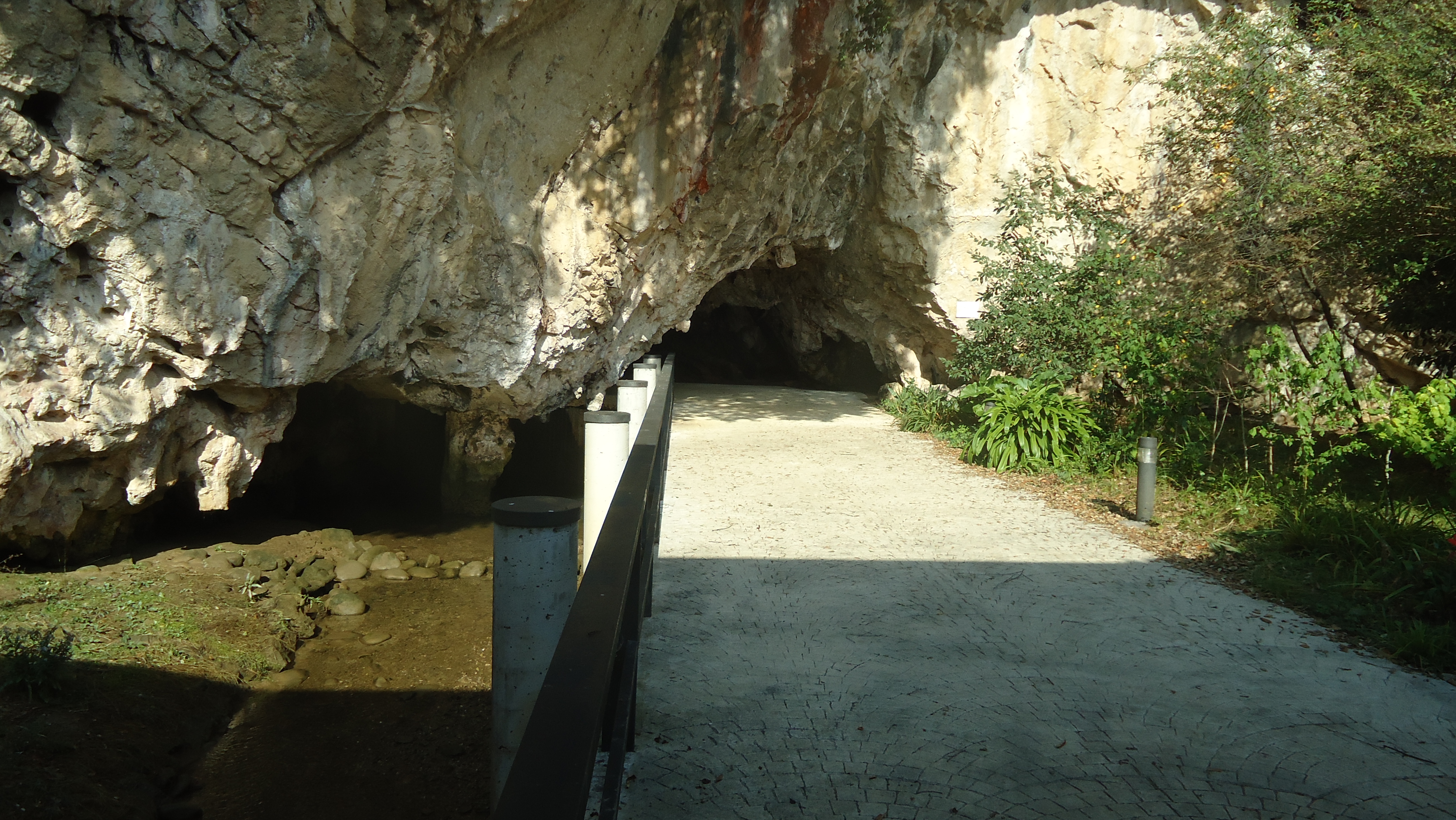
Tito Bustillo Cave
A rockfall thousands of years ago did what no museum conservator could: it sealed the entrance to a cave near the Asturian town of Ribadesella, locking away paintings, bone harpoons, and carved staghorn in conditions so stable that when explorers finally broke through in 1968, the art looked as though it had been finished the week before. The oldest image on these walls is roughly 33,000 years old -- a figure that pushes the boundaries of what we thought Cro-Magnon humans were capable of, and raises the tantalizing possibility that Neanderthals may have held the brush.
An Accidental Time Capsule
Tito Bustillo sits within the limestone hills above Ribadesella, on the coast of Asturias in northern Spain. The cave owes its remarkable preservation to geology: at some point in prehistory, the cliff face collapsed and buried the original entrance beneath tons of rock. No air, no light, no moisture fluctuations -- the interior became a sealed chamber where organic materials survived for tens of thousands of years. When the cave was rediscovered in 1968, archaeologists found not only wall paintings but also bone harpoons and a carved staghorn depicting a goat's head, artifacts of the Magdalenian culture that flourished during the Upper Paleolithic. The cave has since been designated a UNESCO World Heritage Site as part of the Cave of Altamira and Paleolithic Cave Art of Northern Spain.
Painted in the Dark
Twelve prehistoric paintings line the walls, making Tito Bustillo one of the most complete galleries of cave art in northern Spain. Horses, deer, and what appears to be a whale parade across the stone -- animals that the painters likely hunted, and whose images may have served a ritual purpose. One panel depicts female genitalia, interpreted as a fertility invocation. But the painting that draws the most attention is also the oldest: an anthropomorphic figure, simultaneously male and female, dated to around 33,000 years ago by radiocarbon analysis. That date matters because it places the image at the very edge of the period when Neanderthals and Cro-Magnon humans overlapped in this part of Europe. Some researchers have suggested the painting could be Neanderthal work, though the theory remains unproven.
Tools of a Vanished People
Beyond the paintings, the cave yielded objects that illuminate daily life during the Magdalenian period, roughly 17,000 to 12,000 years ago. Bone harpoons, their barbs still sharp, speak to a people who fished the rivers and possibly the Cantabrian Sea just kilometers away. A carved staghorn, shaped into the likeness of a goat's head, suggests an artistic impulse that extended beyond the walls. These artifacts survived intact because the sealed cave maintained constant temperature and humidity -- conditions that would be nearly impossible to replicate in a modern laboratory. Together with the paintings, they make Tito Bustillo one of the richest single-site collections of Upper Paleolithic material culture in Spain.
Between the Mountains and the Sea
Ribadesella sits where the Sella River meets the Bay of Biscay, and the surrounding landscape explains why humans chose this spot for millennia. The limestone karst provided shelter. The river provided fish and fresh water. The coast, close enough to walk in an afternoon, offered marine resources -- perhaps the whale depicted on the cave walls was not artistic imagination but direct observation. From the air, the green Asturian hills fold and crumple toward the coast, hiding dozens of similar caves in their folds. Tito Bustillo is the most famous, but it belongs to a constellation of prehistoric sites scattered across this stretch of northern Spain, each one a fragment of a story that stretches back more than thirty millennia.
From the Air
Located at 43.46°N, 5.07°W near the coast of Asturias, Spain. The cave sits in limestone hills above the town of Ribadesella where the Sella River meets the Bay of Biscay. Best viewed at 3,000-5,000 ft AGL. The nearest airport is Asturias Airport (LEAS), approximately 70 km to the west. The Cantabrian coastline and green hills provide clear visual landmarks.