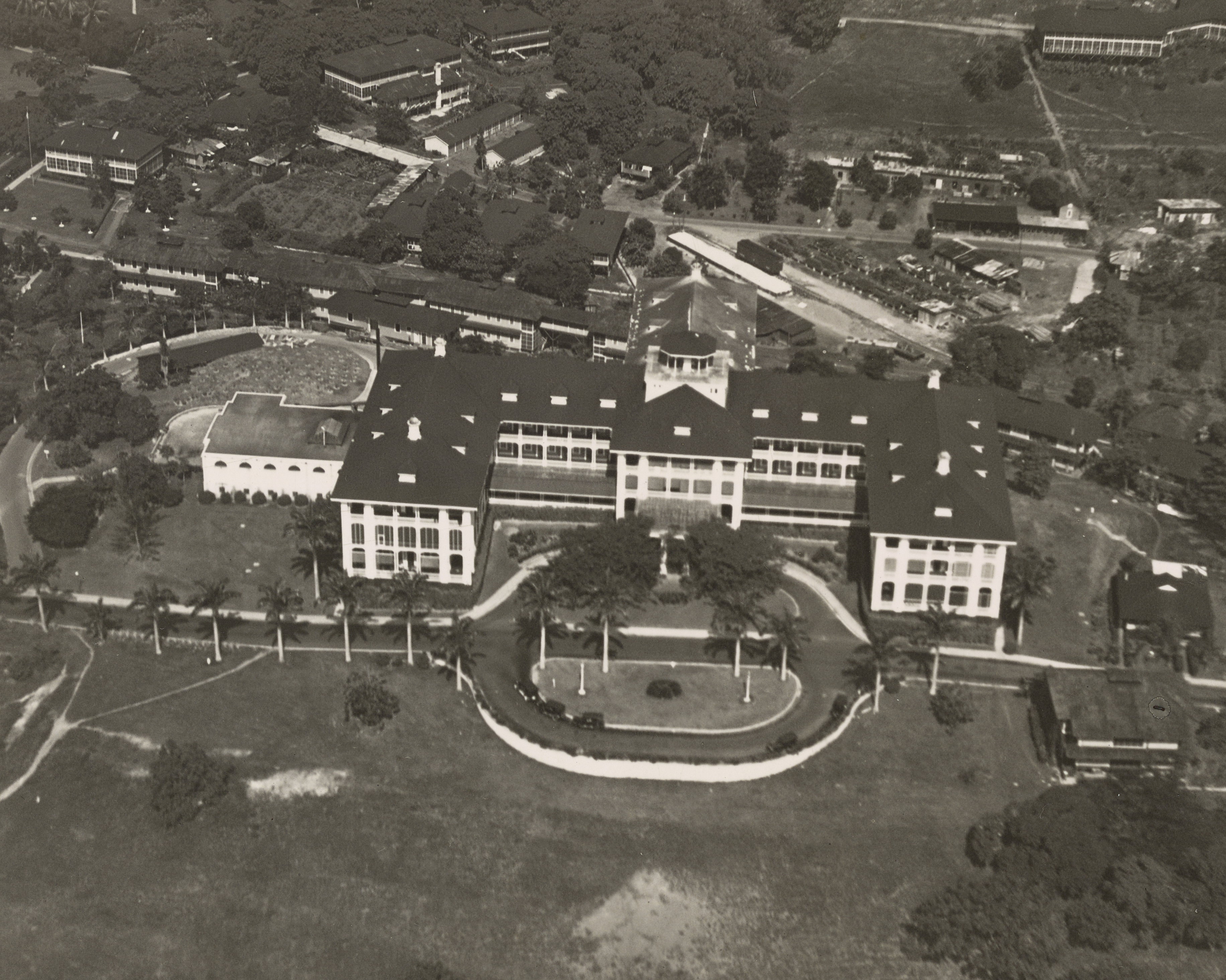
Tivoli Hotel, Panama
The 1907 dinner menu tells you everything. Ancon Turtle Soup. Culebra Fillet of Beef. Potted Gatun Birds. Matachin Ice Cream. Cemetery Road Cigarettes. Every dish was named for a landmark along the Panama Canal route, and every guest at the Tivoli Hotel understood the joke: the canal was not just reshaping the isthmus but remaking its entire culture, right down to dessert. President Theodore Roosevelt and his wife had been the hotel's first guests on November 15, 1906, lending the establishment an immediate prestige that its origins -- temporary housing for canal construction workers -- hardly warranted. For the next sixty-five years, the Tivoli would serve as the social heart of the Canal Zone, a place where geopolitics and fine dining shared the same table.
From Billiard Tables to Ballrooms
The Tivoli was built on Tivoli Hill in Ancon, named after the famous hill in Rome, and sat just across the street from the Canal Zone border with Panama. Its original purpose was modest: house the flood of workers, engineers, and officials arriving for the canal project when Panama had almost no hotel capacity. The construction plan changed midstream. What began as a metal-and-plaster structure became a frame building with a brick center section, because the hotel needed to serve two contradictory purposes -- temporary bunks and respectable guest rooms. During the construction era, the ballroom regularly doubled as a dormitory. Workers slept on cots, and when those ran out, they slept on the tops of billiard tables. A central three-story wing was added in 1911, bringing the hotel's first electric elevator. Hot water reached the bathrooms in 1912. A porte-cochere replaced the covered front steps in 1913.
Diseased to Desired
The Tivoli's rise mirrored a broader transformation. Before the Americans could dig the canal, they had to defeat malaria and yellow fever -- diseases that had turned the isthmus into what contemporaries called the "white man's graveyard." As the medical campaigns succeeded and the canal took shape, the same territory shifted in the American imagination from a place of death to a tropical playground. Tourism scholars describe this shift as the move from "diseased to desired," and the Tivoli was its flagship. Cruise ships began arriving at the canal, and the hotel served luncheon to several hundred passengers at a time. The guest lists read like a social register of American power: movie actors, generals, congressmen, admirals, and ordinary tourists who wanted to see the engineering marvel of the age. During the war years, the Pergola Bar -- added in 1913, serving liquor from 1936 -- was said to be crowded with intelligence agents, newspapermen, and military contractors.
Four Hundred Bullet Holes
The Tivoli's walls bore witness to more than dinner parties. On January 9, 1964, the hotel became a focal point during anti-American riots over sovereignty of the Panama Canal Zone. Twenty-eight people died in the violence, and 400 bullet holes were left in the hotel's facade. The hotel had always stood at the intersection of privilege and power -- situated on the literal border between the American-controlled Zone and the Republic of Panama -- and on that day, it became a site of protest as well as social prestige. At various points in its history, the Tivoli also sheltered political refugees. At one time, four former presidents of Panama were living there simultaneously, each exiled from power but not from the building that symbolized it.
The Long Goodbye
By the late 1960s, the grand hotel was aging. The wooden structure demanded expensive maintenance, and Panama City's own hotel industry had grown to make the Tivoli less essential. It was redesignated as "The Tivoli Guest House," no longer accepting hotel reservations, and pivoted to serving the Canal Zone community as a venue for wedding receptions, school proms, gala dances, luncheons, and happy hours. The transformation was poignant: the hotel that had once hosted a sitting American president now hosted prom dates and retirement dinners. The Tivoli Guest House officially closed on April 15, 1971, sixty-five years after Roosevelt's visit. No record survives of how many rooms it contained during any phase of its life. What survives instead is a story about the strange, layered life of a building that served empires and exiles, construction workers and cruise passengers, all from the same hillside above the canal.
From the Air
Located at 8.963N, 79.544W in the Ancon district of Panama City, on Tivoli Hill near the eastern approach to the Panama Canal. The hotel no longer stands, but the hill and surrounding area are visible from 2,000-3,000 feet AGL. The former Canal Zone border ran along the street below. Nearest airport: Albrook 'Marcos A. Gelabert' International Airport (MPMG), approximately 1 nm west. Tocumen International Airport (MPTO) is 15 nm east.