TivoliVredenburg
The argument was old and unresolvable. Pop wants dry acoustics, walls that swallow sound so the amplification can do its work. Classical wants the opposite, a long reverberation tail in wood and stone that makes a string section bloom. Jazz wants intimacy. Dance wants concrete throb. Most cities solve this with separate buildings in separate neighborhoods. In 2014, Utrecht did the opposite. It piled five halls on top of each other in a single block in the city center, each engineered for a different genre, each its own acoustic universe. The architects called it a vertical city. The engineers spent the first year after opening trying to keep the genres from leaking into each other.
A Merger of Two Tribes
TivoliVredenburg exists because two of Utrecht's most beloved venues agreed to stop being themselves. Tivoli Oudegracht was the city's scrappy pop and rock hall, a place of beer and sweat on a historic canal. Muziekcentrum Vredenburg, designed by Herman Hertzberger and opened in 1979, was the proud home of classical music in the central square. By the early 2000s the city wanted to redevelop the Vredenburg area entirely. Hertzberger himself - thirty years older and still working - was asked to combine the two traditions in a single complex. Design began in 2005. The old Muziekcentrum was demolished in 2011, though Hertzberger saved its Symphony Hall and folded it into the new building as the Grote Zaal. The name TivoliVredenburg was settled in October 2012 because, as the foundation explained, both halves of the name carried national weight - one in pop, one in classical - and neither could be dropped.
Five Rooms, Five Sounds
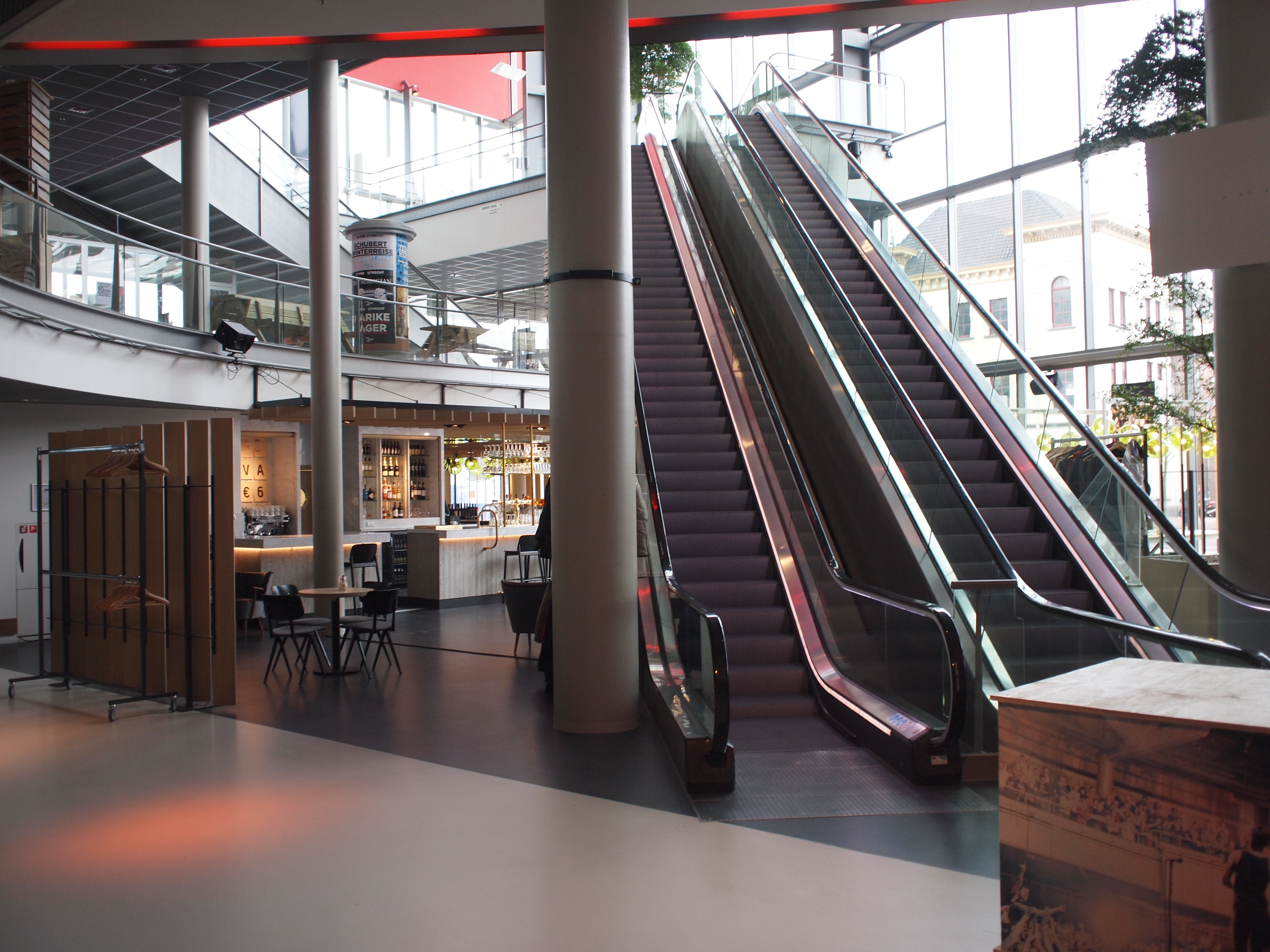
The interior is a stack. The Grote Zaal at 1,717 seats keeps the great wooden geometry of the original symphony hall, all swooping balconies and warm reverberation. Above and beside it sits the Ronda, a 2,000-capacity semi-circular hall designed by Jo Coenen as the pop room - balcony wrapping the entire back wall, walls coated with sound-absorbing materials so that even at concert volume the room does not muddy. Pandora, designed by NL Architects, is the crossover and dance hall, dark and dry, with windows of round portholes looking out over Utrecht. Hertz, designed by Hertzberger's studio, is the classical chamber: 543 seats in cherry wood, sliding curtains that let staff tune the reverberation up or down, a stage backed by glass so the city itself becomes the backdrop. Cloud Nine, the jazz hall designed by Thijs Asselbergs, holds 400 in a wood-floored intimacy. Plazas, staircases, and escalators thread them together. A statue called the Schele Maagd - the Cross-eyed Virgin, rescued from a 1974 demolition - sits on the roof.
When the Halls Started Hearing Each Other
The first event was an art exhibition on 2 April 2014. The first concert came three days later in Pandora. King Willem-Alexander officially inaugurated the building on 3 July 2014. And then, almost immediately, the halls began bleeding sound into one another. The bass from a pop concert in Ronda could be felt during a piano recital in Hertz. By June 2015, the engineers had returned with rubber suspension in the support pillars and sound-insulating plates in the Ronda's roof. The Ronda-Hertz problem was solved. An investigation opened into the same complaint between Cloud Nine and Hertz. Stacking acoustic experiences in a single tower turned out to be exactly as hard as the architects had warned it might be.
The Money Argument
There was also a financial leak. Personnel, production, and catering all cost more than projected. Sponsorship and subsidies came in lower. The opening year brought a multi-million-euro deficit even as visitor numbers exceeded what anyone had forecast - the building drew people, but not enough money. In May 2016 the municipality intervened. Annual rent was cut by 1.9 million euros, and a one-time grant of 400,000 euros was given to strengthen commercial operations and attract bigger artists. The intervention worked. By 2024 the venue was bringing in 40 million euros of revenue, with an additional 10 million from the city, and averaging roughly 1.3 million visitors a year - a substantial fraction of the entire population of the Netherlands passing through one block of Utrecht annually.
Pandemic and After
In March 2020 TivoliVredenburg shut its doors and postponed hundreds of concerts as the Netherlands locked down for COVID-19. It did not reopen properly until February 2022, nearly two years later. The intervening period was difficult and, in one moment, terrible: in November 2023, a cleaner stabbed and killed a coworker inside the building after a fight. The case worked through Dutch courts the following year. In April 2024 a renovation began on the foyers of the Grote Zaal, funded in part by 1,925 individual donors who collectively raised 102,455 euros. A new entrance opened onto the Vredenburgplein. The vertical city, having survived an acoustic crisis, a budget crisis, and a pandemic, continues to fit five separate worlds of music into one building - and on most nights, you can stand in the central plaza and hear all of them at once, faintly, through the walls.
From the Air
TivoliVredenburg stands in central Utrecht at 52.0922 N, 5.11333 E, immediately west of the Hoog Catharijne shopping complex and Utrecht Centraal Station. From above, the building is a notable block of contemporary glass and concrete contrasting with the historic core to the east. Nearest airport is Amsterdam Schiphol (EHAM), about 35 km northwest. Lelystad (EHLE) lies to the northeast. The Utrecht skyline is dominated by the Dom Tower a few hundred meters east of the venue.