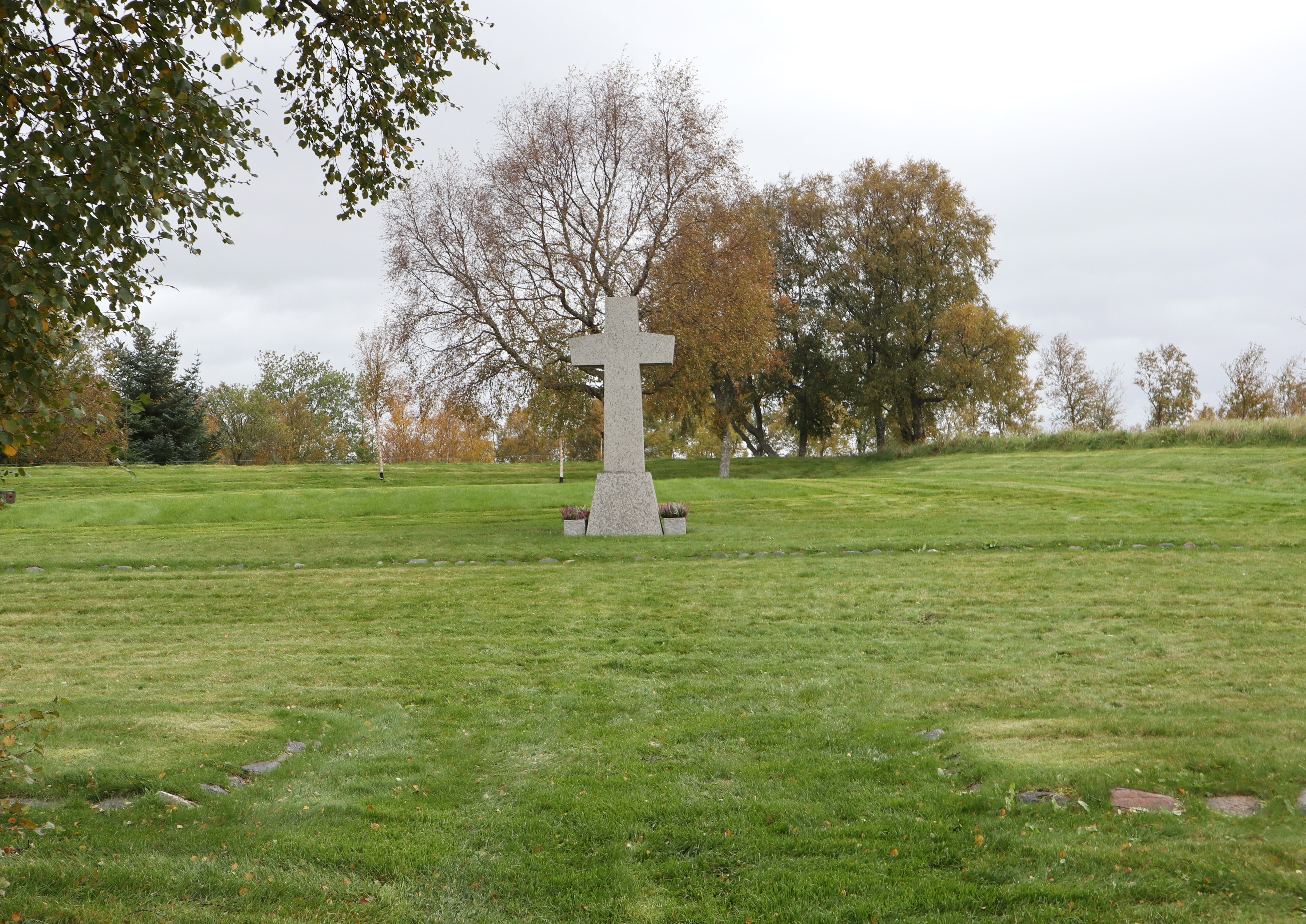
Tjotta International War Cemetery
Every grave at Tjotta International War Cemetery is anonymous. There are no names on the headstones, no dates of birth, no home towns. The roughly 2,500 people buried here died together on 27 November 1944, when British Fleet Air Arm aircraft from HMS Implacable attacked the German transport ship MS Rigel off the Helgeland coast, mistaking it for a troopship. Most of those aboard were not soldiers. They were prisoners of war -- Soviet, Polish, and Serbian men held captive by Nazi Germany -- along with Norwegian prisoners, German deserters, and a small number of German soldiers and Norwegian crew. When the bombs struck, there was almost no chance of survival. The dead could not be identified, and so they rest here together, equals at last in the anonymity of their graves.
The Sinking of the Rigel
MS Rigel was a Norwegian cargo ship requisitioned by the German occupation forces and pressed into service as a prisoner transport. On that November morning in 1944, the vessel was part of a convoy escorted by two small V-Boats of the Kriegsmarine, moving along the Nordland coast. Aboard were approximately 2,248 Soviet, Polish, and Serbian prisoners of war, 95 German deserters, 8 Norwegian prisoners, 455 German soldiers, and a crew of about 30 including coastal pilots. When patrol aircraft from the carrier HMS Implacable spotted the convoy between the islands of Rosoya and Tjotta, south of Sandnessjoen, they identified Rigel as a military target. Supermarine Seafire fighters and Fairey Firefly dive-bombers attacked. The badly damaged ship was grounded on the island of Rosoya by her German captain, an act that saved the lives of the 267 who survived. But for more than 2,500 others, the cold waters of the Norwegian Sea became their grave.
A Quarter Century in the Shallows
The wreck of the Rigel lay partially submerged off Rosoya for twenty-five years, a rusting monument visible from the shore that local people could not ignore and yet that few outside Nordland knew about. The sinking was, for decades, one of World War II's forgotten tragedies -- the victims were mostly Soviet prisoners, and in the political climate of the Cold War, there was little appetite in Norway or Britain to dwell on an Allied attack that had killed thousands of people the Allies were supposedly fighting to free. It was not until about 1969 that the wreck was finally demolished and the remains of the dead recovered for burial.
The Cemetery on the Island
Tjotta International War Cemetery was consecrated in 1970, on the island of Tjotta in what is now Alstahaug Municipality. Because the victims could no longer be identified after a quarter century in the sea, every grave is marked identically -- anonymous, undifferentiated, each one representing a life whose name and story have been lost. A memorial stone in the form of a cross stands on the site, the sole vertical marker in a landscape of equal graves. The cemetery is international in the truest sense: the dead came from the Soviet Union, Poland, Serbia, Norway, and Germany, thrown together by the machinery of war and united in death. Further north on the island, the Tjotta Russian War Cemetery, founded in 1953, holds additional Soviet victims of the German occupation.
The Weight of Anonymity
War cemeteries usually tell individual stories. Headstones bear names, ranks, ages, regiments -- enough for a visitor to reconstruct, however briefly, the outline of a life. Tjotta offers none of that comfort. The anonymity here is not a bureaucratic oversight but a consequence of the violence itself and the decades of neglect that followed. These were men who had already been stripped of their identities as prisoners, reduced to numbers in a system designed to dehumanize them. That their graves should also be nameless carries a particular cruelty. Yet the cemetery's very starkness makes it one of the most powerful war memorials in Northern Norway. Standing among the identical markers on this windswept island, with the Helgeland coast stretching to the horizon, a visitor confronts the full scale of what was lost -- not just the lives, but the stories, the families, the futures that were never lived.
From the Air
Located at 65.85N, 12.39E on the island of Tjotta along the Helgeland coast of Northern Norway. The cemetery is visible as an open, ordered space on the otherwise green island. Sandnessjoen Airport, Stokka (ENST) is approximately 12 nm to the north-northwest. The island of Rosoya, where the Rigel was grounded, is visible nearby to the southwest. The Helgeland coast here is characterized by numerous islands and sheltered waterways. Recommended viewing altitude: 2,000-3,000 feet for the cemetery layout and surrounding island geography.