Toba Castle
A father besieged his own son here. In 1600, as Japan tore itself apart in the power struggle that would decide who ruled after Toyotomi Hideyoshi's death, the pirate admiral Kuki Yoshitaka stormed Toba Castle -- the very fortress he had built six years earlier -- to seize it from his son Kuki Moritaka, who had pledged loyalty to the rival Tokugawa Ieyasu. The castle on this coastal hill overlooking Ise Bay was born from saltwater and ambition, constructed in 1594 by a man who commanded fleets of raiders and won naval battles with iron-clad warships. Its seaward walls were painted black and its landward walls white, earning it the nickname that captured its dual nature: a fortress that faced both the open ocean and the contested interior of Shima Province.
The Pirate Admiral's Stronghold
Kuki Yoshitaka was no ordinary castle builder. He commanded the feared maritime forces that dominated Ise Bay during the Sengoku period, Japan's century of near-constant civil war. In 1575, the warlord Oda Nobunaga enlisted Yoshitaka to help crush the fanatical Ikko-ikki movement entrenched at Nagashima. As payment, Nobunaga granted him control of all Shima Province, forcing rival sea clans like the Mukai to flee eastward. When Nobunaga then clashed with the powerful Mori clan of western Japan, Yoshitaka's navy fought the Murakami pirates in a series of engagements across Osaka Bay. His fleets prevailed through a devastating innovation: armored ships that shrugged off fire arrows and boarding attacks. Toba Castle, built in 1594 on a hill where the coast meets the bay, was the seat of this maritime power -- roughly 400 meters by 200 meters, with stone walls enclosing a central compound and a water moat cutting the entire fortress off from the mainland.
A House Divided at Sekigahara
The year 1600 split the Kuki family down the middle. Toyotomi Hideyoshi, who had inherited the Kuki's loyalty after Nobunaga's death, was himself dead. His heir was a child, and Japan's most powerful lords chose sides. The elder Yoshitaka remained loyal to the Toyotomi cause. His son Moritaka threw in his lot with Tokugawa Ieyasu. When Ieyasu marched north to confront the Uesugi clan at Aizu, Yoshitaka seized the moment: he took Toba Castle from Moritaka with Toyotomi backing. But history favored the son's gamble. After the decisive Battle of Sekigahara ended in Tokugawa victory, Yoshitaka fled the castle and committed seppuku. Moritaka and the Kuki clan were allowed to keep Toba until 1633, when the shogunate decided it no longer needed a private navy and replaced them with a succession of loyal fudai daimyo.
Centuries of Wind and Tremor
Under the new lords, Toba Castle expanded. Naito Tadashige added a second and third bailey, and in 1633 a three-story tenshu -- the central tower that defined a Japanese castle's skyline -- rose above the stone walls. The Inagaki clan took possession in 1725 and ruled the 30,000-koku domain for eight generations, but nature proved a more relentless opponent than any army. Typhoons hammered the coastal fortress in 1792, 1800, and 1838, inflicting severe damage each time. Then, in 1854, one of the catastrophic Ansei earthquakes toppled the tenshu entirely. It was never rebuilt. The Meiji government delivered the final blow in 1871, ordering the remaining structures demolished. By 1875, the outer enclosures had been sold to private owners, leaving only the central Honmaru.
Stones Beneath the Schoolyard
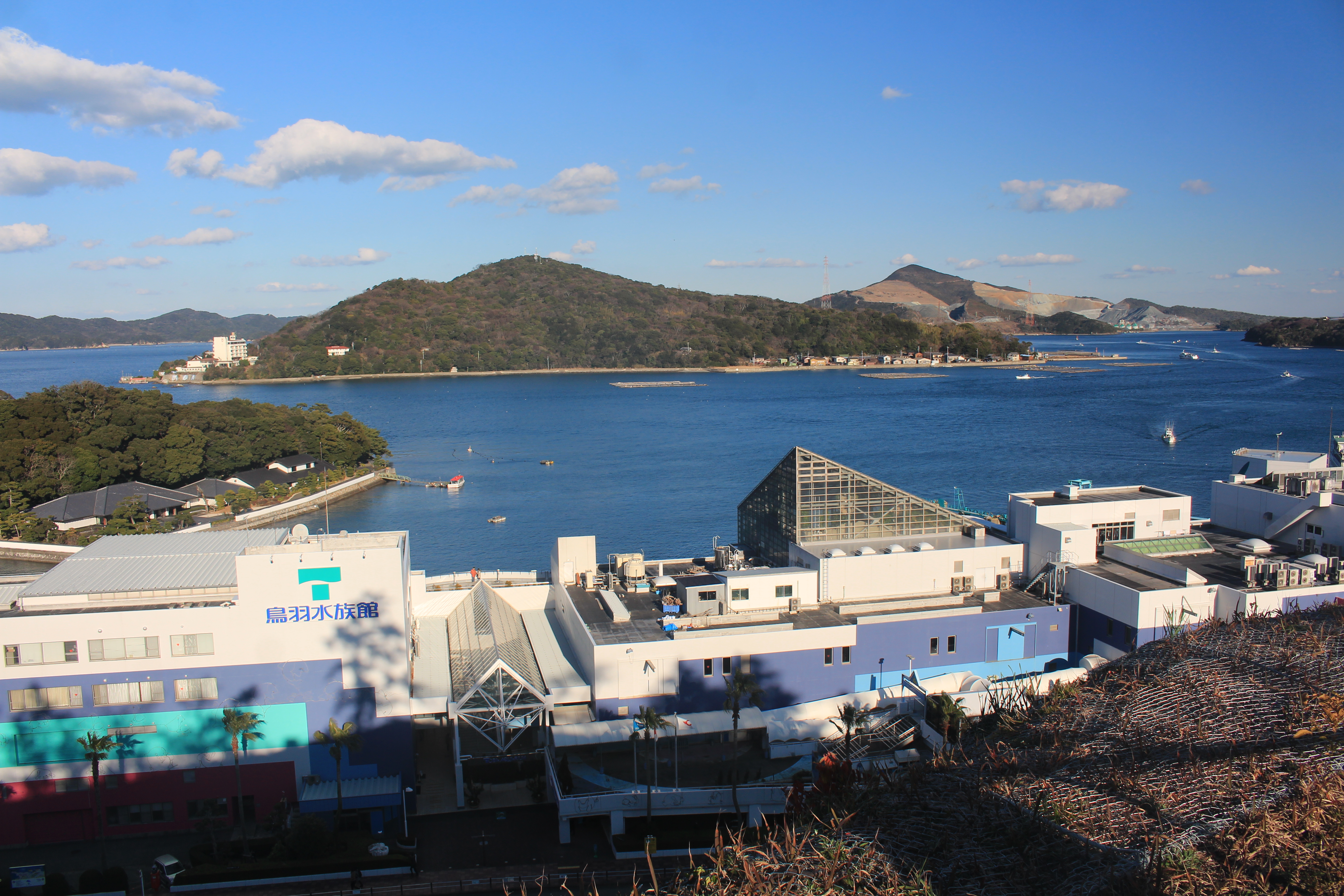
Today the hilltop where Kuki Yoshitaka once plotted naval campaigns is occupied by Toba City Hall, an elementary school, Shiroyama Park, and the Toba Aquarium. The stone walls that survive are the most tangible reminder of the fortress that once commanded Ise Bay. Designated a Mie Prefectural Historic Site in 1965, the castle grounds reward a slow walk -- fragments of the original fortification emerge between modern buildings, and the views across the bay toward the open Pacific hint at why a pirate lord chose this exact hillside. The site sits a fifteen-minute walk from Toba Station, served by both JR Central and the Kintetsu Railway, in a small coastal city better known today for pearl cultivation than for naval warfare.
From the Air
Toba Castle ruins sit at 34.4808N, 136.8446E on a coastal hill in central Toba City, overlooking Ise Bay. From the air, look for the concentration of public buildings (city hall, school, aquarium) on the hillside near the waterfront. The castle site is distinct from the surrounding low-rise development. Nearby airport: Chubu Centrair International Airport (RJGG, approximately 70 nm north). The Shima Peninsula coastline stretching southeast and the entrance to Ise Bay provide strong visual navigation references. Recommended viewing altitude: 2,000-4,000 feet AGL.