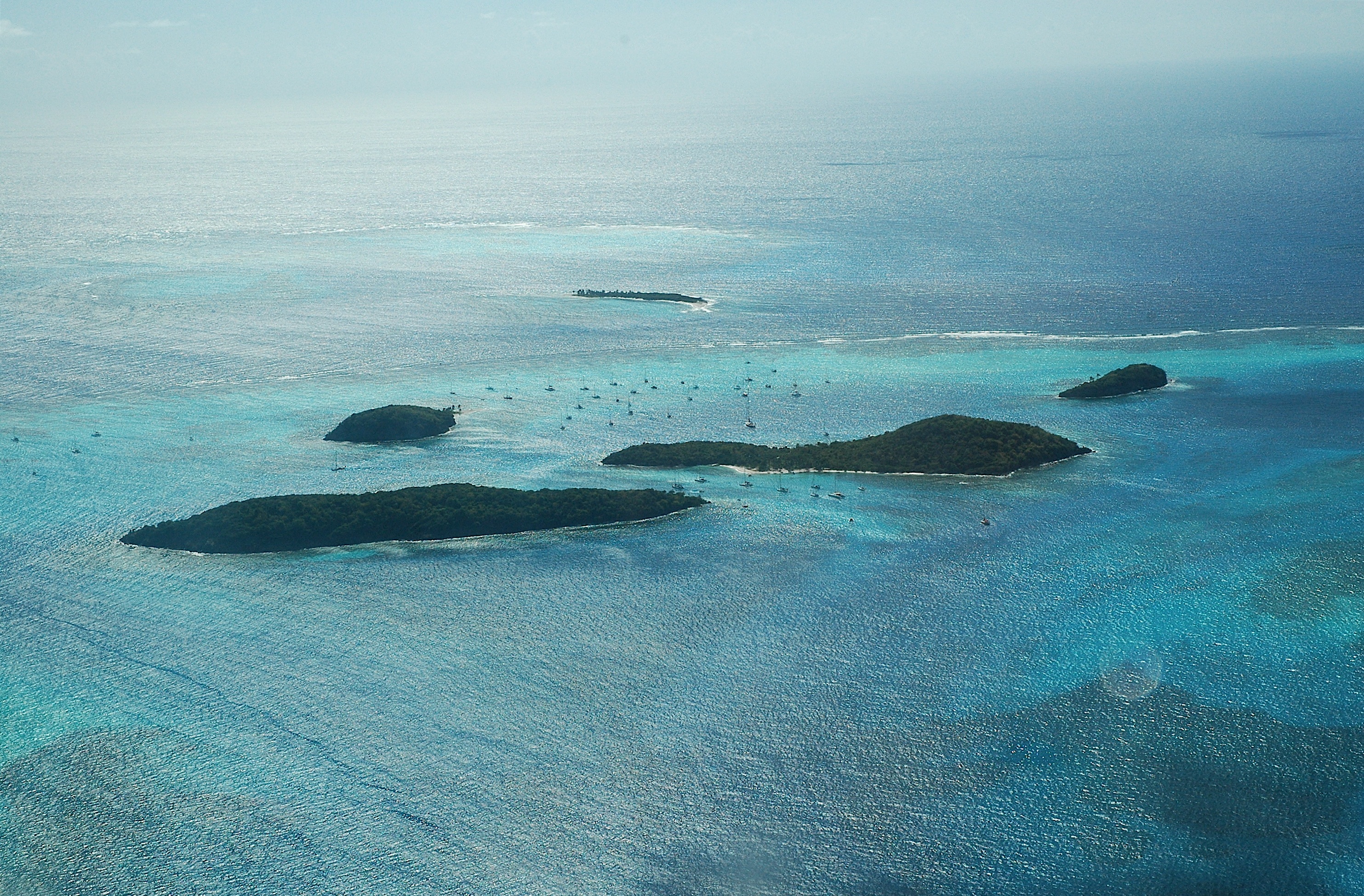
Tobago Cays
From the air, Horseshoe Reef draws a pale arc across the blue like a line someone started and forgot to finish. Inside that arc -- four kilometers of living coral -- five tiny islands sit in a sand-bottom lagoon so clear that anchored yachts appear to float on nothing at all. These are the Tobago Cays, an uninhabited archipelago in the Southern Grenadines: Petit Rameau, Petit Bateau, Baradal, Petit Tabac, and Jamesby. No one lives here permanently, but roughly 3,000 yachts drop anchor in the lagoon each year, and some 50,000 visitors pass through on cruise ships. The cays have no hotels, no shops, no roads. What they have is 1,400 acres of reef-protected water and some of the most extensive coral formations remaining in the Windward Islands.
Ancient Rock, Young Reef
The Grenadines are geologically older than St. Vincent, their parent island to the north. These islands sit on an extensive shallow-water platform, remnants of volcanic activity that predates the more dramatic peaks further up the Lesser Antilles chain. The cays themselves are low and scrubby -- beach vegetation and patches of dry forest, with a small mangrove stand on Petit Rameau and a salt pond on neighboring Mayreau. But the real structure lies underwater. The reef complexes around the windward sides of Mayreau, Union Island, and the cays represent the most extensive and well-developed coral systems in Saint Vincent and the Grenadines. Horseshoe Reef, the signature formation, breaks the Atlantic swells before they reach the lagoon, creating the calm turquoise water that draws sailors from across the Caribbean.
Centuries of Private Hands
For most of recorded history, the Tobago Cays belonged to someone. The islands and neighboring Mayreau were under private ownership from at least the 16th century, passed through colonial hands, and remained privately held long after Saint Vincent and the Grenadines gained independence in 1979. It took until April 12, 1999, for the government to finally purchase the five cays after years of negotiation. Mayreau, the larger inhabited island nearby, stayed in private hands. In 1985, the government had requested assistance from the Organization of American States to develop a management plan for the area, recognizing that this fragile ecosystem needed more than an absentee owner's benign neglect. The Tobago Cays Marine Park was eventually established, encompassing the cays, the lagoon, Horseshoe Reef, and the waters around Mayreau. In December 2014, the park was listed as a regionally significant ecosystem under the SPAW Protocol.
A Lagoon Under Pressure
Being described as one of the largest pristine coral reef groups in the Windward Islands comes with a burden. The same beauty that draws visitors is being degraded by their presence -- and by forces beyond anyone's control. Storm damage, white band disease, and coral bleaching take their natural toll. But human impacts compound the problem. Overfishing, driven by both local fishermen and visiting yachts armed with spear guns, has depleted stocks. Anchors drag across the reef. Sewage from boats and nearby islands seeps into the lagoon. The tension is familiar across the Caribbean: a marine ecosystem whose economic value depends on its beauty, and whose beauty depends on limiting the very activity that generates that value. The marine park's management faces the challenge of balancing access with preservation -- a task complicated by the fact that the cays generate significant revenue for a small island nation.
Five Islands, Each Its Own
Despite their collective name, each cay has its own character. Petit Tabac, the easternmost, gained a moment of cinematic fame as a filming location for Pirates of the Caribbean. Baradal is the preferred snorkeling destination, its leeward waters sheltering sea turtles that have become the cays' unofficial ambassadors. Petit Rameau and Petit Bateau flank the main anchorage, their narrow beaches filling with dinghies on busy days. Jamesby, the smallest, sits slightly apart, its rocky shoreline less inviting to swimmers but rich in the kind of tidal-pool life that rewards patience. None of the islands is more than a few hundred meters across. You can walk around any of them in minutes. What takes longer is the water -- the snorkeling, the drifting, the watching of light shift across a lagoon where the bottom is visible at thirty feet.
From the Air
The Tobago Cays sit at approximately 12.63N, 61.35W in the Southern Grenadines. Horseshoe Reef is clearly visible from altitude as a pale crescent east of the five small islands. The lagoon inside the reef appears as a vivid turquoise patch contrasting with the deeper blue of the open Atlantic. Look for anchored yachts clustered between Petit Rameau and Petit Bateau. Nearby airports: Canouan (TVSC) to the northwest, Union Island (TVSU) to the south. Recommended viewing altitude: 3,000-5,000 ft AGL for the best perspective on the reef formation.