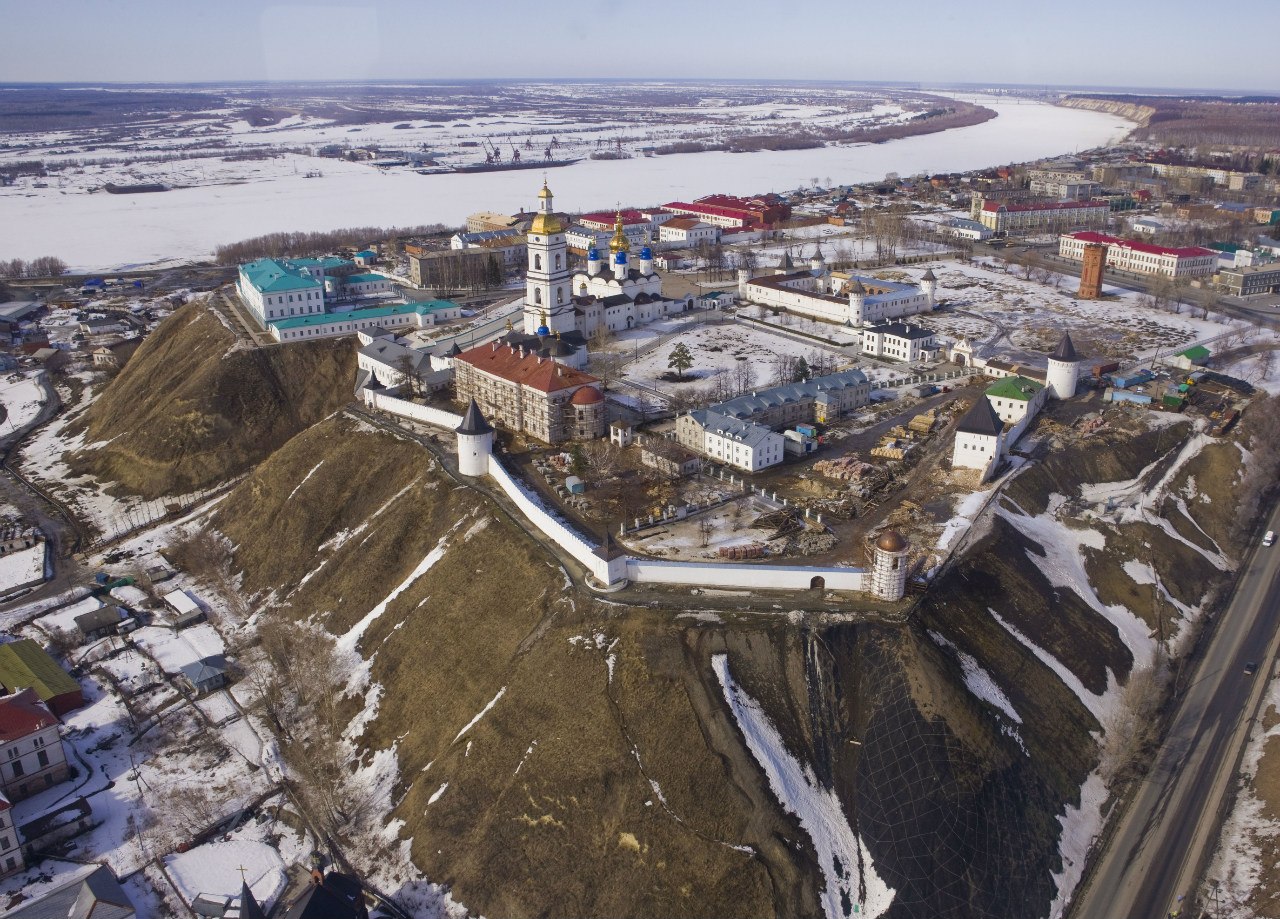
Tobolsk Kremlin
There is only one stone kremlin in Siberia, and it stands where you would least expect to find it -- not in a major industrial center or a modern oil city, but in Tobolsk, a quiet town on a bluff above the Irtysh River in Tyumen Oblast. The Tobolsk Kremlin was built because Moscow wanted it built. In the late 17th century, the capital decided that its Siberian outpost deserved fortifications in stone rather than wood, and sent masons eastward from Moscow and Veliky Ustyug to make it happen. What they raised was not merely a fortress but a statement: Siberia belonged to Russia, and Russia built in stone.
Cathedral on the Frontier
Tobolsk was founded in 1587, a Cossack settlement that grew into the administrative capital of Siberia. For nearly a century its buildings were wooden. Then, between 1683 and 1686, the imported masons constructed the St. Sophia-Assumption Cathedral, the kremlin's centerpiece and the first stone church east of the Urals. Around the turn of the 18th century, stone walls and towers followed, along with a cluster of buildings stretching westward from the cathedral: the Holy Trinity Cathedral, the Bishop's House, the Holy Gate with the Church of St. Sergius of Radonezh, and a bell tower. Metropolitan Paul of Siberia supervised the work. Before his appointment to Tobolsk, Paul had served as Archimandrite of the Chudov Monastery inside the Moscow Kremlin itself -- and the cathedrals he oversaw in Tobolsk, with their cross-domed structures topped by five cupolas, bore the unmistakable imprint of Muscovite tradition transplanted to the Siberian frontier.
The Cartographer Who Built a City
At the end of the 17th century, a remarkable figure took charge of the kremlin's expansion. Semyon Remezov was a cartographer -- the man who produced the first detailed maps of Siberia -- but he was also an architect and, in his spare time, the region's first historian. Remezov designed the Departmental Palace, completed between 1699 and 1704, perched above the southern cliff of the kremlin hill. He followed it with the Trading Arcades in the northwestern corner, built between 1702 and 1706. When Prince Gagarin arrived in 1708 as the first governor of the Siberian province, Remezov designed the stone Demetrius Gate for him in 1712, set dramatically on the edge of the mountain. Gagarin's plans were grander still -- he envisioned a monumental administrative and commercial center -- and he pressed Swedish prisoners of war, exiled to Tobolsk, into the construction gangs. To prevent erosion of the hill, workers even diverted the Tobol River two versts to the south.
Ambition Interrupted
The kremlin's growth halted abruptly. In 1714, Peter the Great issued a blanket ban on stone construction throughout Russia, concentrating all available masons on his new capital of St. Petersburg. Work at Tobolsk continued illegally until 1718, but Governor Gagarin's luck ran out before his buildings were finished. He was executed for corruption, and the Demetrius Gate he had commissioned remained incomplete. The decades that followed brought piecemeal additions -- the Church of the Intercession in the 1740s, stone retaining walls for St. Sophia Gully in 1799, and a new multi-tier bell tower that became the tallest structure in the city. But the era of grand ambition was over. Walls and towers gradually deteriorated, and it was not until 1939 that the kremlin was formally recognized as an architectural-historical monument deserving state protection.
White Walls Above the River
Restoration began in earnest in the early 1970s, with workers reconstructing the walls and towers to their original profiles. Today the kremlin commands its bluff much as it did three centuries ago, its white walls and green-roofed cathedral domes visible for miles along the Irtysh. In 2009, then-President Dmitry Medvedev photographed the complex from the air; the image was auctioned at a St. Petersburg Christmas fair in 2010 for the equivalent of $1.75 million, earning a place on the list of most expensive photographs ever sold. The price was extravagant, but the subject was not. The Tobolsk Kremlin is the architectural proof that Russia's ambitions in Siberia were never temporary -- that the empire built to stay, even when the builders were prisoners and the governors were eventually hanged.
From the Air
Located at 58.199N, 68.253E on a prominent bluff above the Irtysh River in Tobolsk. The white kremlin walls and the green domes of St. Sophia-Assumption Cathedral are highly visible from altitude -- this is the dominant landmark in the city. The lower town (Podgora) spreads below the bluff to the south. Tobolsk Airport is approximately 15 km southwest. Best viewed at 3,000-5,000 ft AGL. The confluence of the Tobol and Irtysh rivers nearby provides excellent navigation reference.