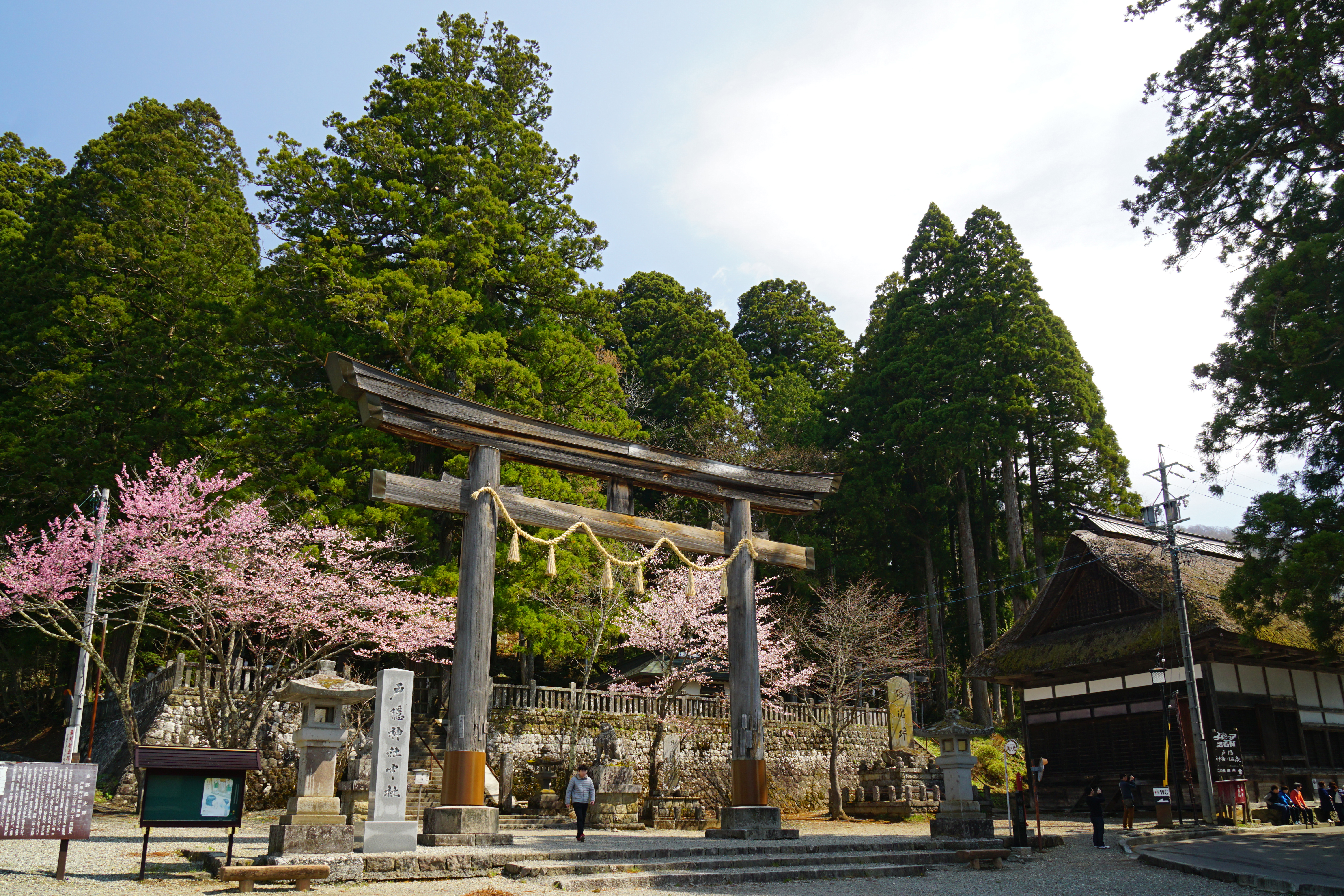
Togakushi Shrine: Two Thousand Years Between the Cedars
The path to Okusha begins quietly. A gravel road passes through forest, crosses a vermilion bridge, and arrives at a wooden gate called Zuishinmon. Beyond it, the world changes. Over 200 Japanese cedars, some more than 400 years old, rise in two rows so straight and tall they form a living nave, their canopy filtering sunlight into green-gold shafts. These cryptomeria are designated Natural Monuments of Japan, and walking between them feels less like hiking and more like entering a cathedral that took four centuries to build. At the end of this two-kilometer avenue, pressed against the base of Mount Togakushi's cliffs, stands the Okusha -- the upper shrine of Togakushi Shrine, the innermost and most sacred of five shrines that have drawn pilgrims to this mountain for what may be more than two thousand years.
Five Shrines, Five Deities
Togakushi Shrine is not a single building but a constellation of five, spread across several kilometers of mountainside and village. Okusha, the upper shrine, enshrines Ame-no-Tajikarao-no-Mikoto -- the god of strength who, according to Japanese mythology, seized the stone door of Amaterasu's cave and hurled it to this mountain. Just below Okusha sits Kuzuryusha, dedicated to a nine-headed dragon deity. Further down the mountain, Chusha serves as the middle shrine. Hokosha, the lower shrine, enshrines Ame-no-Uwaharu-no-Mikoto and is believed to offer blessings for academic achievement, safe childbirth, and the protection of women and children. At Hinomikosha, four deities preside, led by Ame-no-Uzume-no-Mikoto -- the goddess whose ecstatic dancing lured Amaterasu from her cave. Two 500-year-old cedars known as the "husband and wife cedars" stand near this smallest shrine, alongside a cherry tree named after the wandering poet Saigyo. Each shrine carries its own atmosphere, from the mountain grandeur of Okusha to the village intimacy of Hinomikosha.
From Temple to Shrine
The history of Togakushi's sacred site is a story of religious transformation. One tradition holds that Okusha was first established in 210 BC during the reign of Emperor Kogen, though Buddhist accounts date the site to 849 AD when a monk named Gakumon discovered the area and established the practice of Shugendo -- the ascetic mountain tradition blending elements of Buddhism, Shinto, and folk religion. According to the Nihon-Shoki, Emperor Tenmu commissioned a map of the area in 684 AD. For centuries, Togakushi flourished as a Buddhist temple complex whose prestige rivaled Ise Grand Shrine, Mount Koya, and Enryaku-ji. Its formal name was Togakushisan Kansyuin Kenkou-ji. Two major esoteric Buddhist sects, Shingon and Tendai, competed fiercely for control of the temple, with Tendai eventually prevailing. Then came the Meiji government's Shinbutsu Bunri -- the forced separation of Buddhism and Shinto. Under the 1868 Temple Ordinance, the centuries-old temple was converted into a Shinto shrine, Buddhist images were removed, and a tradition that had blended both faiths for over a millennium was cleaved in two.
The Cedar Corridor
The approach to Okusha is the shrine's most powerful experience, and it must be made on foot. From the parking area, visitors pass through Zuishinmon gate and enter the cryptomeria avenue -- a two-kilometer path flanked by towering Japanese cedars that radiate an almost physical sense of age and stillness. The trees, some over 400 years old, are so large that several people would need to link arms to encircle a single trunk. Sunlight filters through the dense canopy in shifting columns. The air smells of damp bark and earth. At the avenue's end, the path steepens toward the cliff face where Okusha's torii gate and shaden main hall stand beneath the mountain's rock walls. In winter, deep snow closes the paths, though snowshoeing is sometimes possible. The remoteness is deliberate: Togakushi has always demanded effort from its pilgrims. The mountain does not come to you.
Pilgrimage and Perseverance
During the eight centuries following its establishment, Togakushi was one of Japan's premier pilgrimage destinations, ranked alongside the most sacred sites in the country. The Togakushi Kodo trail connecting all five shrines stretches about 5.5 kilometers from Hokosha to Okusha and takes two and a half to three hours to walk. Today the shrines can be visited in any order, and buses run between them for those who prefer not to hike. But the full walking pilgrimage remains the way most visitors experience the site, moving from the village shrines upward into increasingly dense forest, the sounds of civilization falling away with each kilometer. Until the 19th century, Buddhist activities at the temple were dedicated to Avalokitesvara, the bodhisattva of compassion. That Buddhist layer has been stripped away by history, but the mountain's capacity to still the mind and challenge the body has not. Togakushi endures as it always has -- demanding that visitors climb toward something worth reaching.
From the Air
Located at 36.74°N, 138.09°E at the base of Mount Togakushi within Myoko-Togakushi Renzan National Park. The five shrine buildings are spread across several kilometers of forested mountainside northwest of Nagano City. The cedar avenue leading to Okusha is not visible from altitude, but the Mount Togakushi ridgeline (1,904 m) and surrounding forest canopy are distinctive. Nearest airports: Matsumoto Airport (RJAF) approximately 80 km south, Niigata Airport (RJSN) approximately 140 km northeast. The area is heavily forested with variable mountain weather.