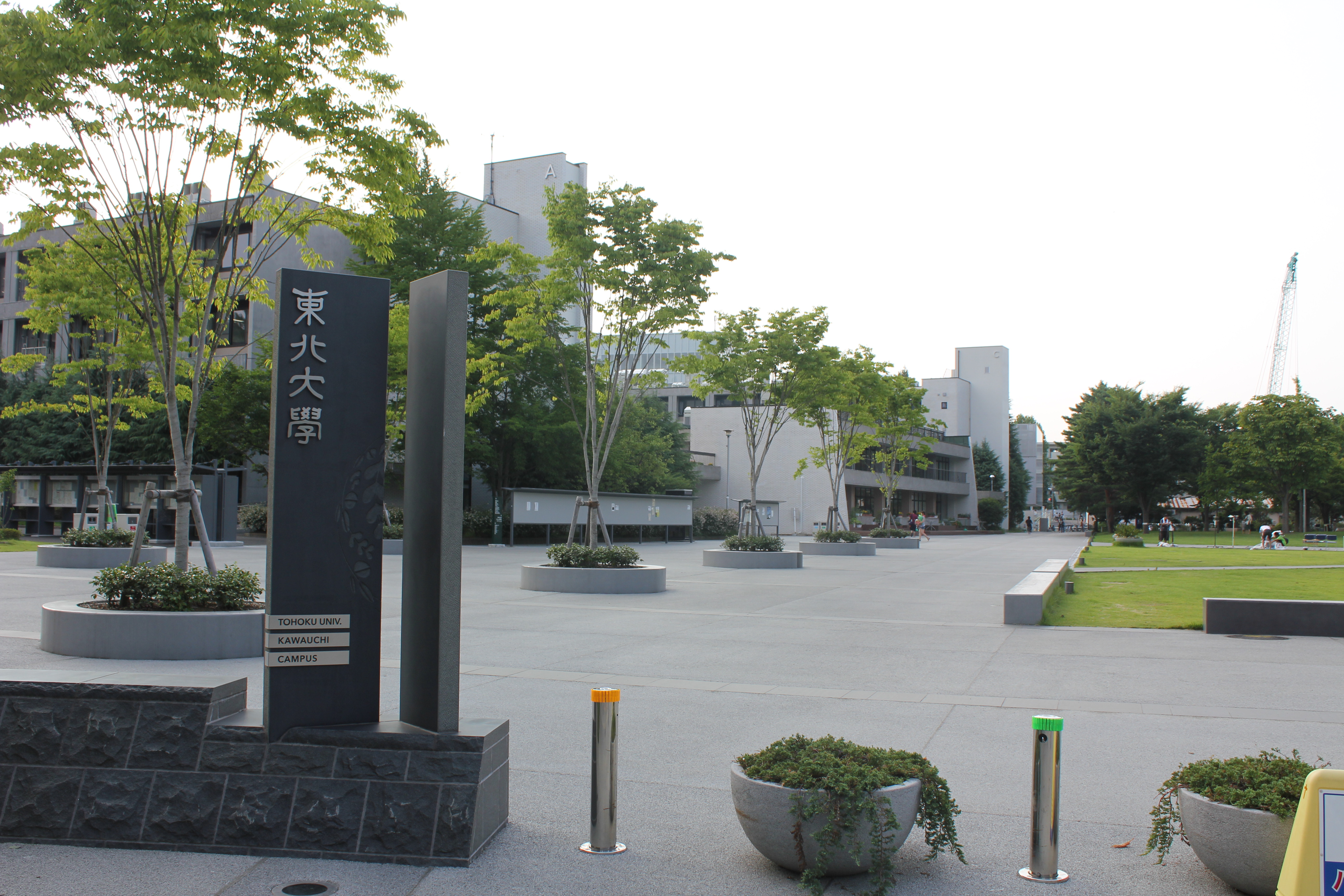
Tohoku University
In 1904, a young Chinese medical student named Zhou Shuren arrived in Sendai, a provincial city in northern Japan that most of his countrymen had never heard of. He enrolled at Sendai Medical College, became its first Chinese student, and would eventually abandon medicine for literature under the pen name Lu Xun, becoming the most influential writer in modern Chinese history. The institution where he studied would grow into Tohoku University, Japan's third Imperial University and one of its most innovative, a place where Albert Einstein himself lectured in 1922 and declared it a worthy rival to his own institution. Spread across four campuses in the wooded hills of Sendai, Tohoku University has spent more than a century proving that great science does not require a Tokyo address.
Open Doors in a Closed Era
When the Meiji government established Tohoku Imperial University on June 22, 1907, it was only the third such institution in Japan, after Tokyo and Kyoto. But from its founding, Tohoku charted its own course. In 1913, it became the first university in Japan to admit female students, a radical decision in an era when higher education was considered an exclusively male domain. It also welcomed foreign students from the outset, embodying an 'Open-Doors' philosophy that remains one of its three core values alongside 'Research First' and 'Practice-Oriented Research and Education.' The university began with just a single college of agriculture in Sapporo, Hokkaido, and it was not until 1911 that teaching actually started in Sendai with the School of Science. The School of Medicine followed in 1915, Engineering in 1919, and Law and Literature in 1922. That agricultural college, incidentally, became independent in 1918 as Hokkaido Imperial University.
The Yagi Antenna and Other Quiet Revolutions
Tohoku's emphasis on practical research has produced inventions that shaped the modern world. In 1926, professor Shintaro Uda co-invented the Yagi-Uda antenna, the familiar multi-element design that would become the ubiquitous television antenna perched on rooftops across the globe. The university's materials science department ranks first in Japan and third worldwide, a distinction that reflects decades of pioneering work in metallurgy and advanced materials. Mathematician Shizuo Kakutani, who later became a professor at Yale, developed the Kakutani fixed-point theorem here, a result with profound applications in game theory and economics. Toshitada Doi, another alumnus, helped pioneer digital audio technology and originated Sony's Aibo robotic pet. The university holds the top position among Japanese universities for number of patents accepted, with 324 in 2009 alone, proof that its founding commitment to practical research endures.
A Campus Between Mountain and Sea
Tohoku University's four principal campuses are woven into the fabric of Sendai, a city of over one million known as the 'City of Trees.' The Katahira campus houses the administration and principal institutes, while Kawauchi accommodates undergraduates in their first two years. The Seiryo campus is home to the medical and dental faculties, and the Aobayama campus, expanded significantly in 2017, serves the sciences, engineering, pharmacy, and agriculture. All four campuses sit inland, pushed toward the mountains and well removed from the coast. This geographic positioning proved consequential on March 11, 2011, when the devastating Tohoku earthquake and tsunami struck the region. No deaths or serious injuries were reported among students or faculty on campus grounds. Earthquake damage did close 27 buildings and caused millions of dollars in equipment losses, but classes resumed by early May, a testament to the resilience of both the institution and the city it calls home.
Where East Met West
The list of notable alumni reads like a cross-section of modern Asian intellectual history. Lu Xun's time at Sendai Medical College from 1904 to 1906 left such an impression that his former lecture hall is preserved as a registered cultural property on the Katahira campus. Economist Hirofumi Uzawa, considered the father of theoretical economics in Japan, studied here, as did Chinese mathematicians Su Buqing and Chen Jiangong, who carried the knowledge they gained back to transform their own nation's academic landscape. Kazumasa Oda, one of Japan's most beloved pop musicians since the 1970s, is an alumnus, as is mystery writer Kotaro Isaka. Nihon Hidankyo, the Japanese organization of atomic bomb survivors, was represented at the 2024 Nobel Peace Prize ceremony by former Tohoku professor Terumi Tanaka. In the Times Higher Education Japan University Rankings, Tohoku placed first in Japan for four consecutive years from 2020 to 2023 and again in 2025.
Sendai's Intellectual Anchor
Today, with 10 faculties, 16 graduate schools, 6 research institutes, and roughly 17,885 students, Tohoku University operates as a National University Corporation, a status it gained in 2004. It ranks 103rd globally in the Times Higher Education World University Rankings and 109th in the QS rankings. But numbers only tell part of the story. The university's identity is inseparable from Sendai itself, a city that Date Masamune founded as a castle town in 1601 and that has grown into the cultural and economic capital of the Tohoku region. From the zelkova-lined boulevards of the campus to the research labs pushing the boundaries of materials science and disaster resilience, Tohoku University remains what it has been since 1907: a place where open doors lead to unexpected discoveries.
From the Air
Tohoku University's campuses are spread across Sendai at 38.254N, 140.874E. The Aobayama campus is visible on the western hillside of the city. Sendai Airport (RJSS) lies approximately 18 km to the south. The city's distinctive grid pattern and tree-lined avenues are visible from altitude, with the university's clusters identifiable near the forested hills west of downtown. Best viewed at 3,000-5,000 feet for campus detail.