Toirano Caves
The cave called Basura was sealed for tens of thousands of years before its discovery in 1950. When explorers broke through into the darkness beneath the Ligurian hills near Toirano, they found what the cave bears had left behind: bones, claw marks, and sleeping hollows worn into the rock by the massive bodies of Ursus spelaeus. The bears had used this cave as a winter shelter during the Pleistocene, and the sealed environment had preserved their traces with extraordinary fidelity. The Toirano Caves, a karst system in the province of Savona just a few kilometers from the Ligurian Ponente Riviera, turned out to be both a paleontological treasure and a geological spectacle.
The Bear's Cathedral
Ursus spelaeus -- the cave bear -- was a massive animal, larger than any modern brown bear, that went extinct roughly 24,000 years ago. The Basura cave preserves not just bones but the physical record of the bears' presence: scratches on walls where they sharpened their claws, depressions in the clay floor where they curled up to sleep through the cold months. Unlike museum specimens behind glass, these traces remain in situ, encountered in the same darkness where the bears left them. Walking through Basura is walking through the last home of a species that vanished before the end of the last ice age, in a space that has changed remarkably little since they abandoned it.
Water's Patient Architecture
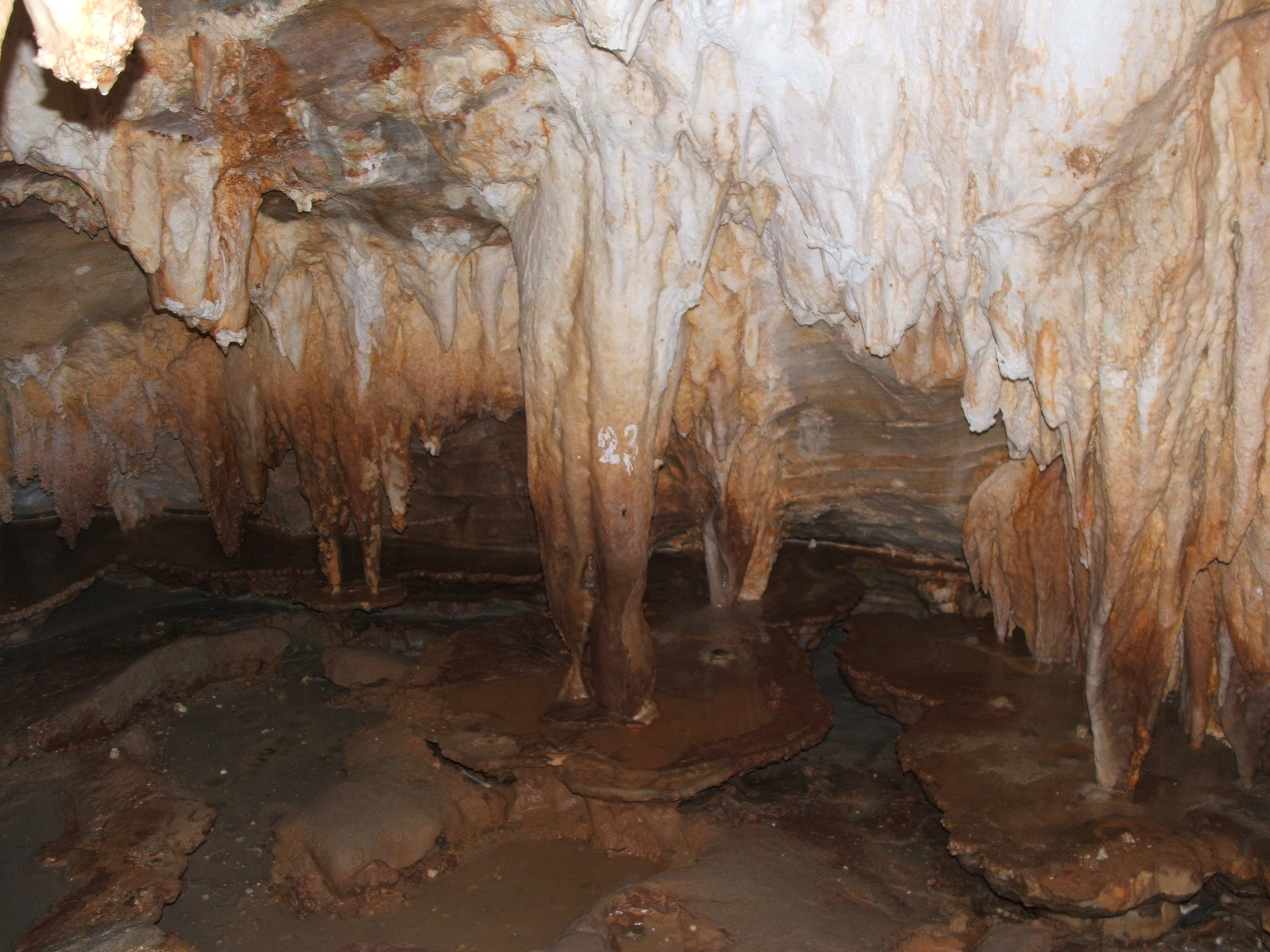
The geological formations in the Toirano Caves rival any show cave in Italy. Stalactites hang in dense curtains, some with distinctive spike formations that give them an almost organic appearance. Speleothems widen noticeably at certain heights, recording periods when water chemistry or flow rates changed. Stalagmites rise from the cave floor in columns and clusters, and in several chambers, the formations have merged into continuous pillars connecting floor to ceiling. The limestone through which water has percolated for millennia is the same karst terrain that characterizes much of the Ligurian interior, but inside the caves, the slow work of dissolution and deposition has produced forms that no sculptor could achieve -- architecture built by dripping water over geological time.
Liguria Underground
The caves sit close to the medieval town of Toirano, accessible from the Borghetto Santo Spirito exit of the A10 motorway, just five kilometers away. The Ligurian coast nearby draws visitors for its beaches and cliff-edge villages, but the Toirano Caves offer something the seaside cannot: a journey into deep time, where the Mediterranean climate and blue water overhead become irrelevant. The cave system extends through multiple connected chambers, each with its own character -- some intimate and densely decorated with formations, others opening into halls large enough to lose all sense of enclosure. The experience moves visitors from the bright Ligurian sun into complete darkness and back again, a passage through geological and biological history compressed into an afternoon.
Preserved in Darkness
What makes Toirano remarkable is the quality of preservation. The sealed environment that kept the bear bones intact also protected the speleothems from the damage that air circulation, humidity changes, and human activity inflict on less isolated caves. Since opening as a show cave, careful management has maintained the conditions that make the formations so striking. The caves offer a rare combination: paleontological significance and geological beauty in a single accessible site, set in a landscape where most visitors come for the sea and the sun, unaware that some of the most dramatic scenery in Liguria lies underground.
From the Air
Located at 44.14N, 8.20E in the Ligurian hills near the coast. The caves are underground and not directly visible from the air, but the town of Toirano and surrounding karst terrain are identifiable. Genoa Cristoforo Colombo Airport (LIMJ) is 70 km northeast. Villanova d'Albenga Airport (LIMG) is closer at approximately 15 km. Best viewed at 3,000-5,000 ft, where the contrast between coastal development and the forested karst interior is apparent.