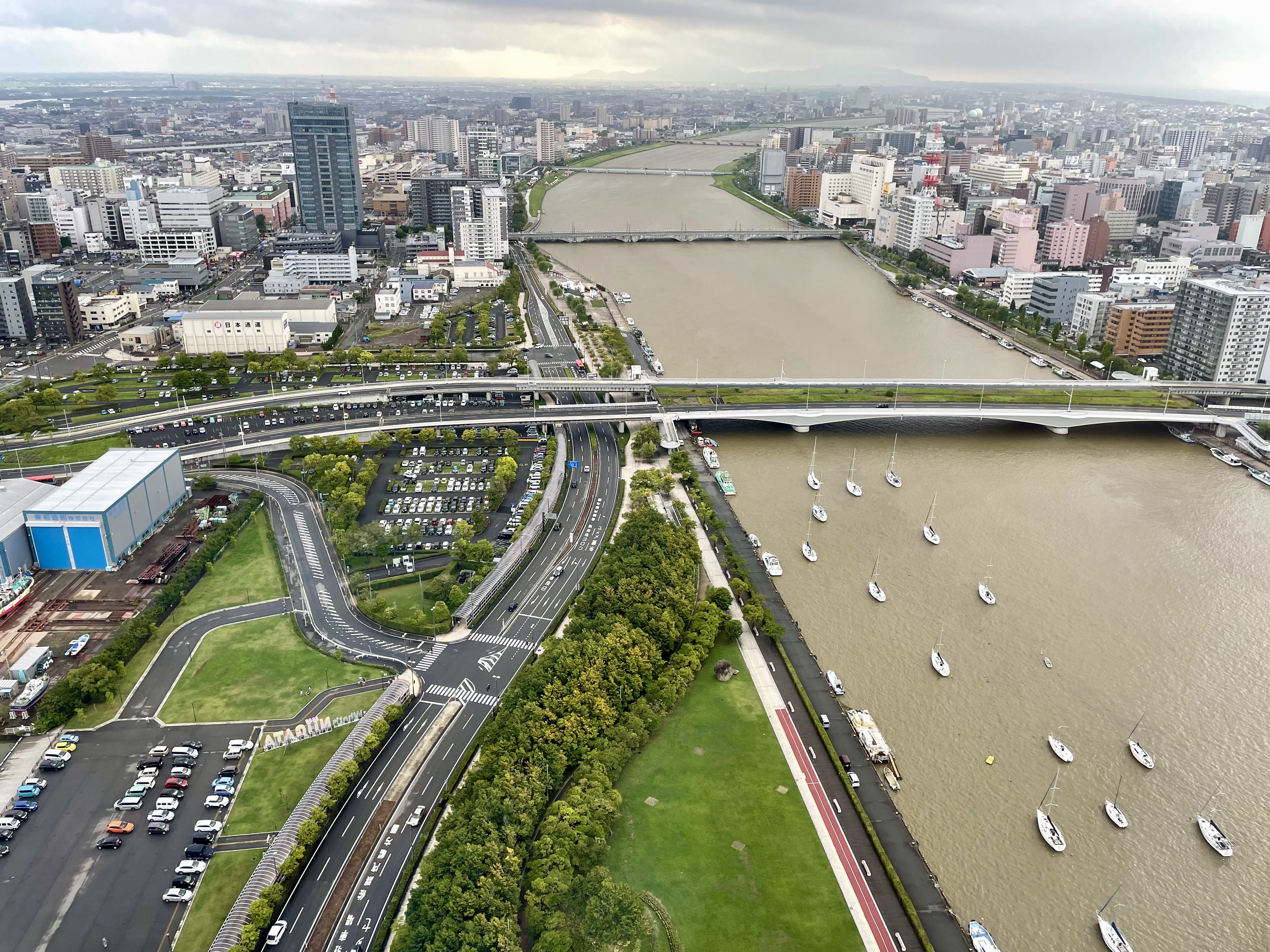
Toki Messe: The Tallest Building on the Sea of Japan
From the 31st floor of Toki Messe, on a clear morning, you can see Sado Island floating on the horizon of the Sea of Japan like a dark brushstroke on silver water. The observatory sits 125 meters above the ground -- the highest vantage point on the entire Sea of Japan coastline -- and the view sweeps from the Gozu mountain range to the east across the flat rice-growing plain of Echigo and out over the river mouth where the Shinano, Japan's longest river, empties into the sea. The building that delivers this view opened on May 1, 2003, designed by Pritzker Prize-winning architect Fumihiko Maki as part of Niigata's waterfront redevelopment. Its name comes from the toki, the crested ibis that serves as Niigata Prefecture's official bird -- a species that was once extinct in the wild in Japan and has since been painstakingly reintroduced. The building, like its namesake, represents a city reinventing itself at the edge of the water.
An Ocean Liner on Dry Land
Toki Messe sits at the mouth of the Shinano River on the Bandaijima waterfront, and its architecture acknowledges the maritime setting. The complex has been compared to an ocean liner -- a long, horizontal mass anchored by the vertical thrust of the 31-story hotel tower. The design by Fumihiko Maki, one of Japan's most celebrated architects, integrates a convention center, exhibition halls, thirteen conference rooms, restaurants, an art museum, and the offices of several international organizations into a single waterfront campus. The tower portion rises 140 meters, making it the tallest building on the Sea of Japan coast. At its base, the exhibition hall and conference facilities sprawl along the riverbank, their scale calibrated for everything from trade shows to basketball games. Since 2004, the Niigata Albirex BB professional basketball team has played its home games here, filling the halls with a different kind of energy than the international conferences the building was designed to host.
The View from 125 Meters
The Befco Bakauke Observatory on the 31st floor is free to visit, and the panorama it offers explains why visitors make the elevator ride. To the west, the Sea of Japan stretches toward the Asian mainland. On clear days, Sado Island -- once a place of exile for poets and emperors, now a UNESCO-recognized cultural landscape -- appears on the horizon roughly 50 kilometers offshore. The smaller island of Awashima is also sometimes visible. To the south and east, the Echigo Plain spreads out in a patchwork of rice paddies that feeds Japan's reputation for premium grain. Below, the Shinano River curves through Niigata's urban core toward its meeting with the sea, crossed by a series of bridges including the historic Bandai Bridge just upstream. The observatory rotates the visitor's perspective through a full circle of geography: mountain, plain, river, city, coast, and open water.
The Bird That Came Back
The name Toki Messe is more than branding. The toki -- the Japanese crested ibis, Nipponia nippon -- carries deep cultural weight in Niigata Prefecture. This elegant wading bird with its distinctive pinkish flight feathers was once common across East Asia, but habitat loss and pesticide use drove the Japanese population to extinction in the wild by the 1980s. The last five wild birds were captured on Sado Island in 1981 in a desperate conservation effort. Through a breeding program using birds gifted by China, the species has been gradually reintroduced to Sado Island, and today a growing population flies free once again over the rice paddies and wetlands of Niigata. Naming the prefecture's most prominent building after this bird was a deliberate act of regional identity -- linking Niigata's modern ambitions to its most celebrated conservation story.
Gateway to a Port City
Niigata has been a port city since the sixteenth century, when a harbor was established at the Shinano River's mouth. During the Edo period, it served as a critical node on the kitamaebune trade route that connected Hokkaido and the Sea of Japan coast to Osaka and the Inland Sea. Rice paid in taxes from the northern domains passed through Niigata on its way to the shogunate's storehouses. In 1858, Niigata was named one of five free treaty ports under Japan's agreements with Western nations, opening to international commerce in 1869. Toki Messe continues this tradition of openness, functioning as the city's primary venue for international exchange. The convention center hosts delegations, trade exhibitions, and cultural events that connect Niigata to the broader world. Twenty minutes on foot from Niigata Station or a short ride on the city's loop bus, the building anchors a waterfront district that has transformed Bandaijima from a working port into a civic destination.
From the Air
Located at 37.93°N, 139.06°E at the mouth of the Shinano River in central Niigata, directly on the Sea of Japan waterfront. The 140-meter tower is the tallest structure on the Sea of Japan coast and is easily identifiable from altitude as a vertical element at the river mouth. Best viewed from 3,000-5,000 feet AGL approaching from the sea to the west for dramatic river-meets-ocean context. Niigata Airport (RJSN) lies approximately 4 nautical miles to the northeast. The Bandai Bridge is visible just upstream, and the Shinano River provides a strong visual corridor through the city.