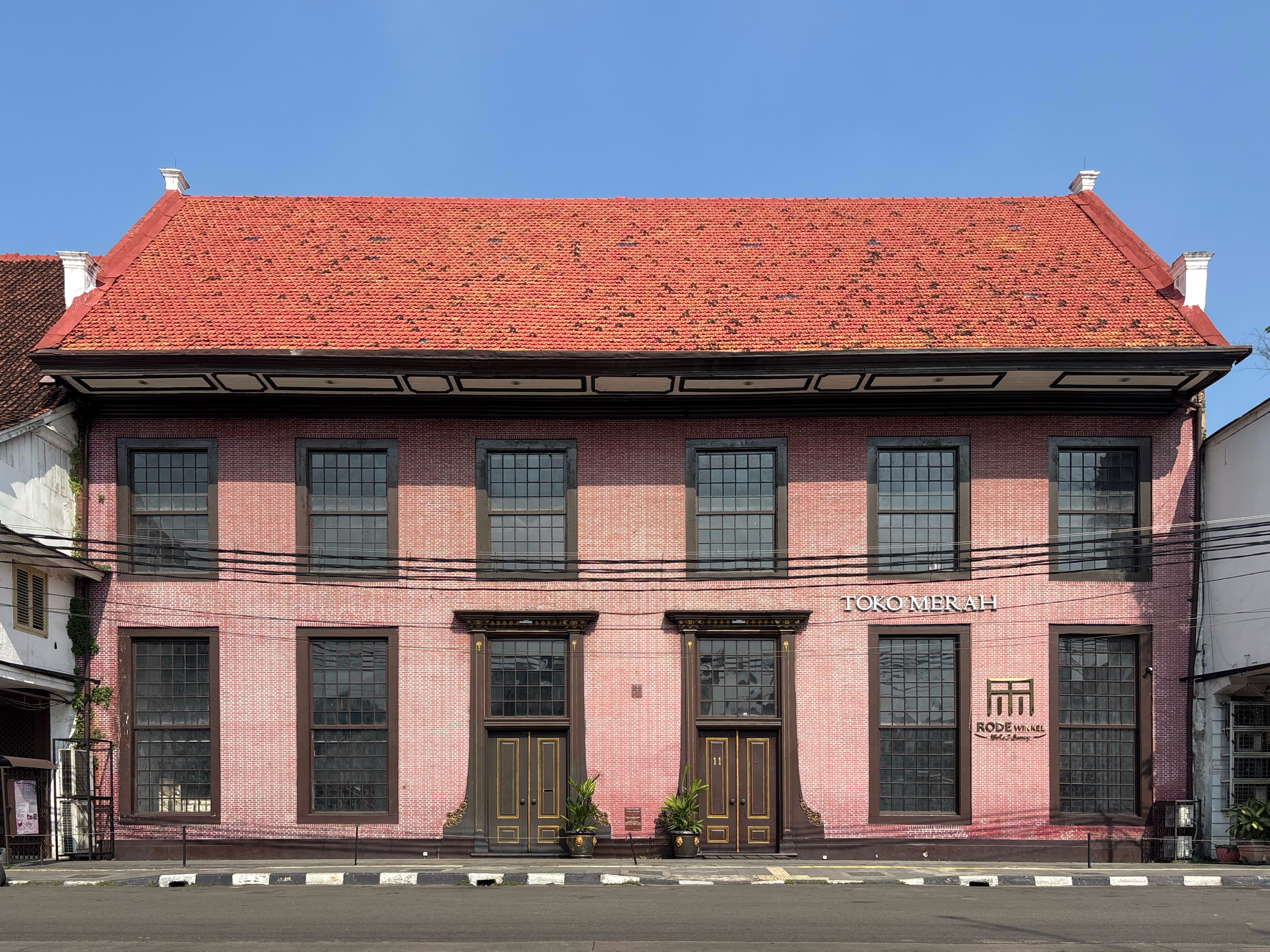
The Red Shop That Outlived Its Owners
The name is almost too simple. Toko Merah - the Red Shop - as if three centuries of colonial ambition, family intrigue, and national transformation could be reduced to a color and a function. But in Jakarta's Old Town, where Dutch canal houses crumble beside motorcycle repair shops and the ghosts of the VOC linger in every weathered facade, simplicity is its own kind of survival. This building on the west bank of the Kali Besar canal has been standing since 1730, making it one of the oldest structures in a city that tends to demolish its past faster than it can document it. The walls are thick, the windows tall and shuttered in the Dutch fashion, and the exterior is painted the deep red that gave it the only name most Jakartans have ever known.
A House Built for the Tropics (Badly)
The architecture of Toko Merah belongs to the earliest period of Dutch colonial building in the East Indies - a style that was essentially 17th-century Amsterdam transplanted to the equator with minimal concession to the climate. High sash windows with split shutters. Gable roofs pitched for rain that falls sideways in a North Sea gale, not the vertical monsoon downpours of Java. Thick masonry walls that held heat like an oven in a city where the temperature rarely drops below 25 degrees Celsius. The building was solidly constructed, with a relatively enclosed structure that would have felt perfectly rational in the Herengracht but made daily life in Batavia an exercise in endurance. Later generations of Dutch builders in Indonesia learned to open their structures up - wide verandas, cross-ventilation, raised floors - but Toko Merah predates that tropical awakening. It is a monument to the stubbornness of early colonial architecture, built by people who believed their way of building was the right way of building, regardless of latitude.
The Governor's Daughter and the Misattributed Address
Jakarta's tourism website has long claimed that Toko Merah served as the residence of three successive Governors-General of the Dutch East Indies: Jacob Mossel, Petrus Albertus van der Parra, and Reynier de Klerck. The truth, as the historian Diessen documented in 1989, is slightly less grand but more interesting. The building's residents were not the governors themselves but their close relatives. Phillipine Theodora, the daughter of Jacob Mossel, lived here with her husband Nicolaas Hartingh, who served as Governor and Director of northeast Java from 1754 to 1761. After Hartingh, it became the residence of the widows of Van der Parra and De Klerck in succession. The distinction matters: Toko Merah was not a seat of power but a house adjacent to power, occupied by the women whose husbands and fathers ran the colony. That it has been misremembered as a governor's palace says something about how history polishes its details - and about the casual erasure of the women who actually lived within its red walls.
From Bligh to Banking
Among the building's more colorful guests was William Bligh - yes, that Bligh, the captain of the HMS Bounty whose crew famously mutinied in 1789. Bligh passed through Batavia on his extraordinary open-boat voyage after the mutiny, and Toko Merah was apparently one of his stops. It is the kind of footnote that delights historians and frustrates anyone looking for a complete narrative, because the details of his visit are sparse. What is better documented is the building's transformation in the 20th century. Between 1920 and 1940, Toko Merah housed the Bank voor Indie, trading family dramas for financial ledgers. After the bank, it became the office of Jacobson van den Berg, a Dutch-owned international trading company. The building's identity shifted from domestic to commercial without any visible change to its facade. The red paint endured. The shutters kept their Dutch proportions. Only the people inside changed.
Independence and What Remains
When Indonesia nationalized Dutch-owned enterprises in 1957, Toko Merah changed hands once more - this time from foreign capital to the Indonesian state. It served as the office of various state-owned enterprises, including PT Satya Niaga from 1972 onward. The building that had once hosted colonial governors' daughters now processed the paperwork of a young republic finding its economic footing. Plans have been discussed to restore Toko Merah as a conference hall and commercial gallery, transforming it into a public space for the first time in its nearly three-century existence. The building sits within the historic heart of Kota Tua, the old walled city of Batavia, within walking distance of the Jakarta History Museum, the Wayang Museum, and the old harbor of Sunda Kelapa where wooden schooners still dock as they have for centuries. In a neighborhood where most colonial-era buildings have been demolished, subdivided, or left to decay, Toko Merah persists - its red paint refreshed, its thick walls still standing, its name still the simplest and most accurate description anyone has ever given it.
From the Air
Located at 6.136°S, 106.811°E on the west bank of the Kali Besar canal in Jakarta's Kota Tua (Old Town) district. From 2,000-3,000 feet, the Old Town's Dutch-era canal grid is distinguishable from surrounding modern development. The building sits amid the cluster of colonial structures near Fatahillah Square. Nearest airport is Soekarno-Hatta International (WIII), approximately 20 km northwest. Jakarta Bay and the historic Sunda Kelapa harbor are visible to the north.