Tokorozawa Aviation Memorial Park
On April 5, 1911, Captain Tokugawa Yoshitoshi climbed into a French-built Henri Farman biplane at the edge of a freshly cleared field in Saitama Prefecture. He coaxed the machine to an altitude of ten meters, covered 800 meters of ground, and landed one minute and twenty seconds later. It was the first flight from Japan's first airfield. The man who made it all possible was Lieutenant General Nagaoka Gaishi, a military visionary famous for two things: recognizing that airplanes would reshape warfare, and possessing a mustache that measured over 20 inches from tip to tip. When he died in 1933, the mustache was clipped, bound in white silk, laid on a satin cushion in its own casket, and buried with full honors in a separate mound. The airfield he championed endured far longer.
Eighty Seconds That Changed a Nation
Tokorozawa Airfield opened on April 1, 1911, with a runway just 50 meters wide and 400 meters long and a small weather station. Only four aircraft operated from the field initially: a Henri Farman, a Hans Grade, a Bleriot, and a Wright Flyer. This was not Japan's first powered flight -- Tokugawa Yoshitoshi and Kumazo Hino had already flown from a meadow at the Yoyogi Parade Grounds in Tokyo the previous December -- but Tokorozawa was the first purpose-built airfield, the place where Japanese aviation acquired permanent ground beneath its wings. By October 1911, the domestically designed Kaishiki biplane No. 1 made its maiden flight here. Emperor Taisho visited the following year to witness the machines firsthand. The Imperial Japanese Army adopted Tokorozawa as its primary aviation training facility, and the first generation of military pilots learned to fly over these Saitama flatlands.
From Pilots to Cold Warriors
During World War II, Tokorozawa served as a training ground for Japanese military pilots, including kamikaze trainees. Remnants of their rest areas still stand within the park grounds -- quiet concrete structures where young men waited between flights, some knowing they would not return from their final missions. When Japan surrendered in August 1945, American forces seized the airfield and converted it into the Tokorozawa Communications Base, part of the vast network of US military installations that dotted postwar Japan. For over two decades, the former runway served American strategic interests rather than Japanese ones. A citizens' movement for the base's return gained momentum through the 1960s, culminating in a march of 4,115 residents in March 1967. By June 1971, sixty percent of the land came back, though communications facilities lingered.
Runways Into Gardens
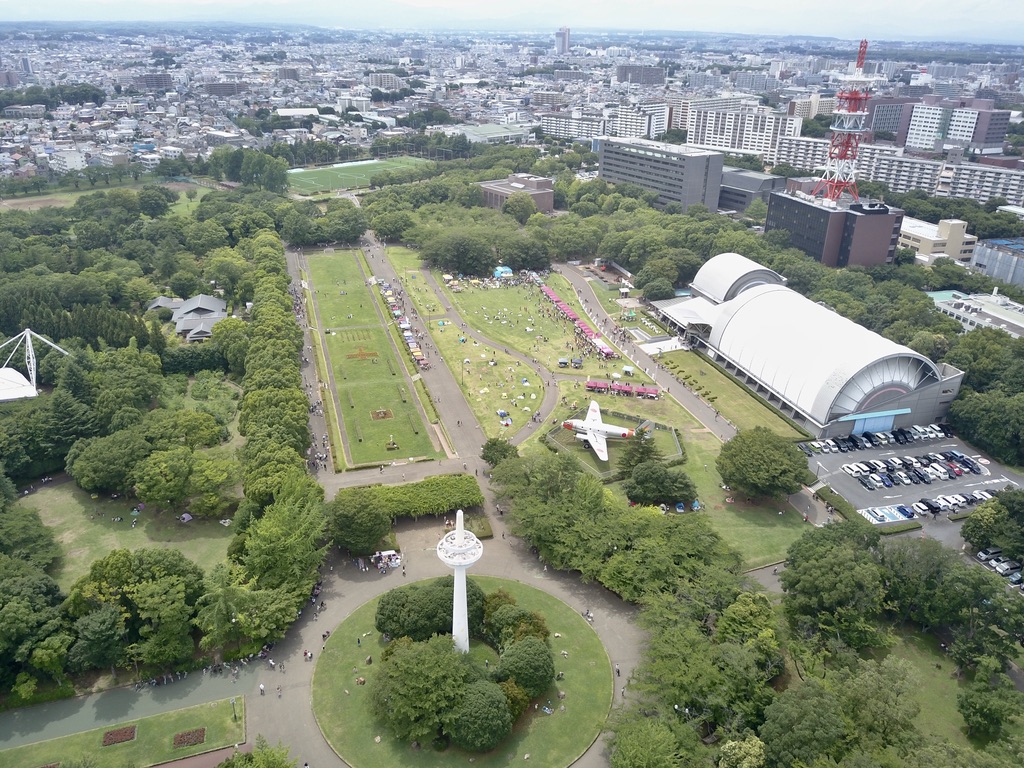
The transformation from military base to public park began in 1974 and reached completion with the park's opening on March 30, 1978. At 50.2 hectares, it became the largest prefectural park in Saitama. The old runway footprint was reimagined as a sunken tea garden, its flower beds renovated in 2008 for the park's thirtieth anniversary. A Japanese garden and teahouse called Saishotei opened in 1999, offering matcha ceremonies in a space that once echoed with engine noise. The Tokorozawa City Library established its main building on the grounds in 1980. Tennis courts, a baseball field, and a dog run fill the spaces between. A running course traces 1.95 kilometers of the park's sidewalks, its surface covered in a special red cushioning material to reduce strain on runners' knees, with footlights illuminating the path after dark.
Where the Henri Farman Still Flies
The Tokorozawa Aviation Museum opened within the park in April 1993, anchoring the site's identity to its origins. Outside Koku-koen Station on the Seibu Shinjuku Line -- the station itself named for the aviation park -- a NAMC YS-11 turboprop stands on permanent outdoor display, placed there in October 1997. The YS-11 holds its own significance: it was the only postwar airliner wholly designed and manufactured in Japan. Inside the museum, the original Henri Farman biplane that Captain Tokugawa flew in 1911 is preserved, the fragile wood-and-fabric machine that started everything. Commemorative signage throughout the park marks the exact spot of that first flight. The park sits about 30 to 45 minutes from central Tokyo, an easy journey that carries visitors from one of the world's most futuristic cities to the modest patch of earth where Japan first left the ground.
From the Air
Located at 35.80N, 139.47E in Tokorozawa, Saitama Prefecture, northwest of central Tokyo. The park occupies 50.2 hectares of the former Tokorozawa Airfield site. The old runway outline is still faintly visible from the air as the sunken garden and linear green corridors. Nearest airports: RJTT (Tokyo Haneda, 45 km south), RJTY (Yokota Air Base, 15 km west). Iruma Air Base (RJTJ) is approximately 8 km northwest. Best viewed at 1,500-3,000 ft to distinguish the park's aviation-heritage layout from surrounding suburban development.