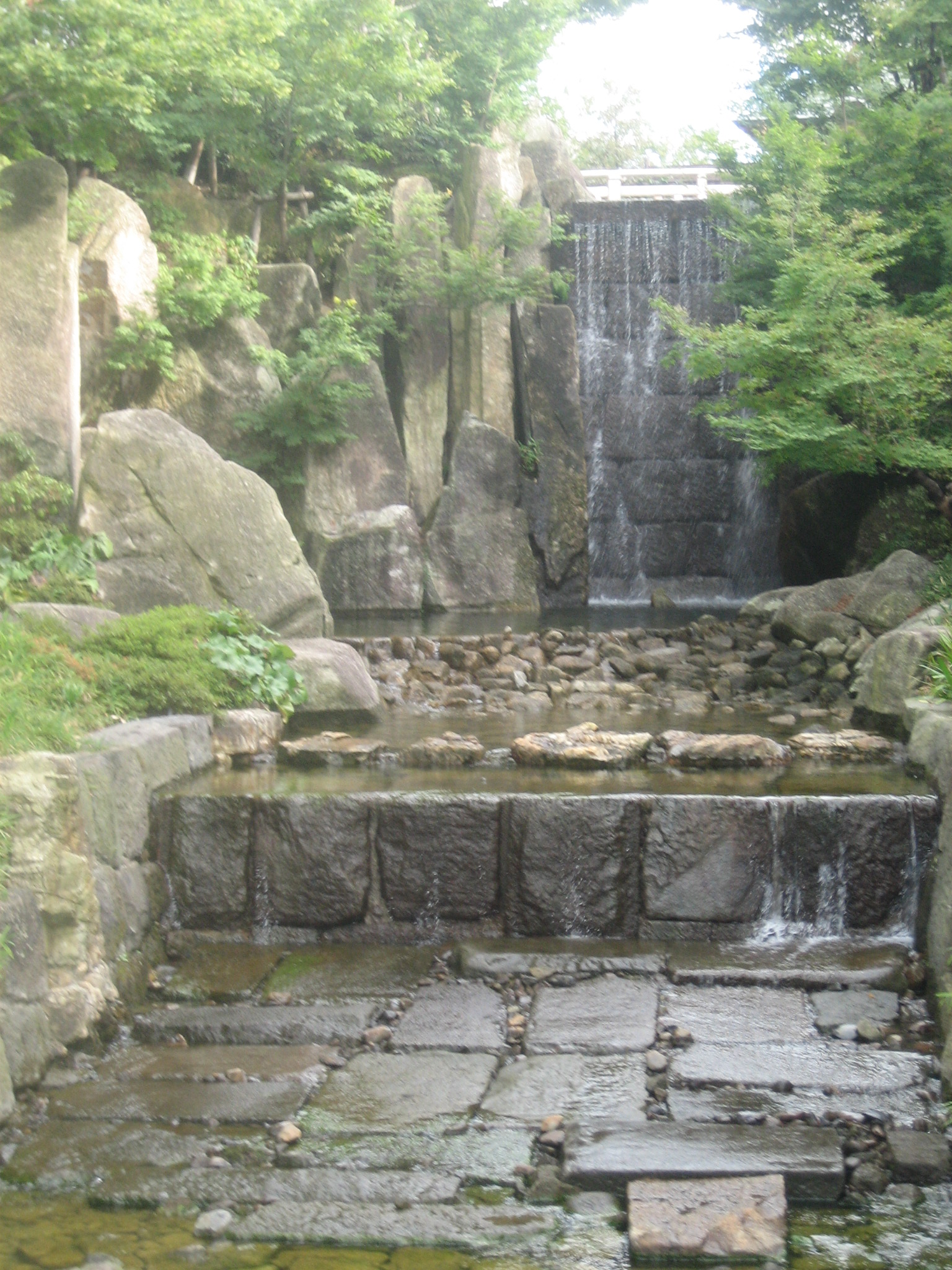
Tokugawa Garden: Where a Warlord's Estate Became a City's Sanctuary
Only the Black Gate survived. When Allied bombing reduced Nagoya to rubble during World War II, the Tokugawa Garden -- once the private landscape of one of Japan's most powerful feudal families -- was obliterated. The gate, a wooden structure with a gabled roof called Kuro-mon, stood alone amid the wreckage. For decades it marked the ghost of a garden that no longer existed. Then, in 2004, the garden came back. Rebuilt as a stroll-style Japanese garden with a central pond, waterfalls, tea houses, and bridges, it reopened as both a historical tribute and a living public park. But the story of this garden begins not with its destruction or its rebirth. It begins with a lord building an estate so grand that his descendants would eventually decide it belonged to everyone.
A Lord's Private Paradise
In the early Edo period, Tokugawa Mitsutomo, the second lord of the Owari branch of the Tokugawa clan, established a vast residence called the Ozone Shimoyashiki. Born in 1625 and serving as domain lord until his death in 1700, Mitsutomo presided over an era when the Tokugawa shogunate's power was at its height and the Owari branch ranked among the most prestigious of the three senior Tokugawa houses. The estate reflected that status: expansive grounds designed for aristocratic life, positioned in what is now eastern Nagoya. After Mitsutomo's death, the property passed through the hands of three retainer families -- Naruse, Ishiko, and Watanabe -- until the Meiji Restoration of 1867 returned ownership to the Owari Tokugawa line. For over two centuries, this land had been a private world, closed to anyone outside the clan's inner circle.
The Gift of 1931
Tokugawa Yoshichika changed everything. The 19th head of the Owari Tokugawa, born in 1886, Yoshichika was a modernizer who recognized that the feudal inheritance his family held carried obligations beyond bloodline. In 1931, he declared that "the time had come to present the property to the community" and donated 23,000 square meters of land and buildings to the City of Nagoya. The donation included family treasures and the establishment of the Owari Tokugawa Reimeikai Foundation, which would oversee the art collection. Nagoya opened the garden to the public in 1932. Three years later, the foundation opened the Tokugawa Art Museum on the same grounds. For a brief, shining period, the compound functioned as Yoshichika envisioned it -- a place where centuries of aristocratic culture could be experienced by ordinary citizens. Then the war came, and the garden was lost.
Rising from Ash and Memory
The firebombing of Nagoya during World War II destroyed nearly everything within the Ozone Shimoyashiki grounds except the Kuro-mon gate. The garden lay dormant for decades, its ponds drained, its paths erased. The turning point came in 1985, when the 50th anniversary of the Tokugawa Art Museum sparked nationwide fundraising led by local economic organizations. The money financed extensive renovations and expansion of the museum, but the garden remained a gap in the compound. It took until 2004 for a full reconstruction to begin. The new garden was designed as a stroll-style landscape centered on a large pond called Ryusen Lake, surrounded by waterfalls, walking promenades, tea houses, and arched bridges. The designers aimed to unite the historical inheritances found in the region into a sanctuary of samurai culture -- a garden that honored the past while functioning as a modern urban retreat.
Seasons in Bloom
The garden's plant palette reads like a calendar. Japanese apricot -- ume -- announces early spring with fragrant pink and white blossoms. Peony, called botan, follows in late spring with heavy, ruffled blooms. Summer brings iris, known as hanashobu, rising from waterside plantings in purple and white. Autumn sets the maples, momiji, on fire with red and gold foliage framing the pond. Between these seasonal anchors, camellias, azaleas, rhododendrons, gardenias, and cluster amaryllis fill the gaps. Japanese witch-hazel, Satsuki azalea, and sasanqua round out a collection that ensures something is always flowering. The Ozone Waterfall, one of the garden's centerpieces, cascades over mossy rocks into the main pond, providing the constant sound of moving water that has been a hallmark of Japanese garden design for centuries.
The Compound Endures
Today, the Tokugawa Garden functions as one piece of a cultural compound that also includes the Tokugawa Art Museum and the Hosa Library, which houses 110,000 items of historical documents and classic literature connected with the Owari Tokugawa family. Accessible from Ozone Station on the Meijo Line of the Nagoya Municipal Subway, the compound sits in an urban neighborhood that gives little warning of the green refuge within. Step through the Kuro-mon -- the original Black Gate, its dark timber worn smooth by nearly four centuries -- and the city disappears. The gate survived the bombing of a city, the collapse of an empire, and decades of neglect. It still opens inward to a garden that a feudal lord planted, a modern heir gave away, a war destroyed, and a community rebuilt.
From the Air
Located at 35.18°N, 136.93°E in eastern Nagoya, Japan, adjacent to the Tokugawa Art Museum and Hosa Library on the former Ozone Shimoyashiki compound. The garden's green canopy and Ryusen Lake are visible from altitude as a distinctive green patch in the urban grid. Chubu Centrair International Airport (RJGG) lies approximately 30 nautical miles to the south. Nagoya Airfield / Komaki (RJNA) is approximately 8 nautical miles to the northwest. Best viewed at 2,000-3,000 feet AGL.