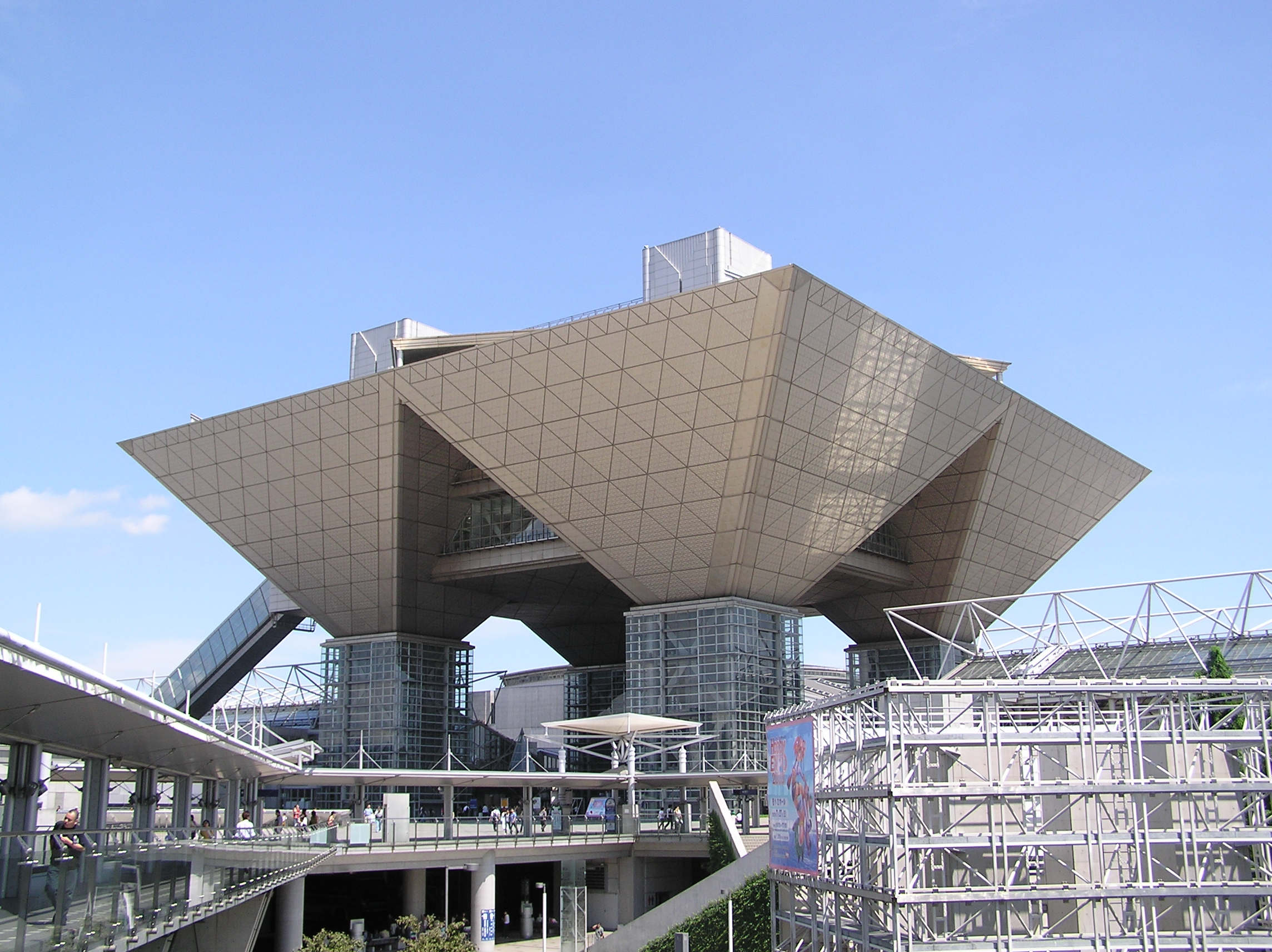
Tokyo Big Sight
Four pyramids, upside down, balanced on concrete stilts above Tokyo Bay. The Conference Tower of Tokyo Big Sight looks like something an architecture student sketched on a dare and a city actually built. Clad in glass and titanium panels, the eight-story structure has no floors three through five -- the inverted pyramid form simply does not allow them -- and visitors ride a 250-ton aerial escalator to reach the convention rooms suspended above the waterfront. Since opening in April 1996, this improbable building in the Ariake district has become Japan's largest exhibition venue and the spiritual home of the world's biggest fan conventions.
Pyramids in Reverse
The Conference Tower remains the building's most arresting feature. Four inverted pyramids, each paneled in glass and titanium, meet above massive supports to create a structure that seems to defy gravity. The first floor holds an 1,100-seat reception hall and four conference rooms. The second floor serves as the main access hub, with the glass-roofed Event Plaza and Entrance Hall connecting visitors to the exhibition halls beyond. Floors three through five simply do not exist -- they vanish into the geometry of the inverted form. Floors six and seven, reachable by escalator from the second floor, house ten conference rooms that can be merged into larger spaces by removing partition walls. Outside, a stylized pond and marble beds add unlikely tranquility to a building that looks like it belongs in a science fiction film.
Building the Impossible
Construction began in October 1992, contracted by the Tokyo Metropolitan Government's Bureau of Finance and handled by eight firms including the Hazama and Shimizu Corporations. Hazama alone took on the Tower segment, claiming forty-five percent of the total contract. The project was finished in October 1995, but the most dramatic moment came on June 30, 1994, when Governor Shunichi Suzuki presided over the lifting-up ceremony -- the raising of the Tower's main structure above ground level. A 250-ton aerial escalator was later installed to link the elevated mass to the lower floors. The venue opened to the public in April 1996, and its floor area surpassed that of Makuhari Messe, the previous record holder, by half.
Where Fandom Comes to Life
Twice a year, Tokyo Big Sight transforms into the epicenter of global fan culture. Comiket, the world's largest self-published comic convention, has called Big Sight home since 1996, drawing hundreds of thousands of attendees across its multi-day runs. AnimeJapan has occupied the halls since 2014, following the Tokyo International Anime Fair which ran from 2002 to 2013. The venue's East Exhibition Hall features a central two-tiered galleria with glass roofing and moving walkways, flanked by six exhibition halls with mobile roofs that let exhibitors control sunlight. The West Exhibition Hall surrounds a central atrium with four internal halls, an outdoor exhibition space overlooking the waterfront, and a rooftop area. Between them, the complex offers twenty-three meeting rooms, six show offices, and enough continuous floor space to host events of nearly any scale.
Olympic Detour and Beyond
Tokyo Big Sight was originally planned as a competition venue for the 2020 Summer Olympics, slated to host wrestling, fencing, and taekwondo. Budget constraints forced the organizing committee to relocate those events elsewhere, but the complex still served a critical role as the main broadcasting and press center for the Games. The pivot captured something essential about Big Sight: it is a building that adapts. Located about thirty minutes by rail from Tokyo Station and twelve minutes by car, the venue sits in the Ariake Minami district on reclaimed waterfront land, part of the broader Odaiba development that reimagined industrial shoreline as a modern entertainment and commercial hub. The Conference Tower, visible from well across the bay, has become as much a symbol of this reinvented coastline as the Rainbow Bridge nearby.
From the Air
Located at 35.630N, 139.794E on the Ariake waterfront of Tokyo Bay. From the air, the Conference Tower's four inverted pyramids are unmistakable -- a distinctive geometric silhouette on the reclaimed shoreline near Odaiba. The Rainbow Bridge is visible to the northwest. Nearest airports: Tokyo Haneda (RJTT) approximately 6 nm south-southwest, Narita International (RJAA) approximately 38 nm east. Best viewed at 2,000-4,000 feet AGL. The large rectangular exhibition halls flanking the tower provide additional visual reference against the waterfront.