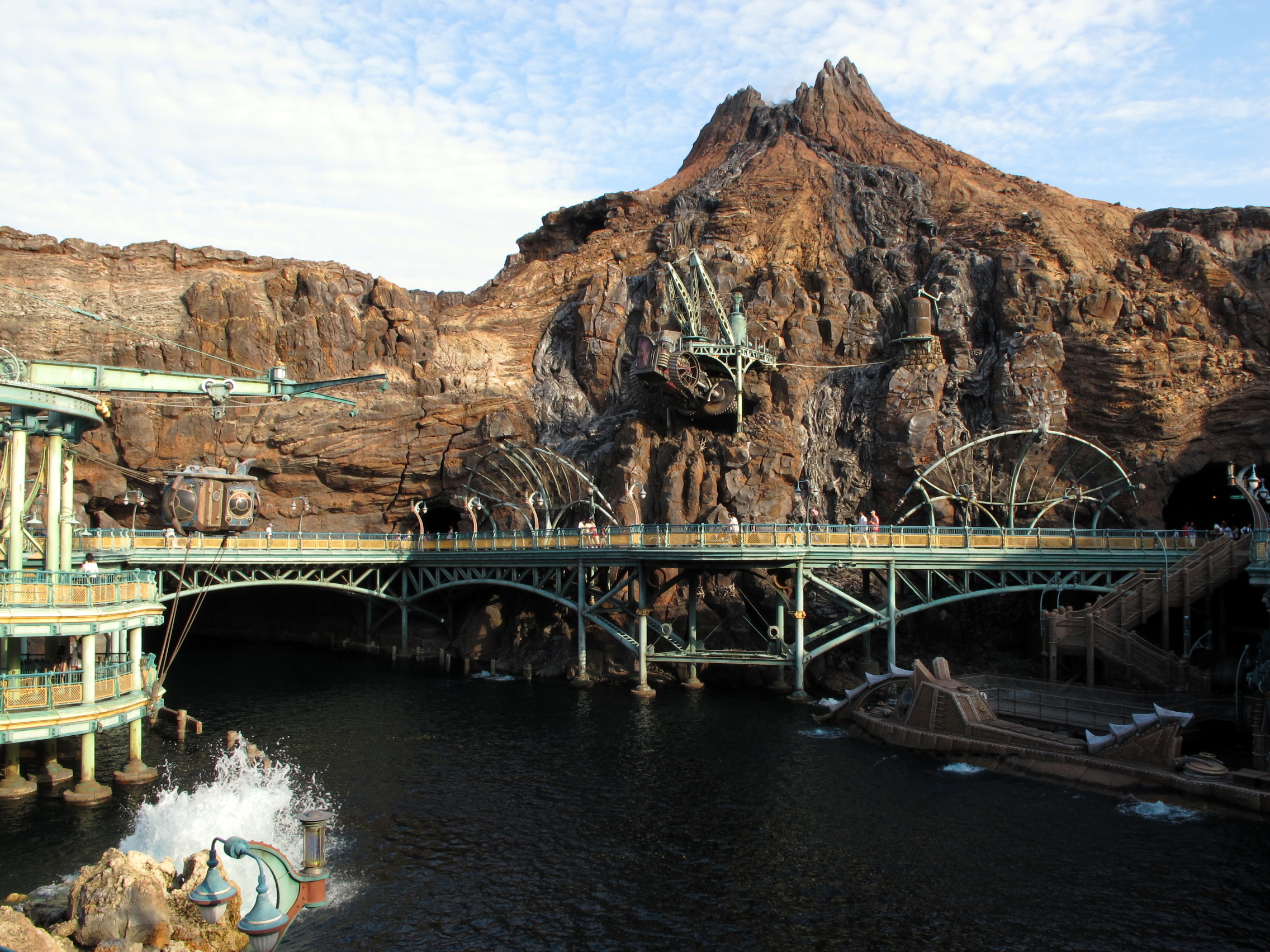
Tokyo DisneySea
It cost roughly three billion U.S. dollars and opened three days before the September 11 attacks redefined international travel. Tokyo DisneySea should have been a catastrophe. Instead, it hit ten million visitors in 307 days -- a world record for any theme park -- and has spent two decades being called the finest Disney park ever built. The reason is simple: DisneySea does not feel like a theme park. Its Mediterranean Harbor entrance replicates Venice and Portofino at full scale, complete with gondolas that glide past a functioning hotel seamlessly woven into the architecture. The effect is less 'attraction' and more 'place you have accidentally wandered into.' That deliberate confusion of fantasy and reality runs through every corner of the park, from the Jules Verne volcano at its center to the 1920s New York waterfront that smells of sea air and popcorn.
A Castaway Idea Finds Its Port
DisneySea began as someone else's dream. In the early 1990s, Disney proposed 'Port Disney' for Long Beach, California -- a nautical-themed park anchored by the RMS Queen Mary. Financial fallout from Euro Disney killed the project. But the Oriental Land Company, which had licensed Tokyo Disneyland in 1983 and watched it become the most-visited theme park outside the United States, saw an opportunity. They took Disney's abandoned waterfront concept and commissioned something far more ambitious. Ground broke in October 1998 on reclaimed land in Urayasu, Chiba Prefecture, along the western shore of Tokyo Bay. The original plan had been a Hollywood Studios clone, but the Japanese asset bubble's collapse in 1991 forced a rethink. What emerged was something no Disney park had attempted: a fully realized world of nautical exploration, with no castle at its center and no Main Street U.S.A. at its entrance.
Eight Ports, One Volcano
Mount Prometheus dominates the skyline -- a fabricated volcano that periodically rumbles and glows, housing Mysterious Island, the park's most atmospheric land. Inside the caldera, Jules Verne's Vulcania comes to life: Journey to the Center of the Earth launches riders through bioluminescent caverns before erupting onto the volcano's outer slope at speed. The surrounding seven ports radiate outward like spokes. Mediterranean Harbor's V-shaped layout breaks from every Disney template, forgoing a central hub in favor of winding Italian streets. American Waterfront reconstructs early-twentieth-century New York and Cape Cod, anchored by the full-sized ocean liner SS Columbia. Arabian Coast conjures a world from One Thousand and One Nights. Mermaid Lagoon tucks an entire undersea kingdom inside a massive shell-shaped building. In June 2024, an eighth port opened: Fantasy Springs, a 320-billion-yen expansion featuring Frozen, Tangled, and Peter Pan areas alongside a new luxury hotel built directly into the park.
Where the Hotel Is the Scenery
The Tokyo DisneySea Hotel MiraCosta is the park's most radical design idea. Rather than standing outside the gates, the hotel is the southern boundary of Mediterranean Harbor -- its rooms, balconies, and terraces look directly into the park. Guests in real hotel rooms peer out at visitors below, who look up and see what appears to be a Portofino residential neighborhood with people in the windows. The line between set and structure dissolves. Theme park designers call this 'kinetic authenticity' -- real human activity providing the illusion of a living town. It won Tokyo DisneySea the Themed Entertainment Association's Thea Award in 2002 for overall concept, design, and construction, a recognition typically reserved for individual attractions rather than entire parks.
The Record That Still Stands
Ten million guests in 307 days. That was Tokyo DisneySea's opening-year record, beating Universal Studios Japan's mark of 338 days by over a month. By 2024, annual attendance had reached 12.4 million, making it the seventh-most-visited theme park on Earth and the third-most-visited in Japan, trailing only Tokyo Disneyland and Universal Studios Japan. The park has weathered Typhoon Hagibis in 2019, a four-month COVID closure in 2020, and the constant pressure of being measured against its own reputation. Theme park enthusiasts routinely rank it first worldwide. The distinction matters because DisneySea is not owned by Disney -- the Oriental Land Company owns and operates it under license, meaning every operational decision, from queue design to food quality, reflects Japanese standards of hospitality rather than Burbank corporate directives.
From the Air
Located at 35.627N, 139.888E on reclaimed land along Tokyo Bay in Urayasu, Chiba Prefecture. The park's Mount Prometheus volcano and distinctive harbor layout are identifiable from altitude. The park sits adjacent to Tokyo Disneyland to the north, with the resort's monorail loop connecting both parks. Nearest airport: Tokyo Haneda (RJTT) approximately 15km southwest across the bay. Narita International (RJAA) lies approximately 55km east. The site is within Tokyo's heavily controlled airspace. Best viewed on approach to Haneda from the east, when the entire Tokyo Disney Resort complex is visible along the bay shoreline.