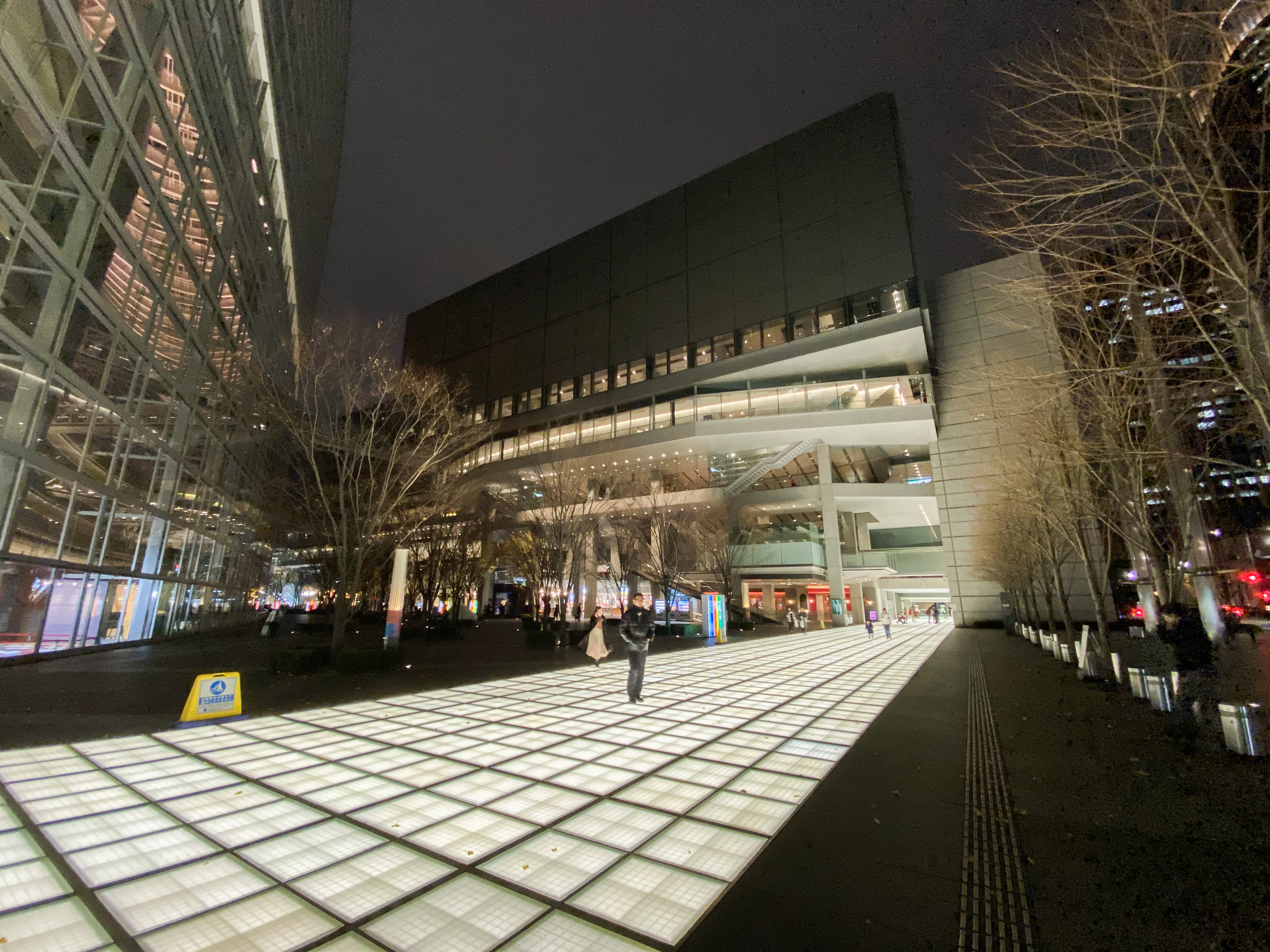
Tokyo International Forum
Stand inside the Glass Hall atrium and look up. The steel trusses curve overhead like the ribs of some enormous translucent ship, converging sixty meters above the lobby floor into a narrow spine of glass. Sunlight pours through the hull. The building hums with foot traffic -- salarymen cutting through on their commute between Tokyo Station and Yurakucho Station, concertgoers heading to the 5,000-seat Hall A, delegates arriving for conferences that shape global policy. Rafael Vinoly designed this building to look like a boat, and the metaphor works in ways he may not have intended: the Tokyo International Forum is a vessel for nearly everything modern Tokyo does, from classical music festivals to Olympic competitions, all housed inside one of the most structurally audacious buildings of the 1990s.
Where City Hall Used to Stand
Until 1991, this site in Marunouchi, Chiyoda, housed Tokyo's City Hall. When the metropolitan government relocated to Kenzo Tange's twin-towered complex in Nishi-Shinjuku, it left behind prime real estate between two of Tokyo's busiest rail stations. The city launched an international design competition, and Vinoly -- born in Montevideo, educated in Buenos Aires, practicing in New York -- won with a scheme that treated the elongated site as a constraint to celebrate rather than overcome. His design placed two primary structures side by side: the soaring Glass Hall, a tapered elliptical atrium that serves as the building's public spine, and a rectangular block containing eight performance and exhibition halls. The complex opened in 1996 and immediately became a landmark, its glass prow visible from the elevated Yamanote Line tracks that curve past the site.
The Boat That Hosts the World
The list of events held at the Forum reads like a cross-section of global ambition. In 1999, FIFA held the draw for the 2002 World Cup preliminary competition here. In 2012, the World Bank and International Monetary Fund convened their annual meetings inside its halls. The International Union of Architects brought its world congress in 2011. The International Bar Association followed in 2014. Between these headline gatherings, the Forum hosts La Folle Journee au Japon, an annual classical music marathon that packs hundreds of short concerts into a single weekend, and NHK's Kohaku Uta Gassen, Japan's iconic New Year's Eve music broadcast. Pop stars from Ariana Grande to Shawn Mendes have filled Hall A. The building's flexibility -- eight halls ranging from intimate recital rooms to the 5,000-seat main auditorium -- means it can accommodate almost any event that fits through its doors.
Olympic Steel
When the 2020 Summer Olympics finally took place in 2021 after a year-long pandemic delay, the Tokyo International Forum served as the venue for Olympic weightlifting and Paralympic powerlifting. Athletes lifted beneath the same steel trusses that had framed corporate keynotes and rock concerts. The choice was pragmatic -- Tokyo already had the infrastructure, and the Forum's central location made it accessible without building new facilities. But there was something fitting about using Vinoly's glass cathedral for the Games. The building was conceived as a public monument to openness, its transparent walls deliberately rejecting the fortress-like opacity of most convention centers. Watching the world's strongest athletes compete inside a structure designed to let in as much light as possible gave the events an almost theatrical quality.
Dokan's Gaze Toward the Palace
On the first floor, facing the direction of the Imperial Palace, stands a bronze sculpture of Ota Dokan -- the fifteenth-century warrior-poet who built Edo Castle in 1457, establishing the settlement that would eventually become Tokyo. The placement is deliberate. Dokan's castle stood less than a kilometer away, on the grounds now occupied by the Imperial Palace. His statue gazes toward it across six centuries of urban transformation. The sculpture anchors the Forum to something older than its glass-and-steel modernism, a reminder that this patch of Marunouchi has been central to Tokyo's identity since before the city had its current name. Outside, the surrounding blocks of corporate towers and rail infrastructure press in on all sides, making the Forum's airy interior feel like a clearing in a steel forest -- a public room carved out of one of the densest business districts on Earth.
From the Air
Located at 35.677N, 139.764E in central Tokyo's Chiyoda ward, between Tokyo Station and Yurakucho Station. The elongated glass-roofed structure is identifiable from altitude by its distinctive boat-like shape running north-south, with the curved glass atrium visible as a bright reflective strip among surrounding office towers. The Imperial Palace grounds and East Gardens lie approximately 500 meters to the northwest. Nearest airports: Tokyo Haneda (RJTT) approximately 14km south, Narita International (RJAA) approximately 60km east. The site is deep within Tokyo's controlled airspace, directly below standard approach paths to Haneda.