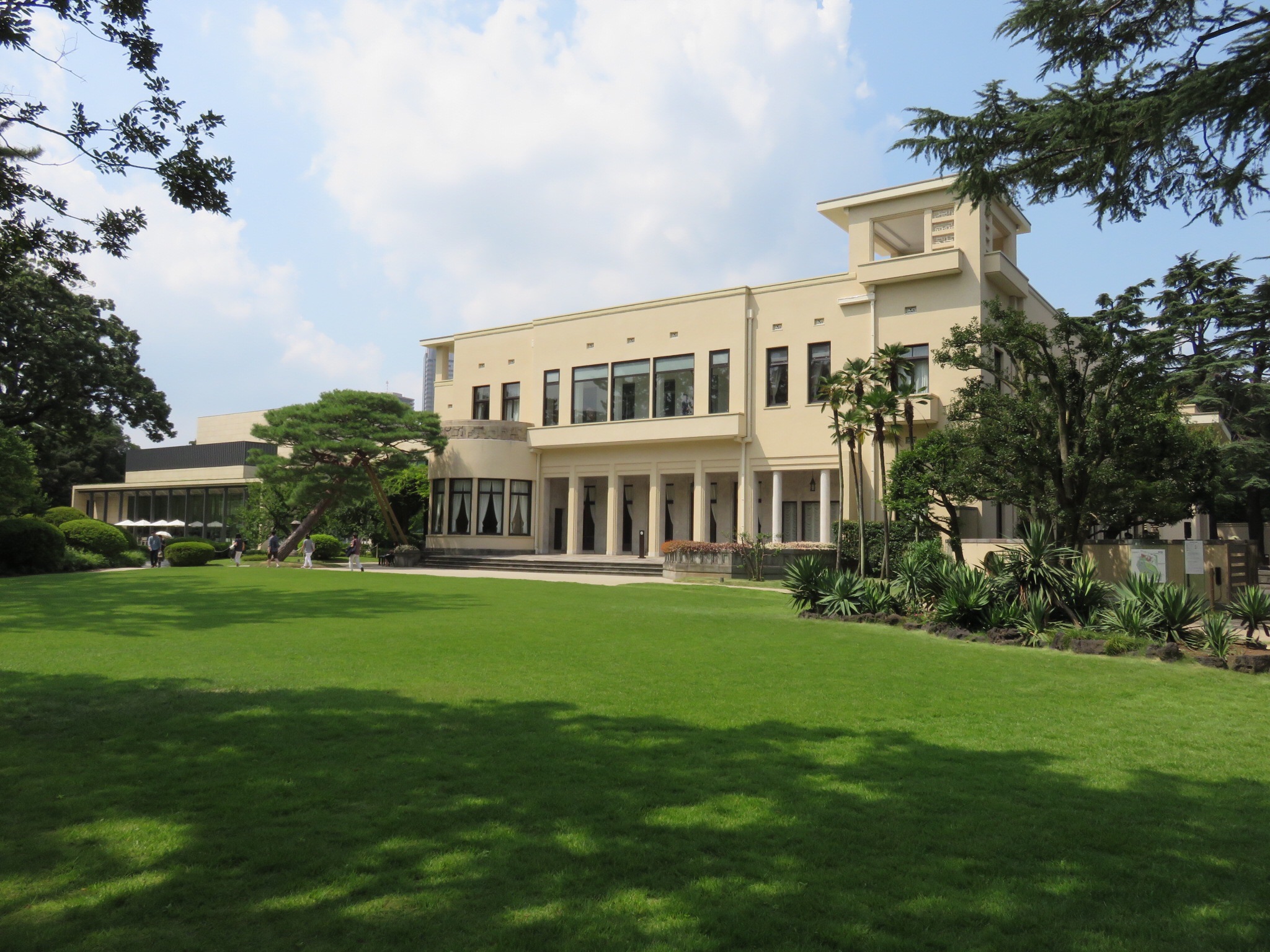
Tokyo Metropolitan Teien Art Museum
The chandelier in the great dining room was made by Rene Lalique. The geometric ceiling panels were designed by Henri Rapin. The porcelain 'perfume tower' in the anteroom was crafted in a style that would have looked fashionable in a Parisian salon of 1930. None of this is in Paris. It is in Shirokanedai, a quiet residential neighborhood in Tokyo's Minato ward, tucked behind garden walls just east of Meguro Station. Prince Asaka Yasuhiko commissioned this house in the early 1930s after returning from years of study and travel in France, where the Art Deco movement had seized his imagination. He brought back not just enthusiasm but actual French designers, and the result is the most authentic Art Deco interior in Japan -- a building where European glamour and Japanese imperial ambition produced something that belongs fully to neither tradition.
The Prince Who Brought Paris Home
Prince Asaka Yasuhiko was a member of a collateral branch of the Japanese imperial family who studied at the Ecole Speciale Militaire de Saint-Cyr, France's premier military academy. He traveled to the United States in 1925 and spent years absorbing European culture. By the time he returned to Japan, Art Deco was sweeping Western capitals -- the geometric patterns, luxurious materials, and streamlined forms that defined the 1925 International Exhibition of Modern Decorative and Industrial Arts in Paris. The prince wanted a residence that embodied this movement. He commissioned Gondo Yukichi of the Imperial Household Ministry's Works Bureau as the building's main architect, but the interiors were designed from plans submitted by Henri Rapin, a prominent French decorator. Rene Lalique, the master glassmaker whose work defined Art Deco luxury, created the lighting fixtures. The residence was completed in 1933.
Three Lives of One Building
The Asaka family lived in the residence from 1933 to 1947. When the postwar restructuring of Japan's imperial system stripped most princes of their status, the building passed to the government. For three years, from 1947 to 1950, it served as the official residence of the Prime Minister of Japan -- cabinet meetings and diplomatic receptions held beneath Lalique glass and Rapin ceilings. From 1950 to 1974, it became a State Guest House, hosting foreign dignitaries in rooms originally designed for one family's private life. By the time the government outgrew the building and relocated its guest house functions to the renovated Akasaka Palace, the former Asaka residence had accumulated enough historical weight to justify preservation. In 1983, it opened to the public as the Tokyo Metropolitan Teien Art Museum -- 'teien' meaning garden, a nod to the landscaped grounds that surround the building.
Lalique Light and Rapin Geometry
Walking through the museum's permanent spaces is a lesson in Art Deco at its most refined. Lalique's lighting fixtures hang in the great dining room -- elaborate glass compositions that catch and scatter light in ways that feel simultaneously warm and crystalline. Rapin's geometric ceiling designs impose order on each room while maintaining the sense of understated opulence that defines the style. A stained-glass ceiling illumination fills one room with colored light. Royal Copenhagen porcelain figures -- penguin ornaments from around 1920 -- sit in rooms where the Asaka family once took their daily meals. The white porcelain 'perfume tower' in the anteroom called Tsugi-no-ma is an object that would command attention in any museum in the world, yet here it occupies its original position, in the room it was designed for, fulfilling its intended purpose of scenting the air for guests arriving at a prince's dinner table.
The Garden and the New Wing
The museum's name insists on the garden, and the grounds justify the emphasis. Japanese landscaping surrounds the Art Deco building, creating a dialogue between European interior design and Japanese spatial philosophy that the prince himself must have intended. Sculpted trees, stone paths, and seasonal plantings provide the kind of meditative quiet that Tokyo's density usually denies. In 2013, the museum closed for extensive renovation. When it reopened in November 2014, it included a new annex designed in collaboration with the photographer and architect Hiroshi Sugimoto. The annex houses modern exhibition spaces, a cafe, and a museum shop, its clean contemporary lines providing yet another layer of architectural contrast. Three eras of design now coexist on one site: 1930s Art Deco, traditional Japanese garden, and twenty-first-century minimalism.
From the Air
Located at 35.637N, 139.719E in Tokyo's Minato ward, in the Shirokanedai neighborhood just east of Meguro Station. The museum grounds appear as a green garden enclave amid dense urban development. The Art Deco building and its 2014 annex are set within landscaped grounds that distinguish the site from surrounding residential towers. The Institute for Nature Study (a forested preserve) lies adjacent to the southwest. Nearest airports: Tokyo Haneda (RJTT) approximately 10km south, Narita International (RJAA) approximately 65km east. The site sits within Tokyo's controlled airspace.