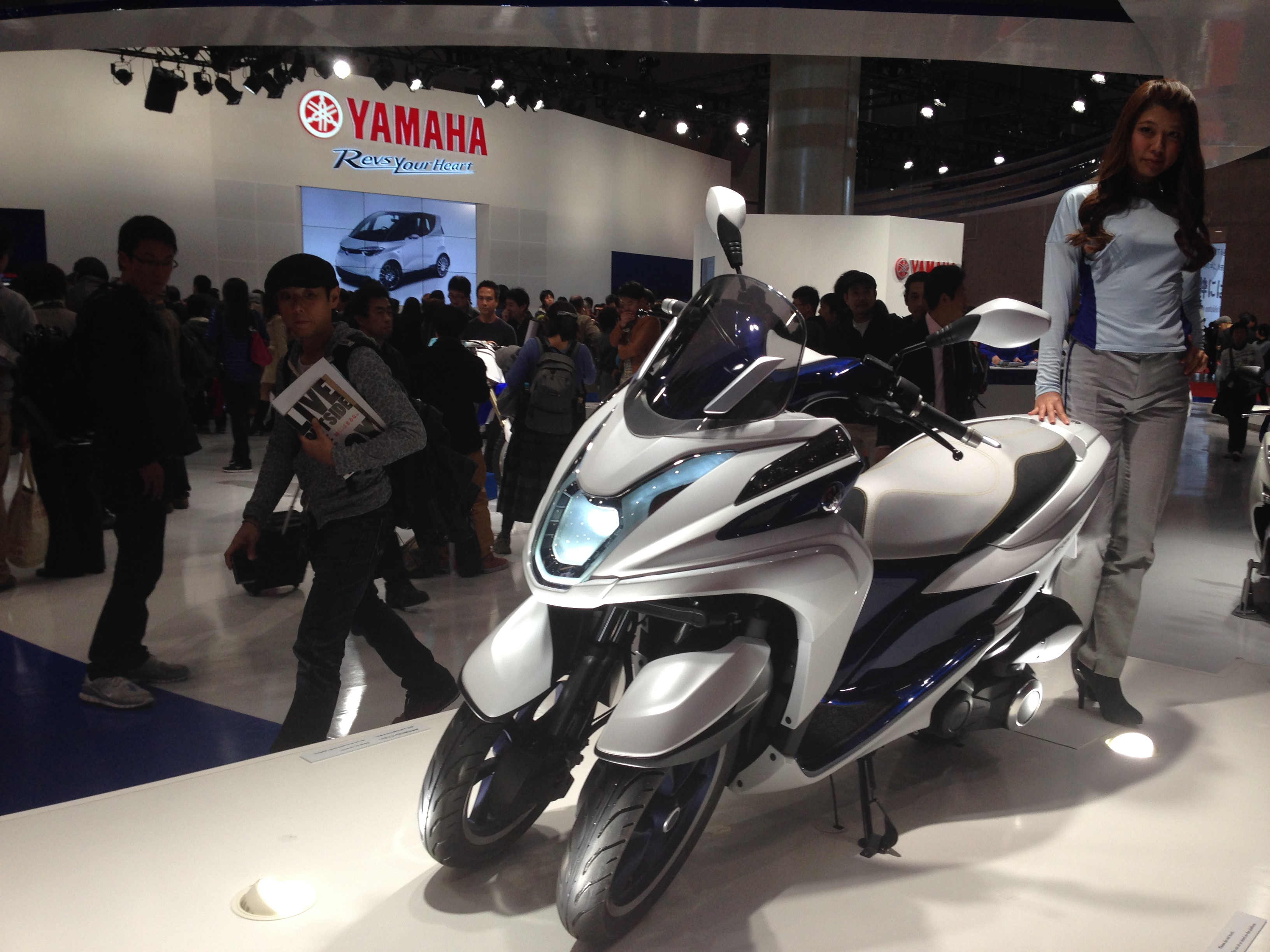
Tokyo Motor Show
Only 17 of the 267 vehicles on display were passenger cars. When the All Japan Motor Show opened in Hibiya Park on a spring day in 1954, Japan's automobile industry barely existed as a consumer force. The show was dominated by trucks and three-wheeled commercial vehicles, the workhorses of a nation still rebuilding from war. Over ten days, 547,000 visitors streamed through the park's tree-lined paths to see them. Nobody could have predicted that this modest outdoor exhibition would evolve into one of the five most important motor shows on the planet, a biennial spectacle at Tokyo Big Sight that would launch concept cars so wild they redefined what an automobile could be.
The Dream Machine Factory
What distinguished the Tokyo Motor Show from its peers in Detroit, Geneva, Frankfurt, and Paris was its appetite for the fantastical. While European and American shows tended to focus on production-ready vehicles, Tokyo became the world's premier stage for concept cars: visionary machines that might never see a showroom floor but pushed the boundaries of design and engineering. Honda stunned the 1962 show with its first-ever automobile, the Sports 360 and 500, drawing over one million visitors for the first time and causing such gridlock that the road from Ginza to the Harumi venue had to be turned into a one-way street. In 1963, Mazda debuted its revolutionary rotary engine. The 1966 show, dubbed the year of 'My Car,' introduced both the Nissan Sunny and Toyota Corolla, the twin engines that would drive Japan's motorization into every household.
Mirrors of a Rising Nation
Each decade of the show reflected Japan's changing relationship with the world. The 1960s exhibits channeled postwar optimism, fueled by the government's Income Doubling Plan and the approach of the 1964 Tokyo Olympics. By 1970, imported automobiles participated for the first time, with 95 foreign vehicles from 33 manufacturers across seven countries. The 1970s brought soul-searching: oil crises shifted the spotlight from horsepower to fuel economy, and Honda's CVCC engine and Mazda's thermal reactor technology took center stage. By 1977, Japan had become the world's number one vehicle exporter, and whispers of trade conflict with Europe and America hung over the exhibition halls. The 1989 show, themed 'Freedom of Mobility,' was a high-water mark of Japan's bubble era, debuting legends like the Honda NSX and Suzuki Cappuccino alongside the Ferrari 348.
Concept Cars and Crystal Balls
The show proved remarkably prescient. Toyota unveiled the Prius hybrid at the 1995 Tokyo Motor Show, years before climate change dominated public discourse. By 2007, hybrid and electric vehicles dominated the exhibition floor. Toyota's 1/X concept, a Prius-like sedan at one-third the weight using carbon-fiber-reinforced plastic, pointed toward a future that is still arriving. Nissan unveiled the Leaf at the 2009 show, and Mitsubishi introduced the i-MiEV, pioneering mass-market electric mobility. The 1989 show alone previewed vehicles that became cult classics: the Nissan Figaro, the Porsche Panamericana, and the Subaru Alcyone SVX, each one a bold experiment in form and engineering that found devoted followings decades later.
A New Identity
The COVID-19 pandemic forced the show's first cancellation in its 67-year history in 2021. When it returned in 2023, it carried a new name: the Japan Mobility Show. The rebranding was deliberate. The event expanded beyond automobiles to embrace the full spectrum of mobility, from Honda's autonomous work vehicles and avatar robots to Suzuki's electric outboard motors and Subaru's air mobility concepts. BYD and Yangwang arrived from China, Sony Honda unveiled the Afeela prototype, and Toyota showed everything from a hydrogen-powered bus to a children's electric vehicle. The show that had started with trucks in a park had become a vision of an entire society in motion, a platform where automotive giants, technology startups, and cross-industry partners converge to imagine what comes next.
Where the World Came to Dream
At its peak in the late 1960s, the show drew over 1.5 million visitors in a single run. The venue migrated from Hibiya Park to the Korakuen bicycle racing track in 1958, then to the Harumi exhibition grounds in the early 1960s, and finally to Tokyo Big Sight on the reclaimed land of Odaiba. Through every move, the show retained its essential character: a place where Japanese manufacturers revealed not just what they could build, but what they dared to imagine. From the Prince Skyline Sports designed by Michelotti in 1961 to the Century Coupe Concept at the 2025 Japan Mobility Show, the event remains a window into the soul of Japanese engineering, where craft meets ambition at the edge of the possible.
From the Air
Located at Tokyo Big Sight (35.63N, 139.79E) on the reclaimed land of Odaiba in Tokyo Bay. The coordinates in the raw data (35.65N, 140.03E) place it near the Makuhari Messe area in Chiba Prefecture, which hosted the 2024 JMS Bizweek edition. From the air, Tokyo Big Sight's distinctive inverted pyramid rooftops are visible along the waterfront. Nearby airports include Tokyo Haneda (RJTT) approximately 10 km southwest, and Narita International (RJAA) approximately 60 km east. Best viewed at 2,000-3,000 ft altitude following Tokyo Bay's coastline.