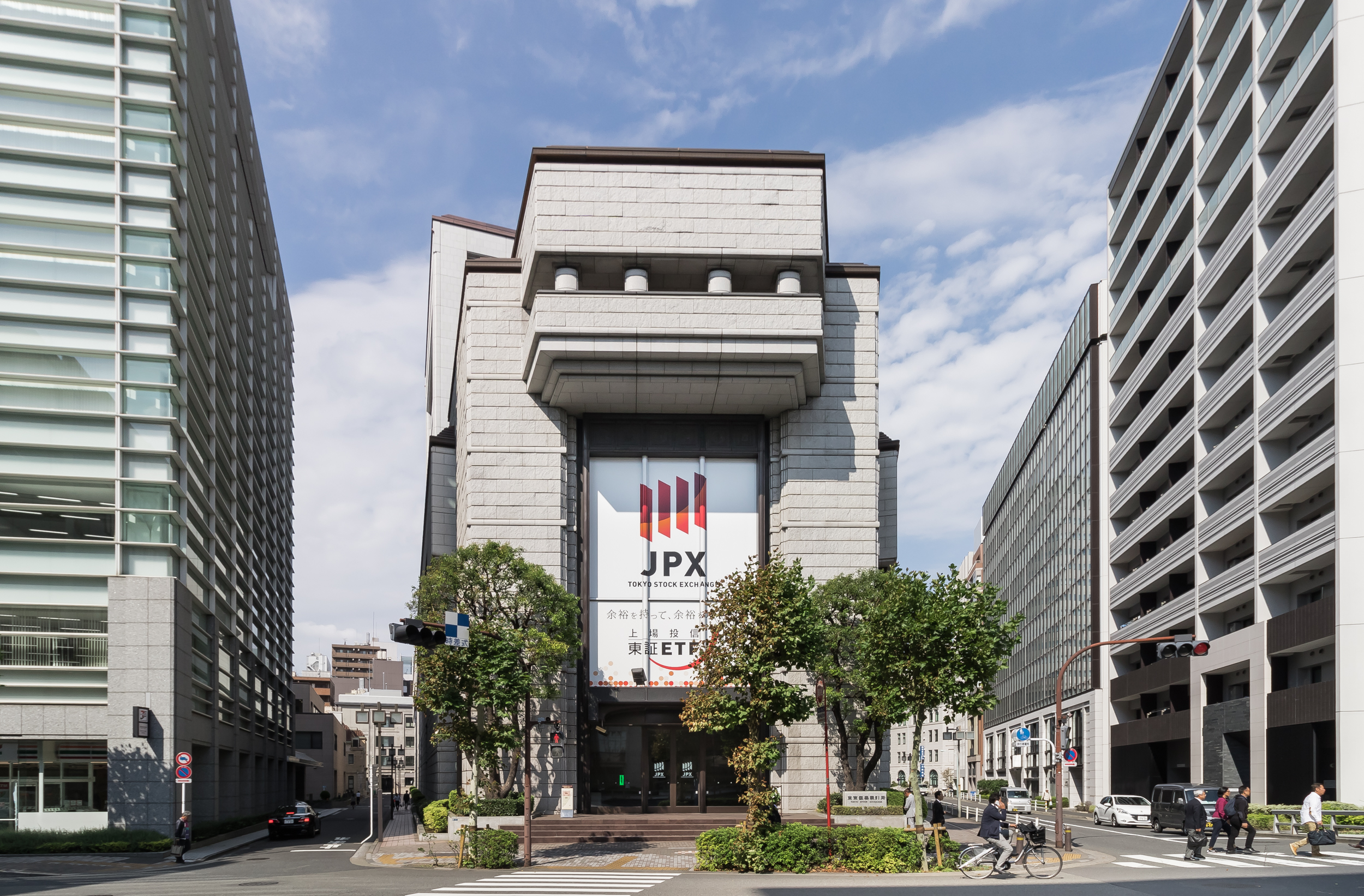
Tokyo Stock Exchange
A trader at Mizuho Securities meant to sell one share of J-Com at 610,000 yen. Instead, on December 8, 2005, he typed an order to sell 610,000 shares at one yen each. The Tokyo Stock Exchange's system blocked every attempt to cancel the order. By the time the damage was tallied, approximately $225 million had evaporated between the exchange and the brokerage. Three executives resigned. The incident was absurd, catastrophic, and entirely characteristic of an institution where astronomical sums move on the strength of keystrokes, where a single digit in the wrong column can topple careers -- and where the machinery of global capitalism has been grinding away in the Kabutocho district since 1878.
The Helmet Town
Kabutocho takes its name from kabuto, the samurai helmet, though the neighborhood's connection to money runs deeper than warfare. The Tokyo Stock Exchange was founded in 1878, during the Meiji era's rush to modernize Japan along Western lines. Its headquarters at 2-1 Nihonbashi-Kabutocho sits in what remains Japan's largest financial district. The original 1931 building gave way to the current structure, which opened on May 23, 1988, a sleek modern complex whose cylindrical trading floor became an icon of Japan's economic ambition. That trading floor fell silent on April 30, 1999, when the exchange switched entirely to electronic transactions. A new electronic facility opened in May 2000, and in 2010 the TSE launched its Arrowhead trading system, pushing execution times into the millisecond range.
The Bubble and Its Shadow
By 1990, the Tokyo Stock Exchange accounted for over 60 percent of the world's total stock market capitalization -- the largest exchange on the planet by a staggering margin. The Nikkei 225 index, tracked by Japan's leading business newspaper the Nihon Keizai Shimbun, had become shorthand for an economy that seemed incapable of decline. Then the bubble burst. Share prices collapsed, and the TSE fell from its peak to become one of the world's fourth-largest exchanges by market capitalization. The psychological scar lingered for decades. Japan's 'lost decade' stretched into two, and the exchange's story became a cautionary tale about speculative excess. Ninety-four domestic and ten foreign securities companies still participate in TSE trading, and the exchange remains a pillar of Asian finance, but the memory of that vertiginous peak and its aftermath colors every rally.
Fat Fingers and Frozen Screens
The TSE has an uncanny talent for spectacular technical failures. In December 2001, during the Dentsu initial public offering, a UBS Warburg trader sold 610,000 shares at six yen each instead of selling 16 shares at 600,000 yen, costing the bank 71 million pounds. In November 2005, bugs in a Fujitsu-built transaction system shut down the exchange after just 90 minutes. On January 18, 2006, the so-called 'livedoor shock' forced trading to halt 20 minutes early when volume threatened to exceed the system's capacity of 4.5 million trades per day. But the most dramatic failure came on October 1, 2020, when a hardware malfunction in the Arrowhead system -- specifically, a failure to switch to backup equipment -- froze all share trading for an entire day. Regional exchanges in Nagoya, Fukuoka, and Sapporo, which ran on the same platform, also went dark. It was the worst outage in the exchange's history as an all-electronic market.
Reinvention in Three Markets
For decades, the TSE organized companies into a First Section for blue chips and a Second Section for mid-caps, along with growth-oriented boards like Mothers and JASDAQ. On April 4, 2022, the exchange restructured entirely into three new divisions: Prime, Standard, and Growth, each defined by stricter criteria for market liquidity and corporate governance. The overhaul was the most significant reorganization since the exchange reopened on May 16, 1949, under the postwar Securities Exchange Act. Now part of Japan Exchange Group, formed through a 2012 merger with the Osaka Securities Exchange, the TSE lists thousands of companies and anchors a financial ecosystem that includes active bond and futures markets. The Kabuto Club, the exchange's press club on the third floor, buzzes most intensely during April and May, when public companies release their annual accounts and the numbers reveal which bets paid off.
From the Air
Located at 35.681N, 139.778E in the Kabutocho district of Chuo ward, central Tokyo. From the air, the TSE sits in the dense commercial grid between Nihonbashi to the north and the Sumida River to the east. The cylindrical shape of the main trading hall is visible at lower altitudes. Nearest airports: Tokyo Haneda (RJTT) approximately 9 nm south-southwest, Narita International (RJAA) approximately 36 nm east. Best viewed at 2,000-4,000 feet AGL. The Imperial Palace grounds and Tokyo Station are visible landmarks to the west-northwest.