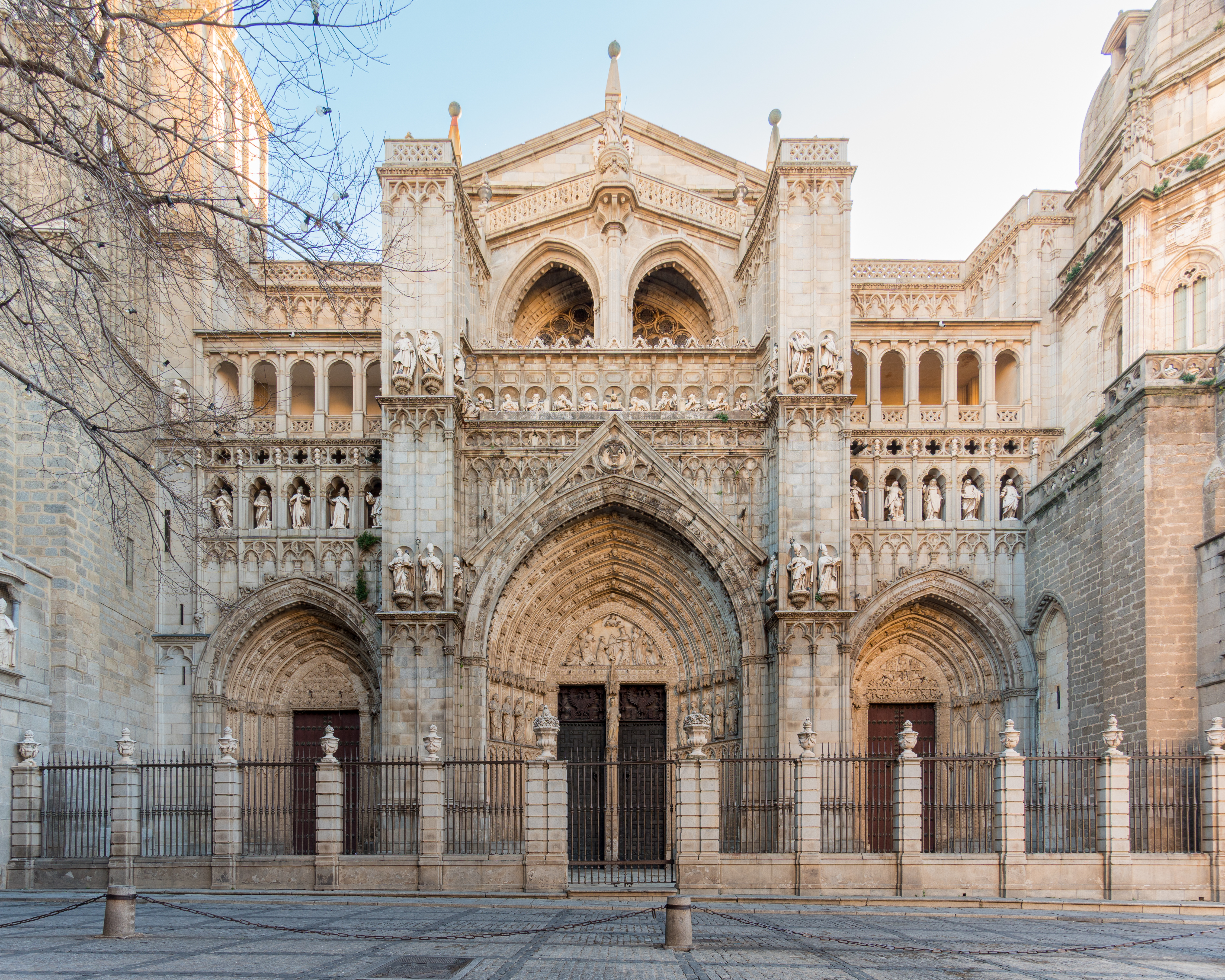
Toledo Cathedral
When Archbishop Rodrigo Ximenez de Rada looked at Toledo's aging mosque-cathedral in the early 13th century, he saw a building with a low ceiling, poor acoustics, and crumbling walls. What he envisioned in its place would take nearly three centuries to complete. Begun in 1226 under Ferdinand III and not vaulted until 1493 under the Catholic Monarchs, Toledo's Primatial Cathedral of Saint Mary is a building that absorbed the ambitions of every generation that worked on it. Built from white limestone quarried at nearby Olihuelas, it was nicknamed Dives Toletana -- the Rich Toledan -- and the name fits. Inside its five naves, the light performs tricks that the original architects calculated with geometric precision.
Three Faiths, One Foundation
The cathedral's site carries the memory of every civilization that shaped Toledo. A Visigothic church dedicated to the Virgin Mary stood here first, consecrated in 587. After the Muslim conquest, the church was demolished and replaced by the city's main mosque, whose five-aisled prayer hall may have influenced the cathedral's own five-nave plan. When Alfonso VI reconquered Toledo in 1085, he promised to preserve the mosque as part of the terms of surrender. His wife Constance and Archbishop Bernard of Sedirac broke that promise in his absence, seizing the mosque by force in 1087 and converting it to Christian worship. Legend holds that Toledo's Muslim community itself helped defuse the resulting crisis, and the cathedral chapter honored the peacemaker -- a faqih named Abu Walid -- by placing his effigy on a pillar in the main chapel, where it remains today.
Gothic Ambition, Mudejar Soul
The cathedral was modeled on Bourges Cathedral in France, but it is no copy. Its builders intended to cover every square meter of the former mosque's footprint, and the result is a plan of unusual breadth -- 120 meters long, 59 meters wide, 44.5 meters high. The ambulatory vaults are an engineering achievement, with alternating rectangular and triangular chapels radiating outward in a pattern also seen at Paris and Le Mans. But the Mudejar influence sets Toledo apart. In the cloister and triforium, multifoiled arches and interlaced patterns borrowed from Islamic tradition weave through the Gothic structure, creating a hybrid style unique to the Iberian Peninsula. The sole tower, designed by Alvar Martinez and crowned by the Flemish architect Hanequin de Bruselas, rises 92 meters and was topped with a spire supporting three crowns that imitate a papal tiara.
Centuries of Patronage
Every major Spanish ecclesiastical figure seemed to leave a mark on Toledo Cathedral. Cardinal Cisneros commissioned the Mozarabic Chapel, where the ancient Hispano-Mozarabic Rite is still celebrated, and ordered the great Gothic altarpiece carved by Diego Copin de Holanda. Cardinal Mendoza's Renaissance cenotaph, attributed to a team under Domenico Fancelli, occupies the presbytery. Archbishop Tavera oversaw the choir stalls by Alonso Berruguete and Felipe Vigarny. Francisco de Villalpando crafted the main chapel's iron screen. The Portal of the Lions, built between 1460 and 1466, contains one of the finest Hispano-Flemish sculptural ensembles of the 15th century, its bronze door panels a masterwork across 35 individual panels. Each generation added, altered, and occasionally demolished what came before, producing a building that reads like a compressed history of European art from the 13th to the 18th century.
Light and Stone
What visitors remember most about Toledo Cathedral is its light. The Gothic architects calculated the interplay of stained glass and limestone with the same care they devoted to structural engineering, and the effect is luminous without being overwhelming. The oldest stained glass, dating to the 13th century, fills the rose window above the Portal of the Clock. The Transparente, an 18th-century Baroque skylight carved into the ambulatory wall by Narciso Tome, punches a shaft of natural light through the ceiling into the heart of the building -- a theatrical gesture that would have startled the Gothic purists, but which captures something essential about the cathedral's character. Toledo was never content with a single style or a single vision. Its cathedral is the physical record of that restlessness: a building always becoming, never quite finished, layered with the ambitions of everyone who touched it.
From the Air
Located at 39.857N, 4.023W in the center of Toledo's hilltop old city. The cathedral's single tower (92 m) is the tallest structure in the old city and is easily spotted from the air, rising distinctly above the surrounding rooflines. Recommended viewing altitude 3,000-5,000 ft AGL. The Tagus River encircles three sides of Toledo, making identification easy. Nearest major airport: Madrid-Barajas (LEMD), approximately 70 km northeast.