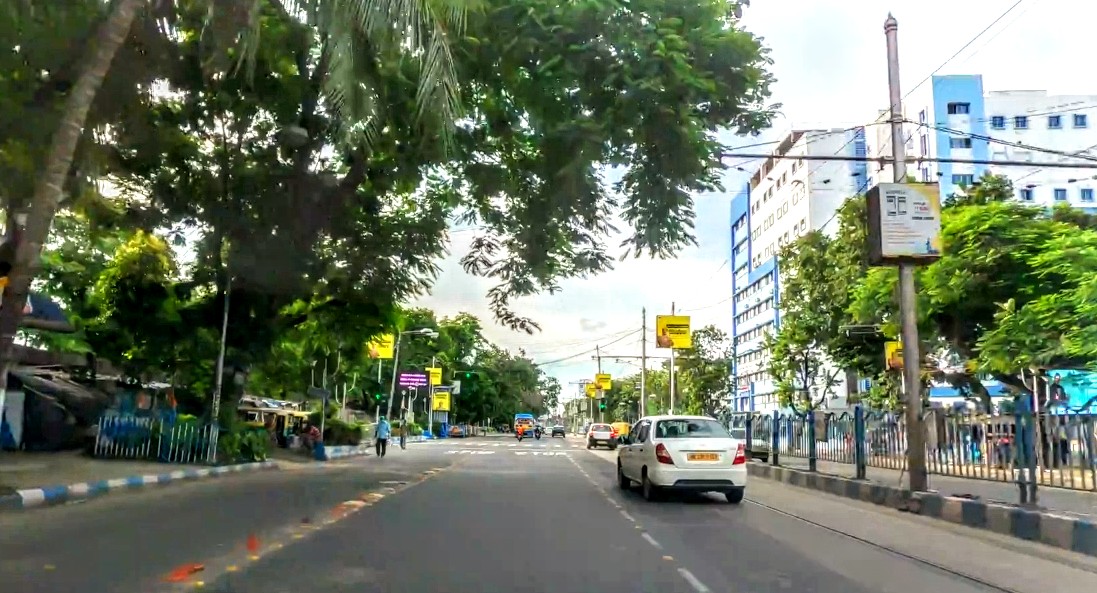
Tollygunge
Before Bollywood, there was Tollywood. The nickname first appeared in print in 1932, a portmanteau of Tollygunge and Hollywood, coined to describe the cluster of film studios that had sprung up in this south Kolkata neighborhood. The irony is rich: the name Tollygunge itself honors a British colonial officer, Colonel William Tolly, who in 1774 dredged the silted-up Adi Ganga channel to make it navigable. A canal project by an Englishman gave a name to a neighborhood that became the birthplace of Indian cinema -- and that name, in turn, inspired the term Bollywood when Bombay's film industry surpassed it decades later.
From Jungle to Suburb
In the eighteenth century, Tollygunge was known as Rasa Pagla -- a stretch of jungle dotted with the garden villas of Europeans who lived in central Calcutta but craved retreats in the surrounding countryside. After Colonel Tolly's canal work, the area began to develop. Tipu Sultan's sons settled here following the Vellore Mutiny of 1806, adding a layer of Mughal-era aristocracy to what was still a semi-rural landscape. The British established the Tollygunge Club and the Royal Calcutta Golf Club in the nineteenth century, turning parts of the neighborhood into genteel sporting grounds. In 1888, Tollygunge and neighboring Ballygunge formed a common police station. By 1903, electric tramcar tracks reached the area, stitching it firmly into Calcutta's expanding urban fabric.
Where Indian Cinema Found Its Voice
The transformation into a film capital began in the 1930s. Bharat Lakshmi Studio was founded on Prince Anwar Shah Road in 1930, followed by New Theatres Studio the same year, then Radha Studio, East India Studio, and Kali Films in rapid succession. Bengal's first full-length talkie, Dena Paona, was released in December 1931. By the mid-1930s, Tollygunge was the center of Indian film production. Indrapuri Studio and Technician Studio became hubs for directors like Ajoy Kar and Tarun Majumdar. Later, Rituparno Ghosh, a Jadavpur University alumnus, made it his creative home. The Bengali film industry pioneered artistic approaches that filmmakers elsewhere in India would later adopt, and for decades, Tollywood was the standard against which other regional industries measured themselves.
The Partition's Long Shadow
The partition of Bengal in 1947 remade Tollygunge in ways no urban planner could have anticipated. Millions of refugees poured across the new border from East Pakistan, and hundreds of improvised colonies appeared almost overnight on vacant land throughout Kolkata's fringes. Tollygunge was among the areas most profoundly transformed. The refugees built settlements that reflected the village layouts of their lost homes, creating a new kind of urban landscape -- dense, improvisational, deeply communal. The influx continued in waves through 1971, and its demographic, cultural, economic, and political impact on the city was enormous. Tollygunge's identity as a neighborhood was permanently reshaped by people who had lost everything and were building again from nothing.
Layers of a Living Neighborhood
Tollygunge today is not a single thing. It is a metro station named after the legendary actor Uttam Kumar. It is the Lake Road Market at 104 Rash Behari Avenue, a sprawling municipal market covering 1.16 acres where vendors sell vegetables, fish, flowers, and betel leaf. It is the Atchala temples of the Ghosh family, built between 1788 and 1807, and the mosque Prince Ghulam Mohammad constructed in 1830. It is M.R. Bangur Hospital, a government super-specialty hospital serving the enormous population of South 24 Parganas district. And it is a literary landmark: Jhumpa Lahiri set her 2013 Man Booker Prize-shortlisted novel The Lowland in Tollygunge, drawing on her own ethnic roots in the neighborhood.
The Tram Depot at the End of the Line
Tollygunge has always been a place where transportation routes terminate and begin. The Calcutta Tramways Company depot here has served as a tram terminal since tracks were laid in 1903. The metro station -- originally called Tollygunge, now Mahanayak Uttam Kumar -- was the southern terminus of the Kolkata Metro from 1984 until the line was extended to New Garia in 2009. Among Tollygunge's notable former residents was A.C. Bhaktivedanta Swami Prabhupada, who founded the International Society for Krishna Consciousness. The neighborhood that gave India its film industry also gave the world the Hare Krishna movement -- a reminder that Tollygunge has always been a place where ideas travel outward, far beyond the limits of a single Kolkata neighborhood.
From the Air
Located at 22.50N, 88.35E in South Kolkata. The neighborhood is a dense urban area identifiable by the metro line running through it and the green spaces of the Tollygunge Club and Royal Calcutta Golf Club. Nearest major airport is Netaji Subhash Chandra Bose International Airport (VECC), approximately 15 km north-northeast. Recommended viewing altitude: 2,000-4,000 feet. Look for the railway lines and tram depot as navigation landmarks in the southern part of Kolkata's urban sprawl.