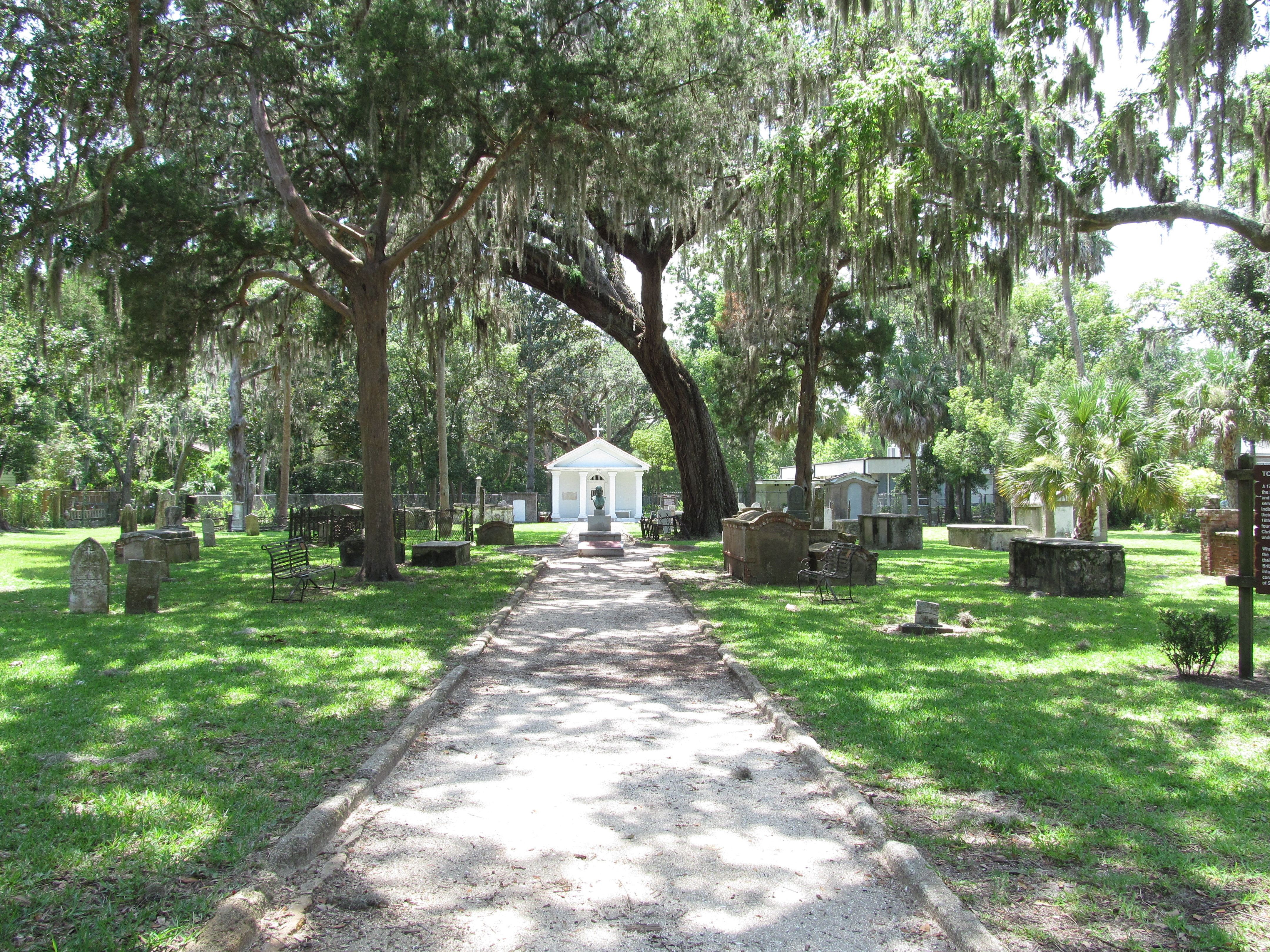
Tolomato Cemetery
Somewhere in Tolomato Cemetery, in an unmarked grave, lies Jorge Biassou -- America's first Black general. A leader of the Haitian Revolution of 1791, Biassou ended up, through the peculiar machinery of colonial politics, serving as a Spanish general and living out his final years in St. Augustine as the second highest-paid official of the colony. His funeral was held at the Cathedral Basilica. His grave has never been found. Haitian diplomats still make pilgrimages to this small Catholic cemetery on Cordova Street, searching for a man whose story embodies the tangled, multinational history buried in every inch of this ground.
A Village Before It Was a Cemetery
Before any headstone was placed here, this was Tolomato -- a village of Guale Indian converts to Christianity and the Franciscan friars who ministered to them. The site appears on a 1737 map of St. Augustine, just outside the city walls across from the Rosario Line, a defensive embankment planted with cactus and Yucca gloriosa, the thorny plants the Spanish called daggers. Part of the cemetery grounds was set aside for formerly enslaved Black Americans who had escaped bondage in the Carolinas and converted to Catholicism. When Britain took control of St. Augustine in 1763, most of the Spanish population of 3,100 left for Cuba, along with the Guale converts and the Franciscan friars. The British, being Protestant, tore down the wooden Catholic church for firewood, leaving only the coquina bell tower standing.
Seventy Miles on Foot from New Smyrna
In 1777, something remarkable happened. The residents of Andrew Turnbull's failed colony at New Smyrna -- indentured servants from the Mediterranean, mostly from the island of Menorca -- decided to flee the miserable conditions en masse. They walked 70 miles north on the King's Road to St. Augustine. British governor Patrick Tonyn granted them refuge. Their spiritual leader, Father Pedro Camps, petitioned to use the abandoned mission and village of Tolomato for his Catholic congregation. The petition was granted, and the grounds became the primary burial place for the Menorcan colonists and their descendants. Father Camps himself was buried at Tolomato when he died in 1790, though his remains were later moved to the newly built cathedral. The cemetery endured through every change of regime -- British back to Spanish in 1783, then American control in 1821 -- serving as the Catholic community's sacred ground through it all.
Generals, Bishops, and Unauthorized Burials
The graves at Tolomato read like a roster of St. Augustine's most improbable characters. Biassou, the Haitian revolutionary turned Spanish general, arrived in 1796 and died in 1801. The first Bishop of St. Augustine, Augustin Verot, who died in 1876, is interred in the mortuary chapel at the back of the grounds. Felix Varela, a Cuban priest and social reformer, rested here for 60 years before his remains were disinterred and returned to Cuba. Confederate soldiers lie here too, including members of the Saint Augustine Blues, the local militia that seized the Castillo de San Marcos for the Confederacy at the start of the Civil War. Gumercindo Antonio Pacetti, a Menorcan who served as mayor, surrendered St. Augustine to Federal forces in March 1862, then fled to the family home in Cuba where he sheltered the escaped Confederate Secretary of War and former U.S. Vice President John C. Breckinridge. Pacetti returned to the city and is buried at Tolomato. The cemetery was officially closed in 1884. Two more burials happened anyway -- Catalina Usina Llambias in 1886 and Robert Sabate in 1892 -- and both families were fined 25 dollars for violating the law.
Layers of Memory on Cordova Street
What makes Tolomato extraordinary is not any single grave but the sheer compression of history within its walls. Guale mission, refuge for those fleeing slavery, Menorcan burial ground, resting place of revolutionaries and Confederate soldiers, a bishop's chapel and an unauthorized grave -- each layer speaks to a different chapter of St. Augustine's story, and each chapter belongs to a different empire. On June 27, 2011, a historic marker was unveiled a few blocks away at 42 St. George Street, on the former home site of General Biassou, an acknowledgment long sought by the Haitian-American Historical Society and Haitian diplomats including Ambassador Raymond Joseph. The unmarked grave remains unmarked. But in a cemetery where Guale, Spanish, Menorcan, Haitian, Cuban, and Confederate dead share the same ground, the absence of a marker is just one more reminder that history in St. Augustine does not sort itself into neat categories.
From the Air
Tolomato Cemetery is located at approximately 29.897N, 81.315W on Cordova Street in the historic district of St. Augustine, Florida. From the air, it is a small, walled green space within the dense urban fabric of the old city, roughly two blocks west of the Castillo de San Marcos and the Matanzas River waterfront. The cemetery is bounded by streets on all sides and distinguished by mature trees and the mortuary chapel at the rear of the grounds. Nearest airport: St. Augustine Airport (KSGJ) approximately 4nm northwest. Jacksonville International (KJAX) is about 35nm north. The site is best identified in context with surrounding landmarks -- the Castillo's star-shaped fort and the Bridge of Lions are both within a few blocks.