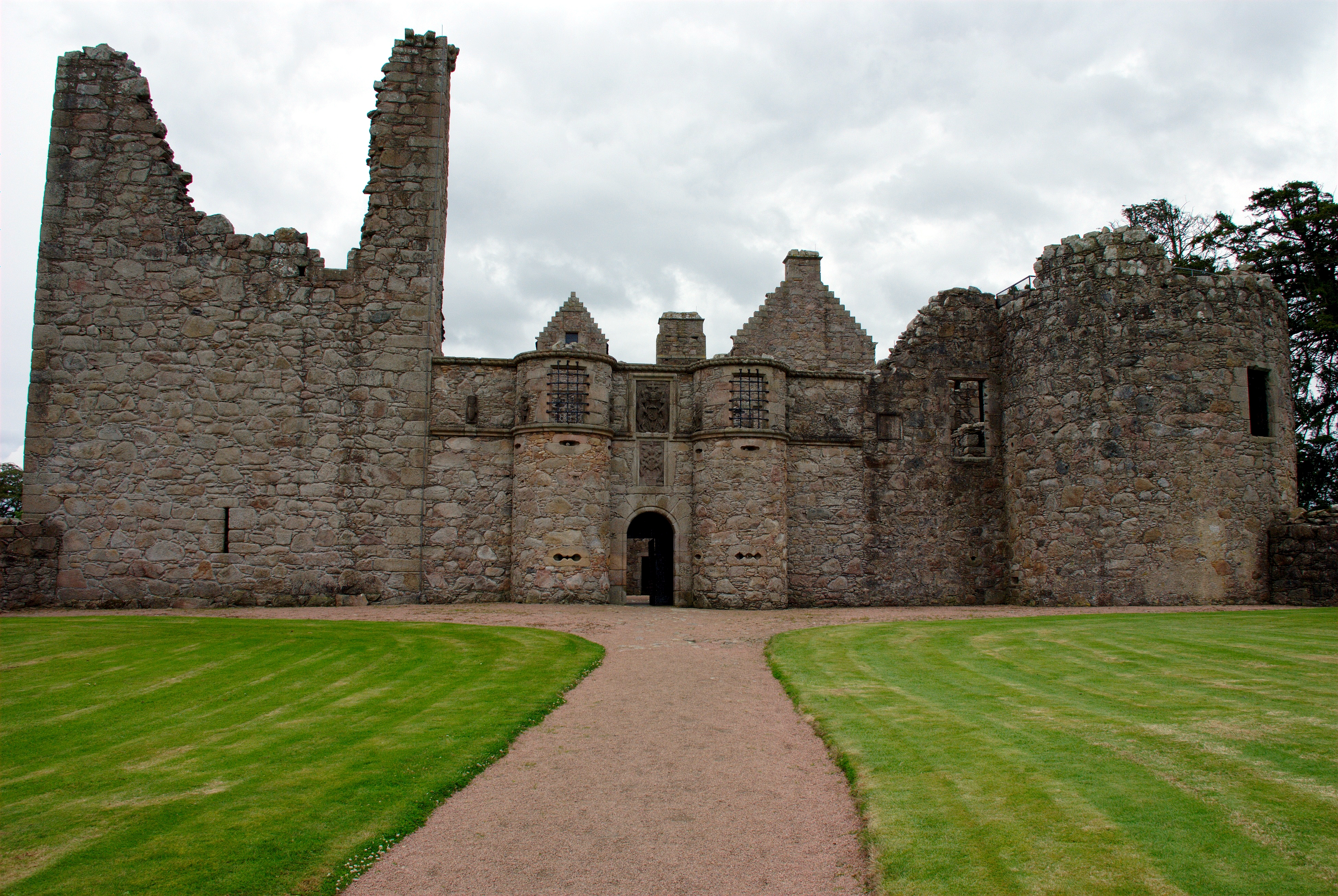
Tolquhon Castle
An inscription carved above the gatehouse of Tolquhon Castle spells it out in plain Scots: "AL THIS WARKE EXCEP THE AULD TOWR WAS BEGUN BE WILLIAM FORBES 15 APRIL 1584 AND ENDIT BE HIM 20 OCTOBER 1589." Five years and six months, start to finish, and William Forbes wanted you to know it. In a landscape of fortified tower houses and thick-walled keeps, the 7th Laird of Tolquhon built something different -- a castle designed not to repel enemies but to impress guests. The result has been called the most characteristic chateau of the Scots Renaissance.
A Renaissance Man's Vision
Before William Forbes began his grand project, the site held only Preston's Tower, a medieval keep that still anchors the northeast corner of the ruins. Forbes kept the old tower but wrapped it in something altogether more ambitious: a courtyard castle with an elaborate gatehouse, a first-floor gallery running the length of the west range, and a main hall in the south range reached by a stair from the courtyard below. The architect was Thomas Leper, a mason whose distinctive triple shot-holes flank the main entrance -- decorative more than defensive, a flourish rather than a fortification. Forbes was a collector, a reader, a man of culture in an age when Aberdeenshire lairds were beginning to look beyond warfare toward the arts. Tolquhon was his statement of intent.
Stone, Space, and Standing
The layout reveals priorities. The gallery on the first floor of the west range was not for soldiers but for walking and conversation, in the manner of the great houses of France. The main hall opened onto views of the surrounding countryside. Even the prison, tucked inside the southeast tower, feels like an afterthought -- necessary, perhaps, but not the point. Beyond the main quadrangle lay a walled outer courtyard containing a doocot, a dovecote that would have supplied the table with pigeons and signalled wealth to visitors. Every element of the design communicated status. The stone tile floor of the main hall, fragments of which survive, suggests a level of finish unusual for rural Aberdeenshire.
The Forbes Legacy
William Forbes did not stop at the castle. In the nearby kirkyard at Tarves, he erected an elaborate tomb in 1589 to commemorate himself and his wife Elizabeth Gordon -- the same year he completed the castle. Both monuments survive as testaments to a man determined to leave his mark on the landscape. The Forbes family held Tolquhon for generations, but the castle's fortunes eventually declined. By the time Historic Environment Scotland took guardianship of the site, the roofs had long since fallen and the galleries stood open to the Aberdeenshire sky. What remains, however, is remarkably intact in its stonework: walls stand to considerable height, the courtyard plan is clearly legible, and the gatehouse inscription still speaks across four centuries.
The Ruin as Document
Walking through Tolquhon today is less like visiting a castle and more like reading a letter. The proportions of the rooms, the placement of windows for light rather than defence, the decorative carvings that survive on doorways and lintels -- all tell the story of a man who valued beauty and learning in an era when many of his neighbours still lived behind walls designed to withstand siege. The Aberdeenshire countryside around the castle remains farmland, quiet and rolling, much as it would have looked when Forbes surveyed his finished work in October 1589. The castle sits roughly midway between Pitmedden and Tarves, modest in setting but extraordinary in ambition.
From the Air
Located at 57.35N, 2.21W in rural Aberdeenshire, roughly 1.5 miles northwest of Pitmedden and 2 miles south of Tarves. The ruined castle courtyard is visible from low altitude against the surrounding green farmland. Nearest airport: Aberdeen (EGPD), approximately 15 miles southeast.